
Synthetic Latex Polymers Market Report Scope & Overview:
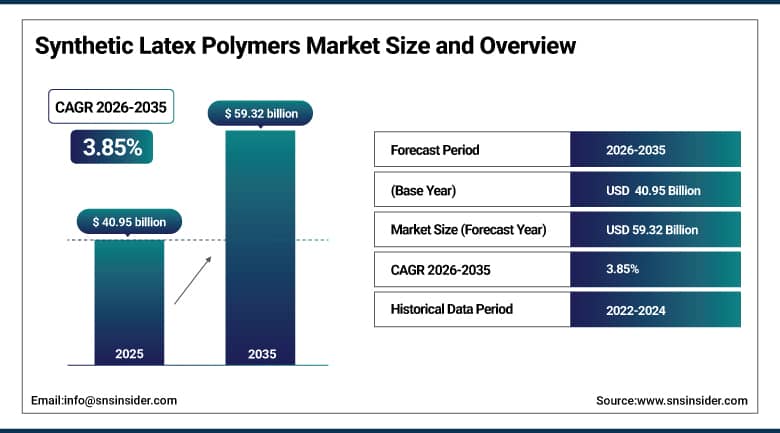
The Synthetic Latex Polymers Market size was valued at USD 40.95 Billion in 2025 and is projected to reach USD 59.32 Billion by 2035, growing at a CAGR of 3.85% during the forecast period 2026–2035.
Synthetic Latex Polymers Market Analysis provides an extensive assessment of market dynamics, innovation in polymers, and their industry application. Increased usage in paints and coatings, adhesives, textiles, and building materials, together with the shift toward water-based and biobased polymers, is driving significant market growth until 2025-2035.
In 2025, the consumption of synthetic latex polymers exceeded 20 million metric tons, driven by increased demand in architectural coatings, packaging adhesives, and textile finishes.
Market Size and Forecast:
-
Market Size in 2025: USD 40.95 Billion
-
Market Size by 2035: USD 59.32 Billion
-
CAGR: 3.85% from 2026 to 2035
-
Base Year: 2025
-
Forecast Period: 2026–2035
-
Historical Data: 2022–2024
To Get More Information On Synthetic Latex Polymers Market - Request Free Sample Report
Synthetic Latex Polymers Market Trends:
-
Shift toward water-based formulations is accelerating due to stricter VOC regulations and sustainability goals.
-
Bio-based and renewable latex polymers are emerging as a fast-growing niche, supported by eco-conscious industries.
-
Emulsion polymerization technology continues to dominate, accounting for the majority of production.
-
Digitalization and smart manufacturing are being adopted to optimize production efficiency and reduce costs.
-
Automotive and industrial coatings are seeing rising demand for high-performance latex polymers.
-
Paper & paperboard applications are under pressure but remain relevant in packaging and printing.
-
Innovation in specialty latexes (e.g., chemical-resistant, UV-resistant) is opening new industrial applications.
-
Global leaders (Dow, BASF, Arkema, Synthomer) continue to invest in R&D for sustainable solutions.
U.S. Synthetic Latex Polymers Market Insights:
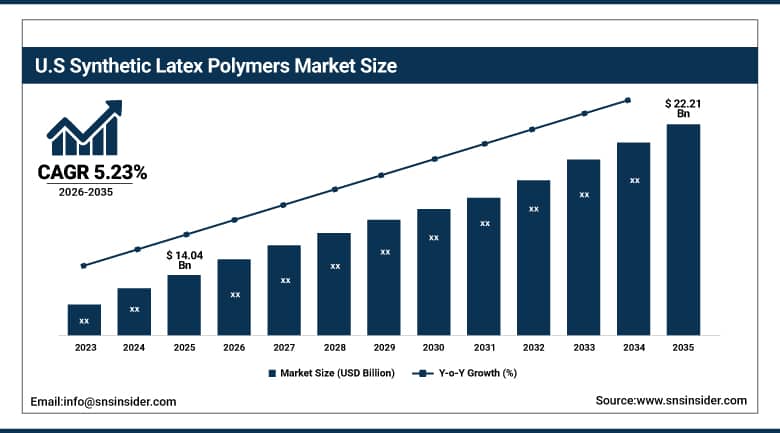
The U.S. Synthetic Latex Polymers Market is projected to grow from USD 14.04 Billion in 2025 to USD 22.21 Billion by 2035, at a CAGR of 5.23%. The Growth is driven by the increasing demands for these polymers in applications such as paints and coatings, adhesives, textiles, and building materials. This market growth can also be attributed to the robust usage of both water-based and bio-based latex polymers along with innovative emulsion polymerization technology development.
Synthetic Latex Polymers Market Growth Drivers:
-
Rising infrastructure development, expanding packaging demand, and increasing adoption of eco-friendly water-based formulations are key drivers of Synthetic Latex Polymers Market growth.
Construction companies, automobile manufacturers, and packaging suppliers have been making use of modern latex polymers such as acrylic, styrene-butadiene rubber, and polyurethane in order to increase product durability, flexibility, and sustainability. Improvements in both emulsion and hybrid polymerization processes, along with better performance properties such as chemical resistance, adhesion, and weather resistance, have made their usage more common, resulting in a stable growth trend within the market.
Over the globe, the use of modern latex polymers among paint and coating, adhesive, and construction materials producers was over 62% in 2025 due to sustainability regulations.
Synthetic Latex Polymers Market Restraints:
-
Volatility in raw material prices, stringent environmental regulations, and competition from bio-based alternatives present significant restraints for the Synthetic Latex Polymers Market.
Companies in paints and coatings, adhesives, textiles, and construction industries have been faced with the task of balancing cost-effectiveness and sustainability. The price variation of petrochemical-based inputs has increased manufacturing expenses, coupled with stringent VOC emissions regulations in North America and Europe that necessitate frequent reformulation of products. Moreover, the increasing incorporation of natural latex and sustainable polymers in various applications increases competition within the industry.
By 2025, nearly 42 percent of the companies had suffered profit margins due to variations in input prices and regulatory compliance costs, implying the continuous need for product improvement and cost reduction in synthetic latex polymer production.
Synthetic Latex Polymers Market Opportunities:
-
Growing development of water-based, bio-based, and hybrid synthetic latex formulations presents significant opportunities for the Synthetic Latex Polymers Market.
Construction companies, automobile manufacturers, packagers, and textile industries are adopting advanced latex polymers due to environmental regulations, improved performance, and reduction in environmental effects. Chemical companies developing new sustainable and high-performing products will benefit from this market trend. Innovations in emulsion polymerization, hybrid, and natural feedstock technologies, together with advancements in bonding, durability, and weather resistance features, make the usage of latex polymers possible in paints & coatings, adhesives, textiles, and construction products.
By 2025, over 47% of paints and coatings manufacturers, and more than 47% of packaging industries, used advanced synthetic latex polymers.
Synthetic Latex Polymers Market Segmentation Analysis:
-
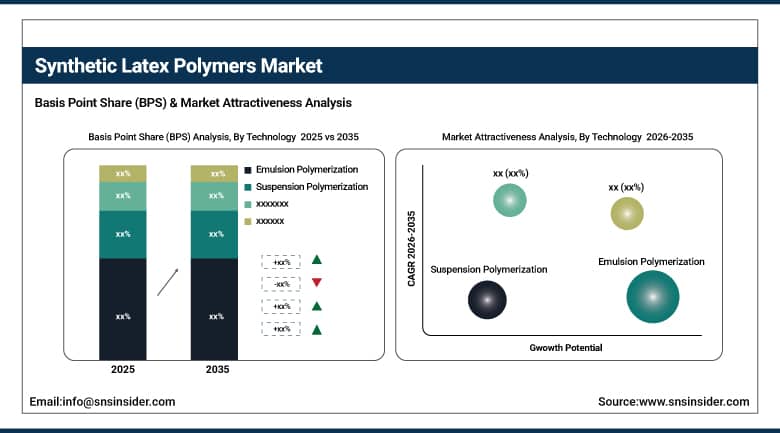
By Technology / Process, Emulsion Polymerization held the largest market share of 69.85% in 2025, while they are also expected to grow at the fastest CAGR of 4.10% during 2026–2035.
-
By Formulation, Water-Based Latex Polymers dominated with 56.58% market share in 2025, whereas Bio-based / Renewable Latex Polymers are projected to record the fastest CAGR of 5.76% through 2026–2035.
-
By Polymer Chemistry Type, Styrene-Butadiene Rubber (SBR) accounted for the highest market share of 29.86% in 2025, while Polyvinyl Acetate (PVAc) are expected to grow at the fastest CAGR of 5.32% during the forecast period.
-
By Application, Paints & Coatings dominated with a 35.64% share in 2025, while Adhesives & Sealants are anticipated to expand at the fastest CAGR of 4.70% through 2026–2035.
By Technology / Process, Emulsion Polymerization Dominate While It Grow Rapidly:
Emulsion polymerization is a dominant in the market since it is a versatile method with great scalability potential which can be used to develop products that adhere to sustainability and VOC criteria. Its successful use in paints and coatings, adhesives, textiles, and construction material applications explains why it is the most utilized polymerization process.
Emulsion polymerization is additionally becoming the fastest growing technology, proving that this process enjoys the dual advantage of being the dominant and growing segment. Suspension, solution, and bulk processes play a role in certain niche applications but cannot compete with emulsion.
By Formulation, Water-Based Latex Polymers Dominate While Bio-based / Renewable Latex Polymers Grow Rapidly:
The Water-Based Latex Polymers category has become the most dominant one owing to its green credentials, compliance with VOC requirements, and extensive applications in paints and coatings, adhesives, and construction applications. The consistent reliability and benefits of being environmentally friendly have helped make these products a preferred choice, indicating a heavy dependence on proven formulas.
The Bio-Based and Renewable Latex Polymers category is expected fastest growing segment, driven by the rising preference for sustainable raw material usage and stricter regulatory requirements that emphasize reducing reliance on products derived from petrochemicals. These products are increasingly gaining importance in paints and coatings, adhesives, textiles, and packaging applications.
By Polymer Chemistry Type, Styrene-Butadiene Rubber (SBR) Dominate While Polyvinyl Acetate (PVAc) Grow Rapidly:
The Styrene-Butadiene Rubber (SBR) continues to be in dominant position due to its toughness, resilience, and economic benefits in paints and coatings, adhesives, and carpet backings. Its excellent performance in construction and automotive industries has made it the most reliable polymer material. The acrylic polymer ranks second due to the high demand for paints and coatings.
The Polyvinyl Acetate (PVAc) polymer is the fastest growing polymer as a result of increasing demands for adhesives and lamination in packaging. On the other hand, Ethylene-Vinyl Acetate (EVA) and Acrylonitrile-Butadiene Rubber (NBR) fill specific roles as more developments are made in specialty polymers for various industrial uses.
By Application, Paints & Coatings Dominates While Adhesives & Sealants Grow Rapidly:
Paints and Coatings segment are the dominant in the market, driven by strong demand in architectural, automotive, and industrial segments. The ability to provide quality protection against environmental elements and excellent aesthetics is the reason why this is the most widely used application area.
Adhesives and sealants have proved to be the fastest growing application area, thanks to growing demands for packaging, infrastructure development, and constructions. Textile applications make a steady contribution in areas which includes carpet backings and finishing. Paper and paperboard applications include coating and lamination in packaging and printing industry.
Synthetic Latex Polymers Market Regional Analysis:
Asia-Pacific Synthetic Latex Polymers Market Insights:
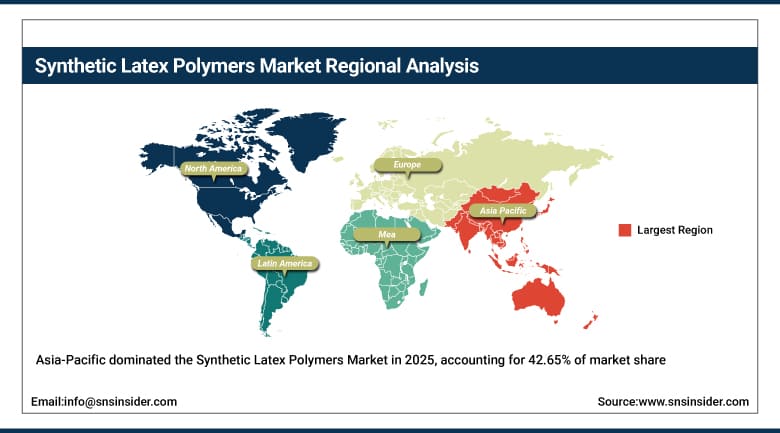
Asia-Pacific is considered to be the leading geographical segment due to its dominant market share of 42.65% along with fastest growth in terms of CAGR, which was 4.49%. The factors behind the highest growth include fast industrialization, expansion in infrastructure, along with high demand for paints and coatings, adhesives, and textiles. Countries including China, India, Japan, and Southeast Asia are the prominent adopters of both water-based and bio-based solutions. Increasing investments in advanced technologies and growing packaging needs are boosting the regional market growth.
Get Customized Report as Per Your Business Requirement - Enquiry Now
China Synthetic Latex Polymers Market Insights:
China leads the Asia-Pacific region market share with the aid of extensive infrastructure developments, automobile manufacturing, and strong demands in packaging and textile applications. The country is quickly adopting water-based and latex hybrids in response to environmental legislation. Meanwhile, domestic producers are working on developing bio-based technologies to minimize the use of petroleum-based raw materials. Construction expansion, along with green policies for materials, is fast-tracing the adoption process.
North America Synthetic Latex Polymers Market Insights:
North American market growth is attributed to high demands for architectural coatings, packaging adhesives, and construction materials. In the United States, there is a high adoption rate of green water-based products due to high levels of volatile organic compound emissions restrictions. Development of hybrid and specialty latex products is increasing usage in the area of industrial and automotive coatings. Research into bio-based resins and improved emulsion technology has further enhanced this region’s competitiveness.
United States Synthetic Latex Polymers Market Insights:
The US market exhibits extensive use of water-based latex polymers due to stringent environmental laws and consumer inclination toward green products. Growing construction activity and rising packaging requirements are aiding growth, while hybrid and bio-based polymer innovations have been creating new avenues. Extensive research and development efforts and superior manufacturing facilities in the country are contributing to the dominance of eco-friendly formulations in the country, establishing it as the largest market in North America.
Europe Synthetic Latex Polymers Market Insights:
The European market for sustainable polymers is influenced by its strict environment policies and a high demand for sustainable materials. Germany, France, and the United Kingdom are among the frontrunners when it comes to the application of water-based and bio-based latex polymers in segments such as paints and coatings and packaging. The use of hybrid systems is becoming more popular in industrial sectors, while developments within feedstock material also offer new possibilities.
Germany Synthetic Latex Polymers Market Insights:
Germany is one of the major drivers behind the market in Europe due to the high demand for automotive coating, building materials, and packaging adhesives. Sustainability and innovations have been prioritized by German manufacturers, thereby boosting the adoption rate of water-based and biobased latex technology. Investments in research and development by local companies have led to the creation of innovative hybrids, while green material campaigns have been instrumental in driving the market forward.
Latin America Synthetic Latex Polymers Market Insights:
Germany is one of the prominent players in the market due to the huge demand for auto coating, construction materials, and packaging adhesives. Sustainability and innovation are at the forefront of the manufacturing industry in Germany, which has resulted in increased acceptance rates for water-based and bio-based latex technology. The efforts made in research and development by the companies operating in the region have helped in creating unique hybrids, and green material initiatives have played a pivotal role in propelling the market.
Middle East & Africa Synthetic Latex Polymers Market Insights:
The Middle East and Africa market will be supported by growth in infrastructure developments, construction, and paint/coatings demand. Saudi Arabia, UAE, and South Africa are increasingly using water-based latex polymer products to achieve sustainability objectives and performance under extreme weather conditions. Industrial coating and packaging material investments are contributing to the growing market, while hybrid latexes and specialty latexes have gained significant momentum in niche markets.
Synthetic Latex Polymers Market Competitive Landscape:
Dow Inc.
Dow Chemicals Company is a top American chemical manufacturing firm that enjoys considerable success within the market of Synthetic Latex Polymers through its styrene-butadiene and acrylic latexes employed for paint and coating manufacture, adhesives, and building products. Sustainability is highly prioritized by the firm, which offers water-based and low-VOC latex solutions complying with environmental regulations. Emphasis on emulsion polymer technology and biobased latex development gives the firm competitive edge in North America and Asia-Pacific regions.
-
In April 2025, Dow expanded its eco-friendly latex portfolio with new water-based acrylic systems designed for packaging adhesives and architectural coatings, reinforcing its sustainability leadership.
BASF SE
BASF SE, which operates from Germany, is among the top chemical companies in the world and an important participant in the Synthetic Latex Polymers industry. BASF produces styrene butadiene, acrylic, and vinyl acetate latexes that are utilized for applications including coatings, adhesives, textile finishing, and papers. The company invests heavily in research and development of innovations for sustainable solutions such as biobased and hybrid latexes.
-
In February 2025, BASF introduced new hybrid latex formulations for industrial coatings, combining durability with reduced environmental impact, supporting Europe’s stringent sustainability goals.
Arkema S.A.
Arkema S.A. is a French corporation that ranks amongst the major providers of specialty chemicals and latex polymers. The products offered by the company include acrylic and styrene butadiene latexes, used in the fields of paints and coatings, adhesives, and construction materials. The company's specialty is in high performance and environmentally friendly latexes, including those resistant to ultra-violet rays and chemicals.
-
In November 2025, Arkema expanded its acrylic latex production capacity in Asia to meet rising demand in construction and packaging, reinforcing its regional growth strategy.
Synthetic Latex Polymers Market Key Players:
-
Dow
-
BASF
-
Synthomer
-
Wacker Chemie
-
LG Chem
-
Kumho Petrochemical
-
LANXESS
-
Ashland
-
ARLANXEO
-
Lion Elastomers
-
SIBUR
-
Sumitomo Chemical
-
Jubilant Agri and Consumer Products Limited (JACPL)
-
Apcotex Industries
-
Matco Chemicals Group
-
Omnova Solutions
-
Trinseo
| Report Attributes | Details |
|---|---|
| Market Size in 2025 | USD 40.95 Billion |
| Market Size by 2035 | USD 59.32 Billion |
| CAGR | CAGR of 3.85% From 2026 to 2035 |
| Base Year | 2025 |
| Forecast Period | 2026-2035 |
| Historical Data | 2022-2024 |
| Report Scope & Coverage | Market Size, Segments Analysis, Competitive Landscape, Regional Analysis, DROC & SWOT Analysis, Forecast Outlook |
| Key Segments | • By Technology / Process (Emulsion Polymerization, Suspension Polymerization, Solution Polymerization, Bulk Polymerization, Others), • By Formulation (Water-Based Latex Polymers, Solvent-Based Latex Polymers, Hybrid Systems, Bio-based / Renewable Latex Polymers, Others), • By Polymer Chemistry Type (Styrene-Butadiene Rubber (SBR), Polyvinyl Acetate (PVAc), Acrylonitrile-Butadiene Rubber (NBR), Polyurethane (PU), Ethylene-Vinyl Acetate (EVA), Acrylics, Others), • By Application (Paints & Coatings, Adhesives & Sealants, Textiles, Paper & Paperboard, Construction Materials, Others) |
| Regional Analysis/Coverage | North America (US, Canada), Europe (Germany, UK, France, Italy, Spain, Russia, Poland, Rest of Europe), Asia Pacific (China, India, Japan, South Korea, Australia, ASEAN Countries, Rest of Asia Pacific), Middle East & Africa (UAE, Saudi Arabia, Qatar, South Africa, Rest of Middle East & Africa), Latin America (Brazil, Argentina, Mexico, Colombia, Rest of Latin America). |
| Company Profiles | Dow, BASF, Arkema, Synthomer, Wacker Chemie, LG Chem, Kumho Petrochemical, LANXESS, DIC Corporation, Ashland, ARLANXEO, Lion Elastomers, SIBUR, Sumitomo Chemical, Jubilant Agri and Consumer Products Limited (JACPL), Apcotex Industries, Matco Chemicals Group, Omnova Solutions, Trinseo, Zeon Corporation. |

Frequently Asked Questions
Asia-Pacific dominated with a 42.65% share in 2025, while it is also the fastest-growing region, expected to expand at a CAGR of 4.49% during 2026–2035.
Styrene-Butadiene Rubber (SBR) dominated with a 29.86% share in 2025, while Polyvinyl Acetate (PVAc) are projected to grow at the fastest CAGR of 5.32% during 2026–2035.
Growth is driven by rising demand in paints & coatings, adhesives, textiles, and construction materials, supported by rapid infrastructure development and industrial expansion.
The market is valued at USD 40.95 Billion in 2025 and is projected to reach USD 59.32 Billion by 2035.
The Synthetic Latex Polymers Market is projected to grow at a CAGR of 3.85% during 2026–2035.
