
Waterproof Breathable Textiles Market Report Scope & Overview:
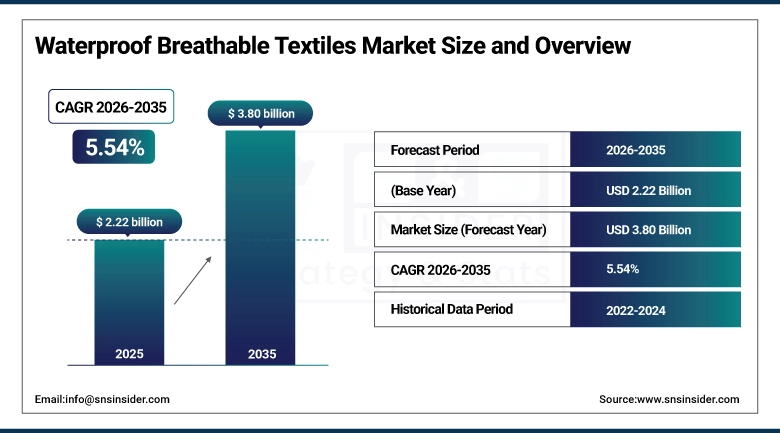
The Waterproof Breathable Textiles Market size was valued at USD 2.22 Billion in 2025 and is projected to reach USD 3.80 Billion by 2035, growing at a CAGR of 5.54% during 2026-2035.
Growth in the market for waterproof breathable textiles can be attributed to the growing demand for performance sportswear, growing participation in outdoor recreation, advancements in textile technology, growing military and medical uses, and consumers’ growing preference for durable and light-weight clothing.
Market Size and Forecast:
-
Market Size in 2025: USD 2.22 Billion
-
Market Size by 2035: USD 3.80 Billion
-
CAGR: 5.54% From 2026 to 2035
-
Base Year: 2025
-
Forecast Period: 2026-2035
-
Historical Data: 2022-2024
To Get more information on Waterproof Breathable Textiles Market - Request Free Sample Report
Key Waterproof Breathable Textiles Market Trends
-
Rising demand for high-performance sportswear and outdoor apparel is driving adoption of advanced waterproof breathable fabrics
-
Increasing focus on sustainable and eco-friendly materials is accelerating innovation in bio-based and recyclable textile solutions
-
Technological advancements in membrane and coating technologies are improving durability, comfort, and breathability
-
Growing use in defense, healthcare, and industrial protective clothing is expanding market applications
-
Expansion of e-commerce and premium apparel brands is boosting global accessibility and consumer demand
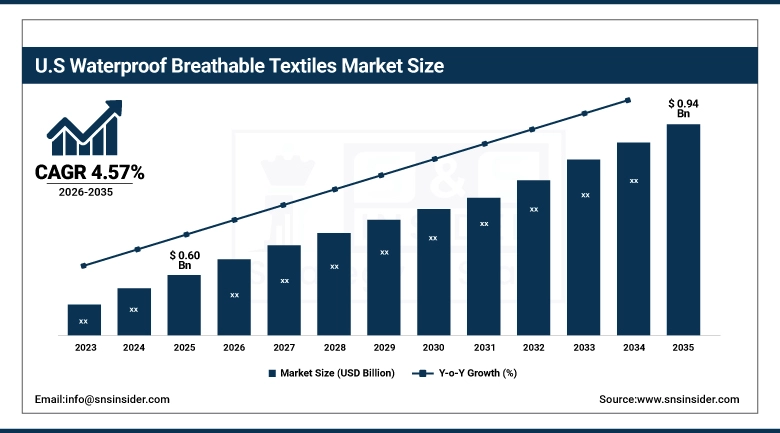
The U.S. Waterproof Breathable Textiles Market size was valued at USD 0.60 Billion in 2025 and is projected to reach USD 0.94 Billion by 2035, growing at a CAGR of 4.57% during 2026-2035. The growth of the U.S. Waterproof Breathable Textiles Market is attributable to the demand for technologically superior outdoor clothes, increased recreational activity, innovation in textiles, and applications in defense, healthcare, and other industrial protective clothes.
Waterproof Breathable Textiles Market Growth Drivers:
-
Rising Demand for High-Performance Apparel and Technical Textiles Accelerating Global Market Expansion Trends
The growth drivers for the market include the rising demand for premium sports clothing, outdoor clothing, and protective clothing. Increased participation in adventure sports and health exercises contributes significantly to driving adoption rates. The development of new technologies in membranes and coatings has led to the improvement in fabric properties. The use of waterproof breathable textiles in other industries such as military, healthcare, and manufacturing further adds to its growth.
Waterproof Breathable Textiles Market Restraints:
-
High Production Costs and Environmental Concerns Limiting Widespread Adoption Across Cost-Sensitive Global Markets
The industry will be constrained because of its high cost of production due to the nature of its sophisticated materials such as ePTFE and special coating. This is a threat especially in economically sensitive environments. The issue of environmental conservation because of non-biodegradable synthetic material and chemical processing poses a threat as well. Stringent rules governing the production of textiles and emission of gases add to the costs incurred by the manufacturer.
Waterproof Breathable Textiles Market Opportunities:
-
Emerging Sustainable Innovations and Expanding Industrial Applications Creating New Growth Avenues Across Global Markets
There are considerable chances with the creation of environmentally friendly and sustainable waterproof breathable material, which can meet the world’s environmental targets. Investments in research and development have made it possible to create green solutions and fabric technology. Applications in the health care, military, and construction industry have provided new sources of income. Moreover, the expansion of urban areas and high disposable incomes in developing countries also make it easy for this product to succeed.
Waterproof Breathable Textiles Market Segment Analysis
-
By Raw Material, Expanded Polytetrafluoroethylene (ePTFE) dominated with 34.26% in 2025, and Others (bio-based polymers, polypropylene, etc.) are expected to grow at the fastest CAGR of 6.66% from 2026 to 2035.
-
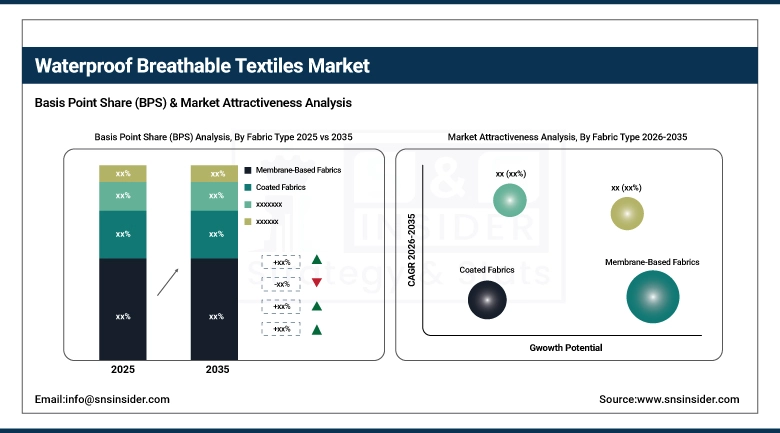
By Fabric Type, Membrane-Based Fabrics dominated with 52.63% in 2025, and Membrane-Based Fabrics are also expected to grow at the fastest CAGR of 5.99% from 2026 to 2035.
-
By Application, Sportswear & Outdoor Gear dominated with 34.92% in 2025, and Protective Clothing (industrial, military, medical) is expected to grow at the fastest CAGR of 6.13% from 2026 to 2035.
-
By End-User Industry, Consumer Apparel & Fashion dominated with 49.76% in 2025, and Healthcare & Medical is expected to grow at the fastest CAGR of 6.98% from 2026 to 2035.
By Raw Material, ePTFE Leads Waterproof Breathable Textiles Market While Bio-Based and Alternative Polymers Set for Fastest Growth 2026 to 2035
The popularity of ePTFE (Expanded Polytetrafluoroethylene) is evident due to its high level of waterproofness, breathable quality, and durability. However, there has been a growing trend towards the use of PU (polyurethane) for its flexibility and relatively cheaper price point, as well as polyester and nylon for their durability and versatility. The rising awareness about the importance of sustainability has sparked interest in eco-friendly materials like bio-polymer and polypropylene.
By Fabric Type, Membrane-Based Fabrics Lead and Maintain Fastest Growth While Coated Fabrics Hold Steady in Waterproof Breathable Textiles Market
Membrane fabrics top the charts since they deliver good moisture management and protection in extreme environments. Another common choice is the coated fabric because of its cost-effectiveness and versatility in usage, but with reduced breathability compared to other types of fabric. Densely woven fabrics, on the other hand, naturally repel water and thus can be used for everyday or casual use purposes. Innovation continues to improve fabric properties and thus broadening their application range.
By Application, Sportswear and Outdoor Gear Leads While Protective Clothing Shows Fastest Growth in Waterproof Breathable Textiles Market 2026 to 2035
Sportswear and outdoor wear make up the dominant products in the market owing to the growing trend of consumers engaging in fitness training, trekking, and adventurous activities that require tough and resistant clothing. Other types of clothing and accessories have a considerable contribution to the industry owing to the increased use of waterproof and breathable garments in daily clothing. Protection clothing enjoys steady growth because of the high demand from industries, military units, and healthcare institutions.
By End-User Industry, Consumer Apparel and Fashion Leads While Healthcare and Medical Shows Fastest Growth in Waterproof Breathable Textiles Market 2026 to 2035
The consumer segment has emerged as the major segment, owing to the growing demand for fashionable and durable clothing. This textile is widely used in the healthcare and medicine sector for protection purposes as well as for hygiene purposes. The defense and military sector make use of such fabrics that offer water-resistant properties. The industrial and construction industry is another significant application area of such textiles for ensuring protection.
Waterproof Breathable Textiles Market Regional Analysis
North America Waterproof Breathable Textiles Market Insights
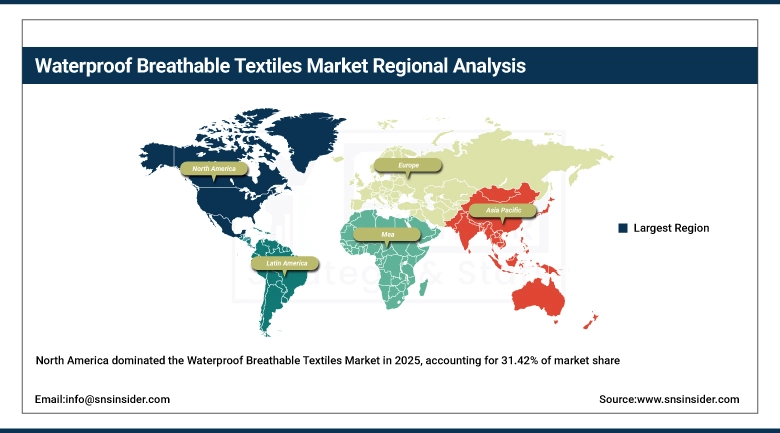
North America held a 31.42% share of the global Waterproof Breathable Textiles Market in 2025 at USD 0.70 Billion, growing at a CAGR of 4.76% through 2035. The region's market reflects the combination of the world's strongest outdoor apparel brand ecosystem, the largest single military procurement budget, and a mature industrial PPE market where waterproof breathable fabrics have moved from premium specification to standard requirement in outdoor-exposed work environments. Canada contributed USD 0.09 Billion at 13.27% of North America in 2025, growing at 5.92% CAGR, with Arc'teryx's Vancouver headquarters and the country's deep outdoor recreation culture anchoring both domestic consumption and premium brand production that feeds global distribution.
Get Customized Report as per Your Business Requirement - Enquiry Now
U.S. Waterproof Breathable Textiles Market Insights
The United States dominated North America's waterproof breathable textiles market at 86.73%, USD 0.60 Billion in 2025. W. L. Gore's domestic manufacturing, the Department of Defense's sustained procurement under programs including the Army Combat Shirt and Generation III Extended Cold Weather Clothing System, and the domestic sales of The North Face, Columbia Sportswear, Patagonia, and Marmot through both specialty retail and mass market channels provide a demand base that's broadly distributed across price points and buyer types rather than concentrated in a single segment.
Europe Waterproof Breathable Textiles Market Insights
Europe held 28.63% at USD 0.64 Billion in 2025, growing at a CAGR of 5.87% through 2035. The region is simultaneously the most technically sophisticated outdoor apparel market globally and the most regulatory challenging environment for fluoropolymer-based textile technology. Brands including Fjallraven, Haglofs, Norrona, Mammut, and Jack Wolfskin are headquartered in Scandinavia and the German-speaking countries, making Europe the primary arena where the PFAS regulatory debate is shaping product development roadmaps in real time. Germany's outdoor retail market served by Globetrotter, Bergzeit, and Sport Schuster in Munich is Europe's largest by volume and the market where technical fabric performance is most consistently the primary purchase decision driver.
Germany Waterproof Breathable Textiles Market Insights
Germany dominated the European Waterproof Breathable Textiles Market in 2025. Beyond its large consumer outdoor market, Germany's industrial and defence textile sectors generate substantial demand: Bundeswehr combat uniform procurement under the IdZ-ES (Infanterist der Zukunft – Erweitertes System) program specifies waterproof breathable outer shell and combat shirt fabrics, and Germany's large chemical and automotive industry workforce generates industrial PPE procurement at volumes that make it one of Europe's most significant non-apparel waterproof breathable textile markets.
Asia Pacific Waterproof Breathable Textiles Market Insights
Asia Pacific led the global Waterproof Breathable Textiles Market with a 36.88% share at USD 0.82 Billion in 2025, growing at a CAGR of 5.93% through 2035. The region's leadership reflects both the dominance of Asian textile manufacturing in the global supply chain Taiwan's Formosa Taffeta, Japan's Toray and Teijin, and South Korea's Hyosung all produce waterproof breathable fabrics for global brand customers and the rapid growth of domestic outdoor recreation demand in Japan, South Korea, and urban China. South Korea's hiking culture, which sees participation rates in regular mountain hiking above 25% of the adult population, generates per-capita outdoor apparel spending that rivals Scandinavia. China's younger urban consumer cohort's embrace of outdoor activities driven by the gor-tex and outdoor lifestyle aesthetics promoted across Douyin and Xiaohongshu is creating a genuinely new consumption wave that domestic brands like Anta Outdoor and international incumbents like The North Face China are competing to capture.
Japan Waterproof Breathable Textiles Market Insights
Japan dominated the Asia Pacific Waterproof Breathable Textiles Market in 2025. Toray Industries, headquartered in Tokyo, is the world's largest producer of polyurethane waterproof breathable membranes outside Gore, with its DERMIZAX and ENTRANT product families specified by outdoor brands across Japan, Europe, and North America. Teijin's Octa product line and Nisshinbo's textile division add further Japanese manufacturing depth in both technical fabrics and the base textiles onto which membranes are laminated.
Latin America (LATAM) and Middle East & Africa (MEA) Waterproof Breathable Textiles Market Insights
Latin America held a 1.96% share at USD 0.04 Billion in 2025, growing at 5.70% CAGR through 2035, with Brazil and Chile generating the majority of regional demand through their outdoor recreation communities in Patagonian trekking, Andean mountaineering, and urban running markets. Brazil's construction and oil and gas sectors add industrial PPE demand for waterproof breathable workwear. The Middle East & Africa held just 1.11% at USD 0.02 Billion in 2025, CAGR 4.75%, where demand is primarily concentrated in military procurement by Gulf state armed forces, specialist industrial applications in oil field operations, and the South African outdoor recreation market whose Drakensberg and Cape Fold mountains generate legitimate demand for technical shell garments among the country's active hiking and trail running communities.
Competitive Landscape for Waterproof Breathable Textiles Market:
W. L. Gore & Associates, Inc., headquartered in Newark, Delaware and privately held since its 1958 founding by Bill and Vieve Gore, is the inventor and dominant incumbent of the waterproof breathable textiles category. Its GORE-TEX brand built on ePTFE membrane technology that Robert Gore discovered in 1969 and Gore commercialised through military, industrial, and outdoor applications across the 1970s and 1980s is the only textile brand in the market that consumers request by name rather than simply accepting what a garment brand specifies.
-
In 2024, W. L. Gore announced the GORE-TEX ePE membrane, replacing the fluoropolymer-based ePTFE with an expanded polyethylene (ePE) construction that delivers equivalent or superior waterproofing and breathability performance without fluorine chemistry, directly addressing the PFAS regulatory risk and brand partner sustainability commitments that had created the most significant competitive vulnerability in the company's history, with initial commercial availability in 2024 outerwear collections from Arc'teryx and other premium brand partners.
Toray Industries, Inc., headquartered in Tokyo, is the world's largest producer of polyurethane-based waterproof breathable membranes outside Gore's ePTFE franchise, with its DERMIZAX EV and ENTRANT G II product families specified by outdoor brands globally seeking GORE-TEX-competitive performance without GORE-TEX licensing relationships and costs. Toray's vertical integration from polyurethane chemistry through membrane production and fabric lamination gives it manufacturing cost advantages in the mid-market outdoor segment where performance and price competitiveness are both procurement criteria.
- In 2024, Toray announced its DERMIZAX NX BIO membrane incorporating bio-based polyol content sourced from plant materials, achieving equivalent moisture vapour transmission performance to its petroleum-derived predecessor while reducing the product's carbon footprint by an independently verified 18%, with the first commercial volume delivered to a European outdoor brand partner whose 2025 collection committed to bio-based material substitution across its technical fabric range.
Waterproof Breathable Textiles Market Key Players:
-
W. L. Gore & Associates, Inc.
-
Toray Industries, Inc.
-
Schoeller Textil AG
-
Formosa Taffeta Co., Ltd.
-
eVent Fabrics
-
HeiQ Materials AG
-
Polartec, LLC
-
Pertex (Mitsui & Co.)
-
Teijin Limited
-
Huntsman Textile Effects
-
Stotz & Co. AG
-
Columbia Sportswear Company
-
The North Face (VF Corporation)
-
Patagonia, Inc.
-
Marmot Mountain LLC
-
Helly Hansen
-
Jack Wolfskin
-
Mountain Hardwear
| Report Attributes | Details |
|---|---|
| Market Size in 2025 | USD 2.22 Billion |
| Market Size by 2035 | USD 3.80 Billion |
| CAGR | CAGR of 5.54% From 2026 to 2035 |
| Base Year | 2025 |
| Forecast Period | 2026-2035 |
| Historical Data | 2022-2024 |
| Report Scope & Coverage | Market Size, Segments Analysis, Competitive Landscape, Regional Analysis, DROC & SWOT Analysis, Forecast Outlook |
| Key Segments | • By Raw Material (Expanded Polytetrafluoroethylene (ePTFE), Polyurethane (PU), Polyester / Nylon, and Others (bio-based polymers, polypropylene, etc.)) • By Fabric Type (Membrane-Based Fabrics, Coated Fabrics, and Densely Woven Fabrics) • By Application (General Clothing & Accessories, Sportswear & Outdoor Gear, Protective Clothing (industrial, military, medical), and Footwear & Accessories) • By End-User Industry (Consumer Apparel & Fashion, Healthcare & Medical, Defense & Military, and Industrial & Construction) |
| Regional Analysis/Coverage | North America (US, Canada), Europe (Germany, UK, France, Italy, Spain, Russia, Poland, Rest of Europe), Asia Pacific (China, India, Japan, South Korea, Australia, ASEAN Countries, Rest of Asia Pacific), Middle East & Africa (UAE, Saudi Arabia, Qatar, South Africa, Rest of Middle East & Africa), Latin America (Brazil, Argentina, Mexico, Colombia, Rest of Latin America). |
| Company Profiles | W. L. Gore & Associates, Inc., Toray Industries, Inc., Sympatex Technologies GmbH, Schoeller Textil AG, Formosa Taffeta Co., Ltd., eVent Fabrics, HeiQ Materials AG, Polartec, LLC, Pertex (Mitsui & Co.), Teijin Limited, Nisshinbo Textile Inc., Huntsman Textile Effects, Stotz & Co. AG, Columbia Sportswear Company, The North Face (VF Corporation), Patagonia, Inc., Marmot Mountain LLC, Helly Hansen, Jack Wolfskin, Mountain Hardwear |

Frequently Asked Questions
Asia Pacific led the Waterproof Breathable Textiles Market in 2025.
Expanded Polytetrafluoroethylene (ePTFE) dominated the Waterproof Breathable Textiles Market in 2025.
The market is driven by rising demand for high-performance sportswear, outdoor gear, protective clothing, and advancements in waterproof breathable fabric technologies.
The Waterproof Breathable Textiles Market size was USD 2.22 Billion in 2025 and is projected to reach USD 3.80 Billion by 2035.
The Waterproof Breathable Textiles Market is expected to grow at a CAGR of 5.54% from 2026-2035.
