
Ultrasound AI Market Report Scope & Overview:
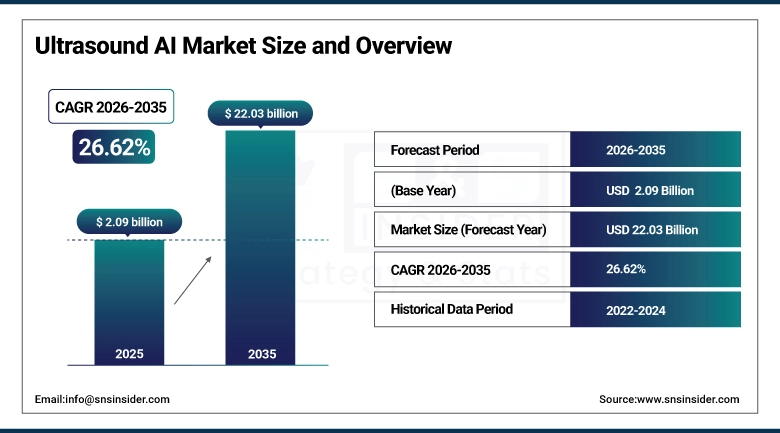
The Ultrasound AI Market is valued at USD 2.09 billion in 2025 and is expected to reach USD 22.03 billion by 2035, growing at a CAGR of 26.62% from 2026-2035.
The Ultrasound AI Market is growing rapidly due to increasing demand for accurate, real-time diagnostic imaging and wider adoption of point-of-care ultrasound. AI-powered solutions improve image quality, automate measurements, and reduce operator dependency, making ultrasound more accessible across clinical settings. Rising use in cardiology, obstetrics, emergency care, and chronic disease management is driving adoption. Additionally, advancements in deep learning algorithms, integration with portable ultrasound devices, shortages of skilled sonographers, and growing investments in digital healthcare technologies are strongly supporting market expansion worldwide.
88% of clinical settings worldwide integrated AI-powered ultrasound solutions leveraging deep learning, portability, and automation to overcome sonographer shortages, enhance diagnostic accuracy, and expand access across cardiology, obstetrics, emergency care, and chronic disease management.
To Get more information On Ultrasound AI Market - Request Free Sample Report
Ultrasound AI Market Trends
-
Rising adoption of AI-enabled ultrasound solutions to enhance image quality and improve diagnostic accuracy
-
Increasing use of automated measurement and interpretation tools to reduce operator dependency and examination variability
-
Growing demand for point-of-care ultrasound AI supporting faster decision-making in emergency and critical care settings
-
Integration of deep learning algorithms for real-time image optimization and anatomical structure recognition
-
Expansion of cloud-based ultrasound AI platforms enabling remote access collaboration and scalable data management
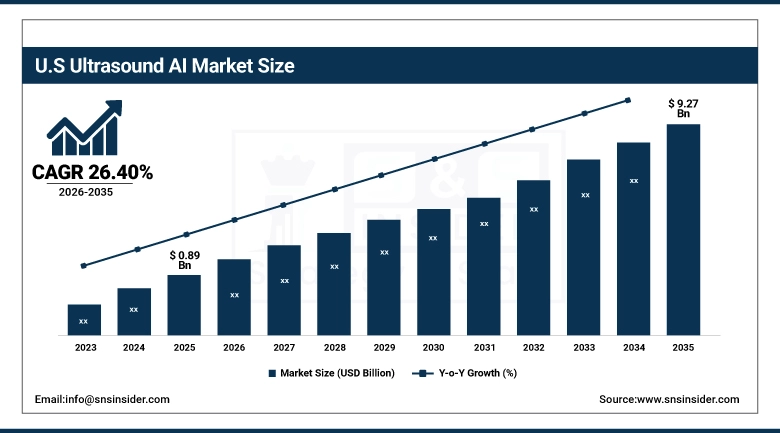
The U.S. Ultrasound AI Market is valued at USD 0.89 billion in 2025 and is expected to reach USD 9.27 billion by 2035, growing at a CAGR of 26.40 % from 2026-2035.
The U.S. Ultrasound AI Market is growing rapidly due to increasing demand for faster, more accurate diagnostic imaging and expanded use of point-of-care ultrasound. AI-driven tools enhance image quality, reduce operator variability, and improve workflow efficiency. Strong investment in digital health, adoption of portable ultrasound systems, and shortages of skilled sonographers are further driving market growth.
Ultrasound AI Market Growth Drivers:
-
Rising demand for early disease detection and workflow efficiency is accelerating adoption of AI-powered ultrasound solutions across hospitals and diagnostic imaging centers globally
Healthcare systems worldwide are increasingly prioritizing early and accurate disease diagnosis to improve patient outcomes and reduce treatment costs. AI-powered ultrasound solutions enhance image quality, automate measurements, and assist in real-time clinical decision-making. These capabilities significantly reduce examination time and improve workflow efficiency for clinicians. Hospitals and diagnostic centers are adopting AI-enabled ultrasound to manage growing patient volumes while maintaining diagnostic accuracy. The ability of AI to support faster, standardized, and reproducible imaging results is a major factor driving widespread adoption across multiple clinical specialties globally.
85% of hospitals and diagnostic imaging centers globally adopted AI-powered ultrasound solutions driven by the urgent need for early disease detection, streamlined workflows, and enhanced diagnostic precision.
-
Shortage of skilled sonographers and radiologists is increasing reliance on AI-assisted ultrasound tools to improve image interpretation accuracy and reduce operator dependency
The global shortage of trained sonographers and radiologists has created challenges in maintaining consistent diagnostic quality. AI-assisted ultrasound systems help bridge this gap by guiding image acquisition, automating interpretation, and reducing operator dependency. These tools support less-experienced clinicians by providing real-time feedback and decision support, improving diagnostic confidence. As healthcare providers face increasing workloads and staffing constraints, AI-enabled ultrasound solutions are becoming essential for maintaining efficiency and accuracy. This growing reliance on AI to compensate for workforce shortages is significantly driving market growth.
82% of healthcare providers turned to AI-assisted ultrasound tools driven by a global shortage of skilled sonographers and radiologists to enhance diagnostic accuracy, standardize image interpretation, and reduce operator dependency.
Ultrasound AI Market Restraints:
-
High implementation costs, integration challenges with legacy imaging systems, and limited budgets restrict widespread adoption of ultrasound AI solutions, especially in small healthcare facilities
The deployment of AI-powered ultrasound systems often requires significant upfront investment in software, hardware upgrades, and IT infrastructure. Integrating AI solutions with existing legacy imaging systems can be complex and time-consuming, increasing operational challenges. Small hospitals, clinics, and diagnostic centers with limited budgets may find these costs prohibitive. Additionally, ongoing expenses related to system maintenance, training, and software updates further limit adoption. These financial and technical barriers slow penetration of ultrasound AI solutions, particularly in cost-sensitive and resource-constrained healthcare environments.
77% of small healthcare facilities deferred adoption of ultrasound AI solutions due to high implementation costs, interoperability hurdles with legacy imaging systems, and constrained budgets limiting equitable access to advanced diagnostic tools.
-
Regulatory approval complexities and data privacy concerns slow commercialization and deployment of AI-based ultrasound technologies across different regional healthcare markets
AI-based medical imaging solutions must comply with stringent regulatory requirements to ensure safety, accuracy, and reliability. Obtaining regulatory approvals across different countries involves lengthy validation processes, clinical trials, and documentation, delaying commercialization. Additionally, concerns related to patient data privacy, cybersecurity, and compliance with healthcare data protection laws pose challenges. Variations in regulatory frameworks across regions further complicate global deployment. These regulatory and privacy-related issues increase development timelines and costs, restraining the rapid adoption of ultrasound AI technologies worldwide.
79% of AI-based ultrasound developers faced delays in commercialization due to fragmented regulatory pathways and heightened data privacy requirements slowing deployment across key regional healthcare markets.
Ultrasound AI Market Opportunities:
-
Advancements in deep learning, cloud computing, and real-time image analytics create opportunities for more accurate, portable, and scalable AI-enabled ultrasound applications
Rapid progress in deep learning algorithms and cloud-based computing is significantly enhancing the performance of AI-enabled ultrasound systems. Improved image recognition, real-time analytics, and automated reporting enable higher diagnostic accuracy and consistency. Cloud integration allows scalable deployment, remote access, and continuous software updates. These advancements also support the development of portable and handheld ultrasound devices with embedded AI capabilities. As technology continues to evolve, manufacturers can introduce cost-effective, high-performance solutions across diverse clinical settings, creating strong growth opportunities for the ultrasound AI market.
86% of AI-enabled ultrasound platforms leveraged deep learning and cloud-based real-time analytics delivering unprecedented accuracy, portability, and scalability for point-of-care diagnostics across diverse clinical settings.
-
Growing adoption of point-of-care ultrasound and telemedicine services offers strong opportunities for AI integration, improving access to diagnostic imaging in remote and underserved regions
Point-of-care ultrasound is increasingly used in emergency care, primary care, and rural healthcare settings due to its portability and rapid diagnostic capabilities. Integrating AI with these systems enhances usability, accuracy, and clinical decision support, even for non-specialist users. The expansion of telemedicine further strengthens this opportunity by enabling remote image interpretation and AI-assisted diagnostics. These developments improve access to quality imaging services in underserved and remote areas. As healthcare systems emphasize decentralized care delivery, AI-enabled ultrasound presents significant opportunities for market expansion.
84% of healthcare providers in remote and underserved regions leveraged AI-integrated point-of-care ultrasound and telemedicine expanding access to timely, accurate diagnostic imaging and bridging critical care gaps.
Ultrasound AI Market Segment Analysis
-
By Component: Hardware led with 48% share, while Software is the fastest-growing segment.
-
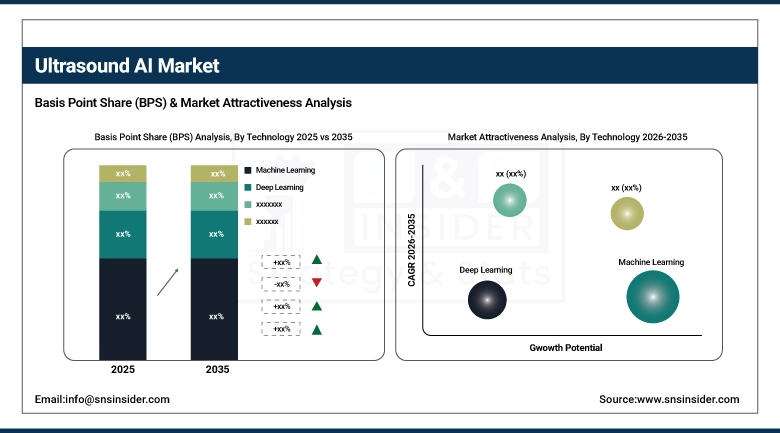
By Technology: Machine Learning led with 38% share, while Deep Learning is the fastest-growing segment.
-
By Application/Modality: Cardiology / Echocardiography led with 38% share, while Obstetrics & Gynecology is the fastest-growing segment.
-
By End Use: Hospitals led with 46% share, while Diagnostic Imaging Centers are the fastest-growing segment.
By Technology: Machine Learning led, while Deep Learning is the fastest-growing segment.
Machine learning leads the technology segment due to its widespread adoption in image classification, pattern recognition, and workflow optimization. Traditional machine learning models are well-suited for structured ultrasound data and are easier to train, validate, and deploy across clinical environments. Their reliability, lower computational requirements, and established regulatory acceptance make them the preferred choice for early and large-scale AI integration. Machine learning algorithms are extensively used for measurements, automated reporting, and anomaly detection, supporting high-volume diagnostic workflows and reinforcing their dominance in the Ultrasound AI ecosystem.
Deep learning is the fastest-growing technology segment, driven by its superior performance in complex image analysis and real-time decision support. Deep neural networks enable advanced applications such as automated segmentation, fetal anomaly detection, and cardiac function assessment. Increasing availability of large annotated datasets, improvements in computing power, and rising clinical confidence are accelerating adoption. Deep learning models significantly reduce operator dependency and improve diagnostic accuracy in challenging cases. As healthcare providers seek higher precision and scalability, deep learning continues to gain momentum across advanced ultrasound applications.
By Component: Hardware led, while Software is the fastest-growing segment.
Hardware dominates the Ultrasound AI market due to its essential role in AI-enabled imaging systems, including probes, scanners, and embedded processors. Advanced ultrasound hardware supports real-time image acquisition, edge computing, and seamless AI inference at the point of care. Hospitals and diagnostic centers prioritize upgrading equipment to improve image quality, workflow efficiency, and diagnostic accuracy. Integration of AI-ready hardware with existing ultrasound platforms enhances clinician productivity and reduces dependency on expert operators. The high capital investment nature of imaging equipment and widespread replacement of legacy systems reinforce hardware’s leading contribution to market revenue.
Software is the fastest-growing component as AI algorithms increasingly drive diagnostic value in ultrasound imaging. Software platforms enable automated image interpretation, measurement, anomaly detection, and clinical decision support across multiple specialties. Cloud-based deployments, continuous algorithm updates, and interoperability with PACS and electronic health records are accelerating adoption. Software solutions also lower entry barriers for smaller facilities by enhancing diagnostic consistency without replacing hardware. Growing regulatory approvals, subscription-based pricing models, and rapid innovation in AI models position software as the primary growth engine of the Ultrasound AI market.
By Application/Modality: Cardiology / Echocardiography led, while Obstetrics & Gynecology is the fastest-growing segment.
Cardiology and echocardiography dominate the application segment due to high procedural volumes and the critical need for accurate, repeatable cardiac assessments. AI-enabled ultrasound supports automated chamber measurements, ejection fraction analysis, and real-time image optimization, improving diagnostic consistency. Growing prevalence of cardiovascular diseases and increasing use of point-of-care cardiac ultrasound further drive adoption. AI tools also reduce exam time and variability among operators, making echocardiography more accessible across care settings. These clinical and operational benefits position cardiology as the largest contributor to Ultrasound AI market demand.
Obstetrics and gynecology represent the fastest-growing application segment, fueled by rising demand for prenatal screening and maternal health monitoring. AI-powered ultrasound improves fetal measurements, anomaly detection, and gestational age estimation, enhancing diagnostic confidence. Increasing awareness of early prenatal care, expanding access in emerging markets, and growing use of portable ultrasound systems accelerate adoption. AI reduces reliance on highly specialized sonographers, supporting broader deployment in primary and rural healthcare settings. These factors collectively drive rapid growth of AI-enabled ultrasound solutions in obstetrics and gynecology.
By End Use: Hospitals led, while Diagnostic Imaging Centers are the fastest-growing segment.
Hospitals dominate the Ultrasound AI market as primary centers for high-volume diagnostic imaging and complex clinical workflows. Large patient inflow, availability of capital budgets, and integration with hospital-wide IT systems support rapid AI adoption. Hospitals use ultrasound AI to improve diagnostic accuracy, streamline workflows, and reduce clinician workload across departments. The need for standardized imaging quality and faster clinical decision-making further drives investment. Strong regulatory compliance, access to skilled personnel, and enterprise-scale deployment capabilities reinforce hospitals’ leading position in the market.
Diagnostic imaging centers are the fastest-growing end-user segment as they increasingly adopt AI to improve throughput and service quality. Competitive pressure drives centers to differentiate through faster reporting, higher accuracy, and reduced repeat scans. Ultrasound AI enables efficient case handling with fewer expert operators, lowering operational costs. Expansion of outpatient diagnostics, rising demand for preventive imaging, and adoption of cloud-based AI platforms support growth. As imaging centers focus on scalability and productivity, AI-enabled ultrasound solutions are becoming a critical growth enabler.
Regional Insights
North America Ultrasound AI Market Insights:
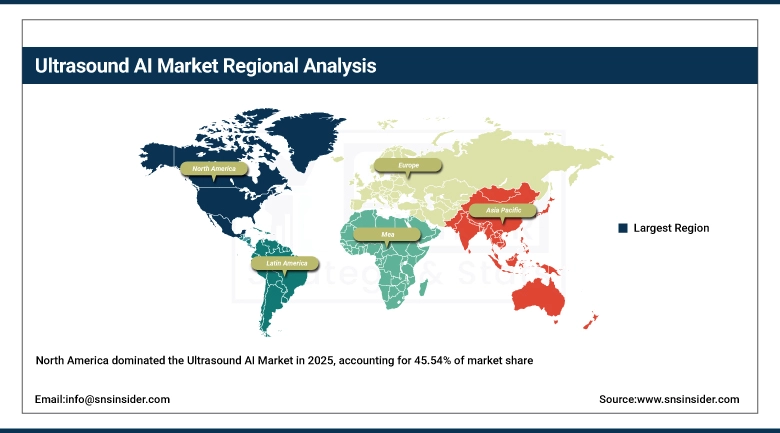
North America dominated the Ultrasound AI Market with a 45.54% share in 2025 due to advanced healthcare infrastructure, high adoption of AI-enabled imaging systems, strong presence of key market players, and widespread integration of digital health solutions. Extensive investments in research, development, and clinical validation further reinforced the region’s market leadership.
Get Customized Report as per Your Business Requirement - Enquiry Now
Asia Pacific Ultrasound AI Market Insights
Asia Pacific is expected to grow at the fastest CAGR of about 28.57% from 2026–2035, driven by increasing healthcare expenditure, rising adoption of AI-assisted diagnostic imaging, growing demand for point-of-care ultrasound, and rapid modernization of healthcare facilities. Expanding medical tourism, supportive government initiatives, and rising prevalence of chronic diseases further accelerate the region’s market growth.
Europe Ultrasound AI Market Insights
Europe held a significant share in the Ultrasound AI Market in 2025, supported by advanced healthcare infrastructure, high adoption of AI-driven imaging solutions, and strong research and development capabilities. Stringent regulatory frameworks, focus on precision diagnostics, and widespread use of digital health platforms further strengthened Europe’s market position.
Middle East & Africa and Latin America Ultrasound AI Market Insights
The Middle East & Africa and Latin America together showed moderate growth in the Ultrasound AI Market in 2025, driven by increasing investments in healthcare infrastructure, rising adoption of AI-assisted imaging systems, and growing awareness of early diagnosis. Expanding private healthcare facilities, technological modernization, and gradual implementation of digital health initiatives further contributed to the regions’ improving market presence.
Competitive Landscape:
GE Healthcare
GE Healthcare is a global leader in medical imaging and diagnostics, with a strong presence in AI-powered ultrasound solutions. The company integrates advanced artificial intelligence into its ultrasound systems to enhance image quality, automate measurements, and support clinical decision-making. GE Healthcare focuses on cardiology, radiology, and point-of-care applications, enabling faster workflows and improved diagnostic accuracy. Its strong R&D capabilities and global footprint support widespread adoption of AI-enabled ultrasound technologies.
-
June 2024, GE Healthcare launched enhanced AI capabilities on its Voluson E10 (obstetrics/gynecology) and Vivid E95 (cardiology) ultrasound systems, featuring AI AutoFollicle and Cardiac AutoEF.
Koninklijke Philips N.V.
Koninklijke Philips N.V. is a major healthcare technology company offering AI-driven ultrasound systems designed to improve clinical efficiency and diagnostic confidence. Philips integrates machine learning and automation to assist clinicians in image acquisition, interpretation, and reporting. The company emphasizes workflow optimization, cardiovascular and obstetric imaging, and interoperability across healthcare environments. With strong investments in digital health and artificial intelligence, Philips continues to advance ultrasound innovation across hospitals and diagnostic imaging centers worldwide.
-
November 2023, Philips expanded its EPIQ Elite and Affiniti ultrasound platforms with TrueVue AI, a suite of deep learning-based tools for automated anatomy recognition and measurement.
Siemens Healthineers
Siemens Healthineers is a leading provider of advanced medical imaging solutions, including AI-enabled ultrasound technologies. The company leverages artificial intelligence to improve image clarity, automate repetitive tasks, and support accurate clinical assessments. Siemens Healthineers focuses on applications such as cardiology, abdominal imaging, and point-of-care diagnostics. Its robust digital ecosystem, combined with continuous innovation and global reach, positions the company as a key player in the growing ultrasound AI market.
-
January 2025, Siemens Healthineers launched AI-Rad Companion for Ultrasound, integrated into its flagship ACUSON SEQUOIA system, enabling automated organ quantification and reporting.
Ultrasound AI Market Key Players
-
GE Healthcare
-
Koninklijke Philips N.V.
-
Siemens Healthineers
-
EchoNous Inc.
-
UltraSight
-
iCardio.ai
-
Sonio SAS
-
Koios Medical
-
Samsung Medison
-
Fujifilm Holdings Corporation
-
Clarius Mobile Health
-
Caption Care
-
Us2.ai
-
Butterfly Network Inc.
-
NovaSignal Corporation
-
Esaote S.p.A.
-
Mindray Medical
-
Analogic Corporation
-
Hitachi Medical Systems
-
Bracco Imaging
Ultrasound AI Market Report Scope:
| Report Attributes | Details |
|---|---|
| Market Size in 2025 | USD 2.09 Billion |
| Market Size by 2035 | USD 22.03 Billion |
| CAGR | CAGR of 26.62% From 2026 to 2035 |
| Base Year | 2025 |
| Forecast Period | 2026-2035 |
| Historical Data | 2022-2024 |
| Report Scope & Coverage | Market Size, Segments Analysis, Competitive Landscape, Regional Analysis, DROC & SWOT Analysis, Forecast Outlook |
| Key Segments | • By Component: Software, Hardware, Services • By Technology: Machine Learning, Deep Learning, Computer Vision, Natural Language Processing • By Application: Cardiology / Echocardiography, Radiology, Obstetrics & Gynecology, Urology, Others • By End Use: Hospitals, Diagnostic Imaging Centers, Ambulatory Surgical / Outpatient Centers, Others |
| Regional Analysis/Coverage | North America (US, Canada, Mexico), Europe (Eastern Europe [Poland, Romania, Hungary, Turkey, Rest of Eastern Europe] Western Europe] Germany, France, UK, Italy, Spain, Netherlands, Switzerland, Austria, Rest of Western Europe]), Asia Pacific (China, India, Japan, South Korea, Vietnam, Singapore, Australia, Rest of Asia Pacific), Middle East & Africa (Middle East [UAE, Egypt, Saudi Arabia, Qatar, Rest of Middle East], Africa [Nigeria, South Africa, Rest of Africa], Latin America (Brazil, Argentina, Colombia, Rest of Latin America) |
| Company Profiles | GE Healthcare, Koninklijke Philips N.V., Siemens Healthineers, EchoNous Inc., UltraSight, iCardio.ai, Sonio SAS, Koios Medical, Samsung Medison, Fujifilm Holdings Corporation, Clarius Mobile Health, Caption Care, Us2.ai, Butterfly Network Inc., NovaSignal Corporation, Esaote S.p.A., Mindray Medical, Analogic Corporation, Hitachi Medical Systems, Bracco Imaging |
Frequently Asked Questions
North America dominated the Ultrasound AI Market in 2025 with a 45.54% market share.
Cardiology / Echocardiography dominated the Ultrasound AI Market by application.
Rising demand for accurate real-time diagnostics and AI-driven automation to reduce operator dependency is the major growth driver.
The Ultrasound AI Market was valued at USD 2.09 billion in 2025.
The Ultrasound AI Market is expected to grow at a CAGR of 26.62% from 2026 to 2035.
