
Wound Care Biologics Market Report Scope & Overview:
The market for Wound Care Biologics is estimated to be valued at 2.80 Billion in 2025 and is expected to reach 6.24 Billion in 2035, growing at a CAGR of 8.48% from 2026 to 2035.
The analysis report for the market for Wound Care Biologics provides insights into market dynamics, innovations in products, and their applications. Factors such as the increasing prevalence of chronic wounds such as diabetic foot ulcers and pressure ulcers, the aging population, the increased use of advanced biologics for wound care such as skin substitutes, and the development of wound care infrastructure are contributing to the growth of the market for wound care biologics from 2026 to 2035.
The use of wound care biologics exceeded 50 million treatments in 2025.driven by increasing chronic wound cases and growing adoption of advanced wound healing therapies.

To Get more information on Wound Care Biologics Market - Request Free Sample Report
Wound Care Biologics Market Trends:
-
The prevalence of chronic wounds like diabetic foot ulcers, pressure ulcers, and venous leg ulcers is on the increase, thus fueling the demand for advanced wound care biologics.
-
The aging population, combined with the growing prevalence of diabetes, is fueling the long-term use of biologic wound healing products.
-
The availability of skin substitutes, bioengineered tissues, and growth factors is enhancing the effectiveness of wound healing, reducing the time to recover, and providing better patient care.
-
The creation of new formulations like topical biologics and injectables is enhancing the ease of use and effectiveness of the product.
-
The growing number of clinics, hospitals, and home healthcare facilities is enhancing the availability of advanced wound care products.
-
The partnerships between biotech companies, healthcare organizations, and research facilities are enhancing the product development and penetration of the market.
U.S. Wound Care Biologics Market Insights:
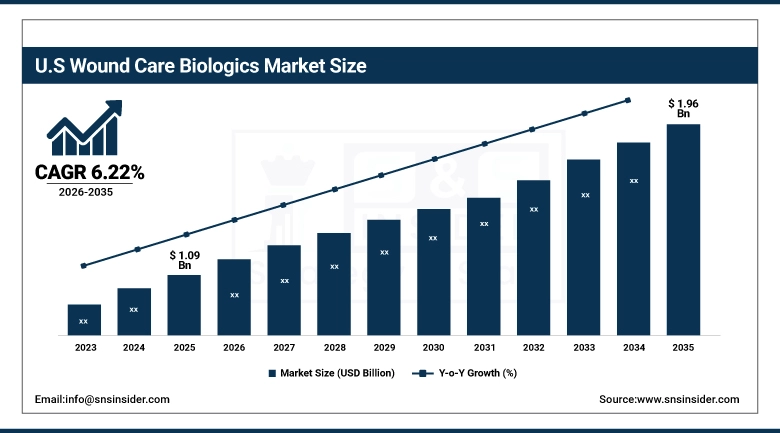
The U.S. Wound Care Biologics Market is projected to grow from USD 1.09 Billion in 2025 to USD 1.96 Billion by 2035, at a CAGR of 6.22%. Growth is driven by rising prevalence of chronic wounds such as diabetic foot ulcers and pressure ulcers, increasing aging population, strong adoption of advanced biologics including skin substitutes, and growing investments in innovative wound healing technologies across hospitals and specialized wound care clinics.
Wound Care Biologics Market Growth Drivers:
-
Rise in prevalence rates of chronic wounds and incidence of diabetes are creating growth opportunities in the Wound Care Biologics Market.
The increasing prevalence rates of chronic wounds like diabetic foot ulcers, pressure ulcers, and venous leg ulcers, along with an increasing incidence of diabetes and an aging population, are creating growth opportunities in the Wound Care Biologics Market. Advanced therapies are being adopted in hospitals, wound care clinics, and home healthcare settings to promote healing and prevent complications in chronic wounds. Advanced therapies in wound care include skin substitutes, bioengineered tissue substitutes, growth factors, and other biologics. Such advances in topical and injectable biologics are accelerating growth in the Wound Care Biologics Market with better clinical outcomes, increased recovery rates, and better patient care.
In 2025, more than 60% of hospitals, wound care clinics, and home healthcare providers are utilizing advanced wound care biologics to manage chronic wounds.
Wound Care Biologics Market Restraints:
-
High treatment costs and limited reimbursement policies are restraining factors for the adoption of advanced wound care biologics in emerging nations.
In the Wound Care Biologics Market, several significant impediments exist, including inconsistent reimbursement policies, elevated treatment expenses, and budgetary limitations. The adoption of advanced wound care products, such as skin substitutes, bioengineered tissues, and growth factor-based therapies, could be hindered by their higher treatment costs, particularly within small and mid-sized hospitals, wound care clinics, and other healthcare environments sensitive to financial considerations. Furthermore, inconsistent reimbursement practices, coupled with budgetary constraints and the high cost of treatment, may deter the utilization of wound care products, especially in the context of managing chronic wounds over extended periods. Moreover, the adoption of wound care products could be hindered by supply chain problems, the need for skilled professionals, and financial pressures, particularly in developing countries. This would then limit the growth of the wound care biologics market.
Wound Care Biologics Market Opportunities:
-
Increase in the use of regenerative medicine and bioengineered skin substitutes is creating opportunities for the wound care biologics market.
Advances in regenerative medicine technologies, including next-generation skin substitutes, tissue bioengineered products, and amniotic tissue-derived biologics, are creating opportunities for the wound care biologics market. Hospitals, wound care centers, and clinics are increasingly using these products to promote tissue regeneration, speed up the wound healing process, and decrease the risk of complications. Companies that provide innovative, affordable, and easy-to-use wound care biologics will benefit from these opportunities. Advances in tissue bioengineered products, biomaterials, and cell-based technologies will also contribute to the growth of the wound care biologics market.
More than 48% of healthcare providers have adopted regenerative medicine and bioengineered wound care biologics in 2025 due to the need for rapid wound healing.
Wound Care Biologics Market Segmentation Analysis:
-
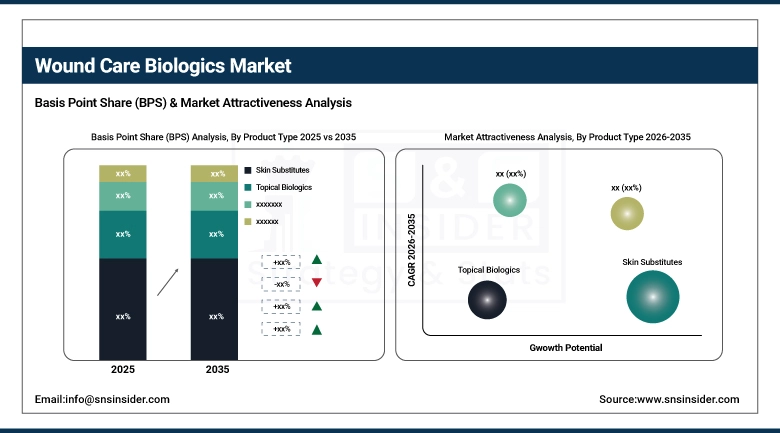
By Product Type, Skin Substitutes had Dominated with the highest market share of 52.25% in 2025, whereas Topical Biologics is anticipated to witness the fastest growth at a CAGR of 8.85% from 2026 to 2035.
-
By Wound Type / Indication, Chronic Wounds had dominated with the highest market share of 67.65% in 2025, whereas Acute Wounds is anticipated to witness the fastest growth at a CAGR of 6.95% from 2026 to 2035.
-
By Technology, Acellular Biologics had Dominated with the highest market share of 55.85% in 2025, whereas Cell-based Biologics is anticipated to witness the fastest growth at a CAGR of 9.16% from 2026 to 2035.
-
By End User, Hospitals had dominated the highest market share of 63.39% in 2025, whereas Wound Care Clinics is anticipated to witness the fastest growth at a CAGR of 8.86% from 2026 to 2035.
-
By Application, Advanced Wound Care had dominated the highest market share of 47.41% in 2025, whereas Chronic Wound Management is anticipated to witness the fastest growth at a CAGR of 7.76% from 2026 to 2035.
By Product Type, Skin Substitutes Dominate While Topical Biologics Grow Rapidly:
The Skin Substitutes segment had the largest market share due to its high efficacy in tissue regeneration and healing in chronic wounds. In 2025, more than 25 million treatments were used in Skin Substitutes, indicating its acceptance in hospitals and clinics for treating complex wounds like diabetic foot ulcers and pressure sores.
Topical Biologics is the fastest-growing segment in the market due to increasing demand for cost-effective and user-friendly treatments. The usage of Topical Biologics increased significantly in 2025, with more than 18 million treatments being used for early-stage and moderate wounds.
By Wound Type / Indication, Chronic Wounds Dominate While Acute Wounds Grow Rapidly:
Chronic Wounds segment accounted for the highest share in the market, with most cases treated with advanced biologics due to the long time to recover and the recurrence rate. In 2025, over 35 million cases were treated with biologic therapy, indicating the high level of dependence on this treatment by healthcare practitioners in managing wounds.
Acute Wounds is the fastest-growing segment, mainly due to the increase in surgical procedures, trauma cases, and burn injuries. Over 15 million cases were treated in 2025, indicating the growing use of biologics in surgical procedures and acute care settings.
By Technology, Acellular Biologics Dominate While Cell-based Biologics Grow Rapidly:
Acellular Biologics accounted for the largest share in the market due to its availability, cost-effectiveness, and ease of storage and usage. They are used in large quantities in chronic wounds, particularly in hospitals and clinics. In 2025, usage was more than 30 million treatments due to the popularity of this product.
Cell-based Biologics are growing rapidly in the market due to advances in regenerative medicine and increasing demand for better healing options. They are used in more than 12 million treatments in 2025, particularly in complex wounds that are not healing.
By Application, Advanced Wound Care Dominates While Chronic Wound Management Grows Rapidly:
The Advanced Wound Care segment held the highest share of the market, driven by the increasing trend of using biologics to treat wounds that are complicated and require additional support for healing. In 2025, the number of treatments exceeded 28 million, indicating a strong reliance on advanced therapies for treating wounds.
Chronic Wound Management is the fastest-growing segment of the biologics market, owing to the increasing number of patients suffering from diabetic ulcers, pressure ulcers, and chronic wounds that do not have the ability to heal. The number of treatments exceeded 20 million cases in 2025, especially for patients undergoing treatment in outpatient settings.
By End User, Hospitals Dominate While Specialty Clinics Grow Rapidly:
Hospitals segment has been a market leader in providing a point of care for advanced wound treatment and complex wound cases, providing more than 30 million biologic treatments in 2025. The high patient volume, presence of wound care units, and availability of advanced technology also add to their dominance in the market. The rise in healthcare infrastructure and availability of skilled professionals also contribute to the adoption of wound care biologics in hospitals.
Wound Care Clinics segment is expected to grow at the highest rate, driven by the increase in the number of outpatient facilities, rising need for specialized wound care, and a focus on cost-effective settings. Wound Care Clinics provided more than 15 million treatments in 2025, which can be attributed to the increased use of advanced biologics and personalized wound care products in settings other than hospitals.
Wound Care Biologics Market Regional Analysis:
North America Wound Care Biologics Market Insights:
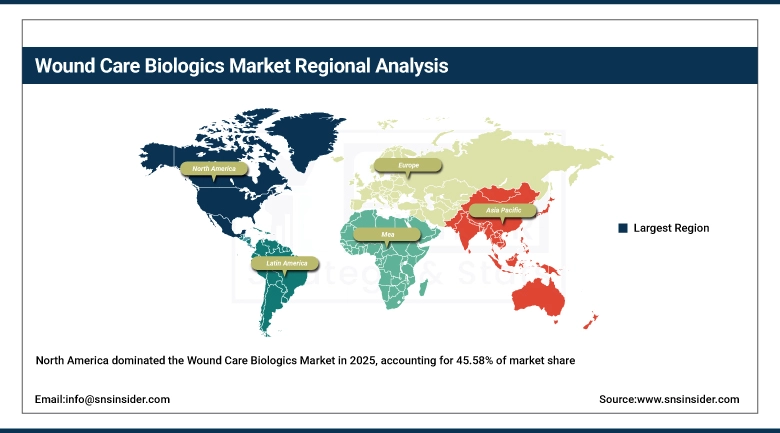
The North America wound care biologics market is dominated by the region, holding 45.58% of the market share in 2025. This is due to the large number of chronic wounds and the well-established healthcare infrastructure in the United States and Canada. The market is witnessing significant growth due to the increased adoption of advanced wound care biologics such as skin substitutes, acellular matrices, and growth factor-based wound care products in hospitals and clinics. The increasing prevalence of diabetes, aging population, and the need for advanced wound care solutions are also contributing to the growth of the market in the region.
Get Customized Report as per Your Business Requirement - Enquiry Now
U.S. Wound Care Biologics Market Insights:
The U.S. wound care biologics market is growing due to the large number of patients suffering from chronic wounds, well-established healthcare infrastructure, and the increased adoption of advanced wound care products such as skin substitutes and bioengineered wound care products. The prevalence of diabetic foot ulcers and pressure ulcers is increasing in the country. Additionally, the number of specialized clinics for wound care is also increasing in the country.
Asia-Pacific Wound Care Biologics Market Insights:
Asia-Pacific wound care biologics market is the fastest-growing region, which will register a CAGR of 12.25% during the forecast period of 2026-2035. The growth of the wound care biologics market in the region will be driven by an increase in the prevalence of chronic wounds, a growing number of diabetics, and an expansion of access to healthcare facilities in countries like China, India, Japan, and Southeast Asia. Increasing awareness of the benefits of advanced wound care products, an expansion of hospital infrastructure, and an increase in investments in wound care infrastructure will also propel the growth of the wound care biologics market.
China Wound Care Biologics Market Insights:
China wound care biologics market will register growth driven by a growing number of diabetics, an increase in the number of patients with chronic wounds, and a continuous expansion of access to healthcare facilities. Increasing adoption of advanced wound care products, a growing focus of the government towards modernization of healthcare infrastructure, and an increasing presence of domestic as well as international players will drive the growth of the wound care biologics market.
Europe Wound Care Biologics Market:
Factors like an increasing elderly population, a rise in the incidence of chronic wounds, and a focus on advanced wound management are contributing to the growth of the Europe Wound Care Biologics Market. Countries like Germany, France, and the UK are influencing the regional market with respect to the adoption of bioengineered skin substitutes, acellular matrices, and regenerative wound care products. The expansion of wound care services, incorporation of advanced treatment modalities, and a conducive reimbursement environment are further contributing to the growth of the regional wound care biologics market. The consistent focus on advancements in wound healing, research, and training programs has further emphasized the importance of the region as a promising wound care biologics market.
Germany Wound Care Biologics Market Insights:
Germany holds a strong position as a promising wound care biologics market, driven by a well-established healthcare system, awareness of advanced wound management modalities, and an increased focus on innovative wound care products. The country has experienced growth with respect to the adoption of innovative wound care products, a strong presence of specialized wound care centers, a focus on clinical efficiency, and advancements in wound healing technologies.
Latin America Wound Care Biologics Market Insights:
The Latin America Wound Care Biologics Market is growing, and this is mainly due to the increase in the prevalence of chronic wounds in this region. The Latin America region is showing improvement in terms of access to healthcare facilities, which is contributing to the growth of this market. The countries in this region, like Brazil, Mexico, and Argentina, are showing positive signs in terms of the increase in awareness about the availability of advanced wound care products.
Middle East and Africa Wound Care Biologics Market Insights
The Middle East & Africa Wound Care Biologics Market is growing, and this is mainly due to the improvement in healthcare facilities in this region. The Middle East & Africa region is showing positive signs in terms of the increase in the prevalence of diabetic foot wounds, which is contributing to the growth of this market. The countries in this region, like Saudi Arabia, the UAE, and South Africa, are showing positive signs in terms of improvement in healthcare facilities, which is contributing to the growth of this market.
Wound Care Biologics Market Competitive Landscape:
Smith & Nephew plc is a medical technology business headquartered in the United Kingdom, a leading player in the wound care biologics segment, providing advanced wound care products, including dermal regeneration templates and bioengineered skin substitutes, for the treatment of chronic and acute wounds. The products provided by the company in the wound care segment focus on enhancing healing outcomes using advanced biomaterial technology. The focus on clinical effectiveness, along with strategic acquisitions and innovative products, further strengthens their position in the market in advanced wound care products.
-
In April 2025, Smith & Nephew, a medical technology company, has strengthened its advanced wound care portfolio with next-generation biologic skin substitute products, which can help in improving healing outcomes, reducing treatment times, and further strengthening its position in chronic wound management.
Organogenesis Holdings Inc. is a prominent regenerative medicine company in the US that specializes in advanced wound care biologics, mainly cellular and tissue-based products. The company's main products, such as bioengineered skin substitutes and amniotic tissue products, are widely used to treat chronic wounds such as diabetic foot ulcers and venous leg ulcers. The company is dedicated to innovation in regenerative medicine, clinical evidence, and making its products more accessible to patients across the US.
-
In March 2025 Organogenesis Holdings Inc. expanded access to its advanced wound care biologics portfolio through clinical partnerships and product improvements to accelerate wound healing, promote patient health benefits, and increase the adoption of these products in wound care centers.
MiMedx Group Inc. is a prominent US-based biopharmaceutical company that specializes in placental tissue-based biologics for wound care applications. The company's main products are advanced tissue allografts derived from human amniotic tissue for chronic and surgical wounds. The company is dedicated to innovation in regenerative biomaterials, clinical research, and manufacturing processes. Strong distribution channels, increased acceptance of amniotic tissue products for wound care, and improving efficiency in wound healing are some of the reasons for the company's increased market presence.
-
In June 2025, MiMedx Group advanced its placental-derived biologics portfolio by introducing enhanced allograft solutions, aiming to improve tissue regeneration, reduce healing time, and expand its footprint in advanced wound care markets.
Wound Care Biologics Market Key Players:
Some of the Wound Care Biologics Market Companies are:
-
Smith & Nephew plc
-
Organogenesis Holdings Inc.
-
MiMedx Group, Inc.
-
Integra LifeSciences Holdings Corporation
-
3M Health Care (Acelity Inc.)
-
Mölnlycke Health Care AB
-
Coloplast A/S
-
Convatec Group plc
-
Tissue Regenix Group plc
-
Vericel Corporation
-
Kerecis hf.
-
Amnio Technology LLC
-
Alliqua BioMedical, Inc.
-
BioTissue Holdings Inc.
-
Solsys Medical LLC
-
Human BioSciences, Inc.
-
Skye Biologics, Inc.
-
Wright Medical Group N.V.
-
Osiris Therapeutics, Inc. (Smith & Nephew)
-
Derma Sciences, Inc. (Integra LifeSciences)
| Report Attributes | Details |
|---|---|
| Market Size in 2025 | USD 2.80 billion |
| Market Size by 2035 | USD 6.24 Billion |
| CAGR | CAGR of 8.48% From 2026 to 2035 |
| Base Year | 2025 |
| Forecast Period | 2026-2035 |
| Historical Data | 2022-2024 |
| Report Scope & Coverage | Market Size, Segments Analysis, Competitive Landscape, Regional Analysis, DROC & SWOT Analysis, Forecast Outlook |
| Key Segments | • By Product Type (Skin Substitutes, Topical Biologics, Others) • By Wound Type / Indication (Chronic Wounds, Acute Wounds, Others) • By Technology (Cell-based Biologics, Acellular Biologics, Growth Factor-based Therapies, Others) • By End User (Hospitals, Wound Care Clinics, Ambulatory Surgical Centres, Home-Care Settings, Others) • By Application (Advanced Wound Care, Surgical Wound Care, Chronic Wound Management, Acute Wound Management, Others) |
| Regional Analysis/Coverage | North America (US, Canada), Europe (Germany, UK, France, Italy, Spain, Russia, Poland, Rest of Europe), Asia Pacific (China, India, Japan, South Korea, Australia, ASEAN Countries, Rest of Asia Pacific), Middle East & Africa (UAE, Saudi Arabia, Qatar, South Africa, Rest of Middle East & Africa), Latin America (Brazil, Argentina, Mexico, Colombia, Rest of Latin America). |
| Company Profiles | Smith & Nephew, Organogenesis Holdings, MiMedx Group, Integra LifeSciences, Acelity (3M Health Care), Mölnlycke Health Care, Coloplast, Convatec Group, Derma Sciences (Integra LifeSciences), Tissue Regenix, Osiris Therapeutics (Smith & Nephew), Wright Medical Group, Human BioSciences, Amnio Technology, Alliqua BioMedical, Kerecis, Vericel Corporation, BioTissue Holdings, Skye Biologics, Solsys Medical |
Frequently Asked Questions
North America dominated with a share of 45.58% in 2025, while Asia-Pacific is the fastest-growing region, expected to expand at a CAGR of 12.25% during 2026–2035.
Skin Substitutes dominated with a share of 52.25% in 2025, while Topical Biologics are projected to grow at the fastest CAGR of 8.85% during 2026–2035.
Growth is driven by rising prevalence of chronic wounds, increasing diabetes and aging population, growing adoption of advanced biologics such as skin substitutes, and expansion of wound care infrastructure.
The market is valued at USD 2.80 Billion in 2025 and is projected to reach USD 6.24 Billion by 2035.
The Wound Care Biologics Market is projected to grow at a CAGR of 8.48% during 2026–2035.
