
Particle Therapy Market Report Scope & Overview:
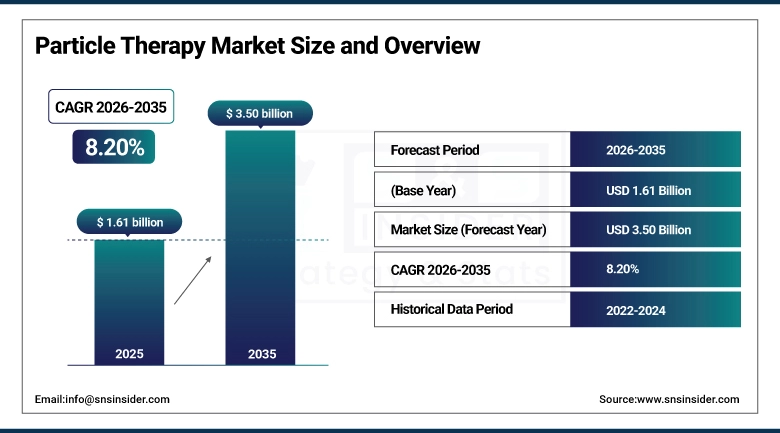
The Particle Therapy Market size is valued at USD 1.61 Billion in 2025 and is projected to reach USD 3.50 Billion by 2035, growing at a CAGR of 8.20% during the forecast period 2026–2035.
The Particle Therapy Market Analysis report offers an exhaustive overview of the market dynamics, technology advancements, and applications. The rising prevalence of cancer cases, increasing acceptance of proton therapy and heavy ion therapy, the rising popularity of precision medicine in cancer therapy and the rapid development of healthcare infrastructure are the key growth drivers of the particle therapy market.
The particle therapy market is expected to grow nearly twice its size by 2031. It is estimated to grow beyond USD 3.50 billion by 2035.
Market Size and Forecast:
-
Market Size in 2025: USD 1.61 Billion
-
Market Size by 2035: USD 3.50 Billion
-
CAGR: 8.20% from 2026 to 2035
-
Base Year: 2025
-
Forecast Period: 2026–2035
-
Historical Data: 2022–2024
To Get more information on Particle Therapy Market - Request Free Sample Report
Particle Therapy Market Trends:
-
Rise of proton therapy as the primary technology, accounting for a significant share of 85%.
-
Increased interest in carbon therapy, particularly in Japan, Germany, and China.
-
Movement toward single-room proton therapy machines to minimize installation costs.
-
Increased use of multi-room machines, particularly in hospitals and cancer centers, for maximum patient capacity.
-
Increased interest in paediatric and head and neck cancers due to accuracy and minimum side effects.
-
Quiet expansion of the regional market, driven by new installations in Asia-Pacific, including China, Japan, and India.
-
Increased interest in AI-based technologies for image guidance and treatment planning.
U.S. Particle Therapy Market Insights:
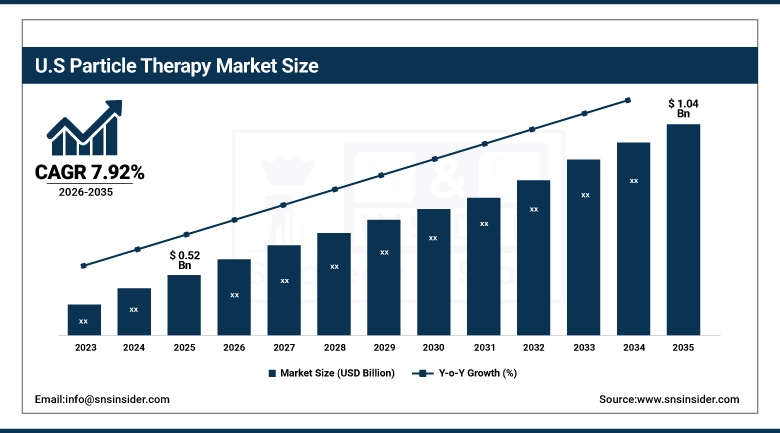
The Particle Therapy Market is predicted to increase from 0.52 billion in 2025 to 1.04 billion in 2035 at a steady CAGR of 7.92%. This can be attributed to a rise in global cancer cases, a rise in the use of proton and heavy ion therapy, and a widening range of applications in paediatric cancer, head & neck cancer, and lung cancer. High demand for single-room and small-sized proton therapy systems, along with advancements in technology in particle therapy systems, are fuelling growth in the global particle therapy market.
Particle Therapy Market Growth Drivers:
-
Rising global cancer incidence and increasing demand for precision oncology are key drivers of Particle Therapy Market growth.
Hospitals, specialty oncology centers, and research institutions worldwide are increasingly using state-of-the-art proton and heavy ion therapy systems for better treatment outcomes and minimizing side effects, especially for paediatric and head & neck cancer treatments. Increased availability of single-room, compact, and modular systems is making it easier for more institutions and researchers to access and use particle therapy, and recent advances in beam delivery, imaging integration, and artificial intelligence-based treatment planning techniques are making it more patient-compliant.
More than 62% of the world's top oncology hospitals and cancer centers worldwide used advanced particle therapy systems in 2025, and this trend is set to continue steadily through 2035.
Particle Therapy Market Restraints:
-
High installation and operational costs, limited availability of treatment centers, and regulatory hurdles are key restraints impacting Particle Therapy Market growth.
Hospitals and oncology centers may face considerable financial challenges, as the development and maintenance of particle therapy technologies demand investment of over hundreds of millions of dollars. In addition, accessibility is still low, with only a handful of institutions worldwide offering proton and heavy ion treatments. This creates an imbalance in accessibility for patients. Competition from new technologies in photon-based treatments, including IMRT and stereotactic radiation therapy, which are more accessible and cost-effective, may pose a challenge for the adoption of new technologies.
In 2025, only fewer than 12% of global oncology hospitals and cancer treatment centers were equipped with particle therapy technologies.
Particle Therapy Market Opportunities:
-
Expanding healthcare infrastructure, rising investments in oncology research, and growing demand for precision medicine are creating significant opportunities in the Particle Therapy Market.
Hospitals, specialty oncology centers, and academic institutions are increasingly looking at advanced proton therapy systems and heavy ion therapy systems to expand the clinical applications of the technology beyond conventional cancers. The development of single-room, compact, and modular designs is providing new opportunities for accessibility of the technology, especially in the emerging markets where cost and space have been a challenge. In addition, the incorporation of AI technology for treatment planning, imaging technology for delivery, and the development of technology to reduce secondary exposure are providing new benefits to patients.
In 2025, investments in new oncology infrastructure across the globe were over 45% for particle therapy systems, providing new opportunities for players to expand the footprint of the market.
Particle Therapy Market Segmentation Analysis:
-
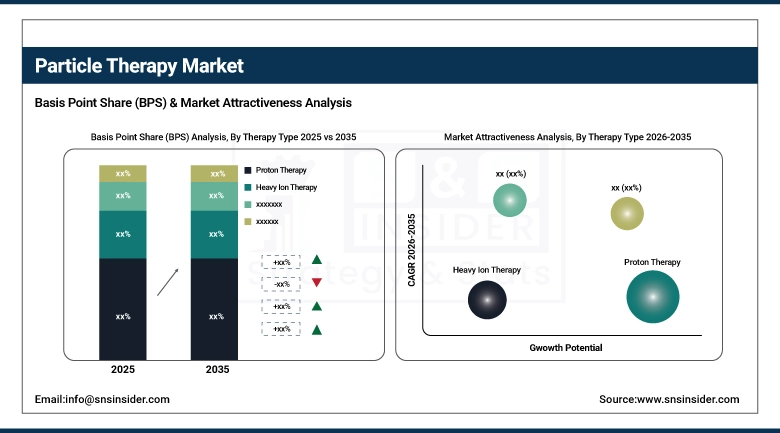
By Therapy Type, Proton Therapy held the largest market share of 86.46% in 2025, while Heavy ION Therapy are expected to grow at the fastest CAGR of 10.87% during 2026–2035.
-
By System Type, Multi-room System dominated with 66.55% market share in 2025, whereas Compact Proton Systems are projected to record the fastest CAGR of 9.77% through 2026–2035.
-
By Application, Treatment accounted for the highest market share of 92.12% in 2025, while Clinical Research are expected to grow at the fastest CAGR of 9.11% during the forecast period.
-
By Cancer Type, Paediatric cancer dominated with a 22.27% share in 2025, while Head & Neck Cancer are anticipated to expand at the fastest CAGR of 7.79% through 2026–2035.
By Therapy Type, Proton Therapy Dominates While Heavy Ion Therapy Grows Rapidly:
Proton Therapy dominated the segment owing to proven clinical efficacy, lower side effects, and wide reimbursement coverage in North America and Europe. The dominance of the Proton Therapy segment has been further strengthened by innovations in compact single-room systems, making it accessible to mid-sized hospitals and emerging countries.
Heavy Ion Therapy is the fastest-growing segment of the particle therapy market, driven by its high biological effectiveness in treating radio-resistant tumours such as sarcomas, pancreatic cancer, and recurrent head and neck tumours. New installations in Japan, Germany, and China are expanding rapidly, backed by government funding and high-end research collaborations.
By System Type, Multi-room Systems Dominate While Compact Proton Systems Grow Rapidly:
The Multi-room Systems segment held a dominant share in the market due to its capability to treat patients simultaneously in multiple gantries. This system has been adopted by leading oncology hospitals and research centers due to its potential to combine advanced imaging technologies, adaptive planning systems, and interdisciplinary treatment approaches.
The Compact Proton Systems segment is fastest growing rate due to advancements in single-room designs, reduced requirements for shielding, and shorter installation schedules. This system has gained popularity due to its cost-effectiveness and flexibility to accommodate mid-sized hospitals and cancer treatment centers without incurring large infrastructure costs.
By Application, Treatment Dominates While Clinical Research Grows Rapidly:
Treatment segment dominates the market due to the gold-standard status of particle therapy in treating complex cancers where accuracy is a prime concern. Its capacity to lower secondary effects in the long term and increase survival rates has made it a popular choice in oncology hospitals and treatment centers.
Clinical Research segment is fastest growing segment due to advancements in translational oncology and investigations into particle therapy in combination with immunotherapy agents and biologics. Research efforts are increasingly focused on optimizing dose fractionation, relative biological effectiveness, and expanding particle therapy into radio-resistant tumours.
By Cancer Type, Paediatric Cancer Dominates While Head & Neck Cancer Grows Rapidly:
The Paediatric Cancer segment has clearly established dominated position in market area for particle therapy, primarily driven by its unparalleled capability to minimize side effects in paediatric and young patients. Proton and heavy ion therapy are preferred treatment options in hospitals and specialized cancer treatment centers for paediatric and young patients.
Head & Neck Cancer has clearly become the fastest-growing segment of particle therapy, primarily driven by its precision in treating tumours in areas close to critical structures such as the brainstem, spinal cord, and optic nerves. The precision of particle therapy in minimizing damage while maintaining high treatment efficacy has clearly improved treatment outcomes for patients, especially in complex cases where conventional radiation therapy is more risky.
Particle Therapy Market Regional Analysis:
North America Particle Therapy Market Insights:
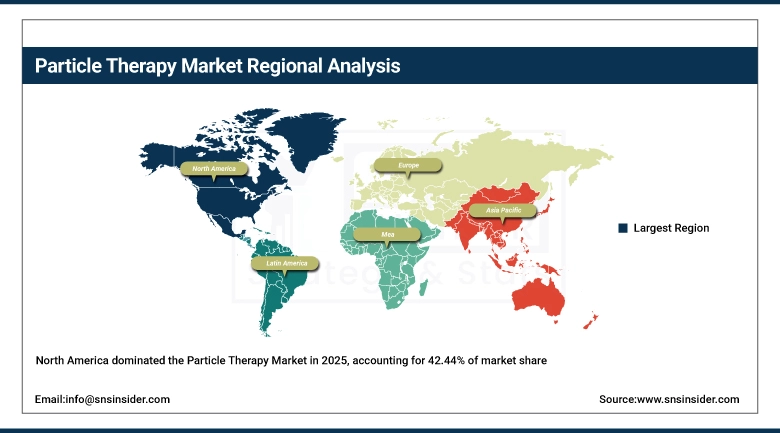
The North America particle therapy market has been a dominated, holding a share of 42.44% in 2025, owing to the prevalence of cancer and a strong infrastructure base in the United States and Canada. The high acceptance of proton therapy systems in hospitals and specialty clinics has been a major factor in boosting growth in North America, owing to a high level of expertise and favourable reimbursement policies. The need for precision medicine in cancer treatment and growth in multi-room and compact systems of proton therapy have further strengthened North America’s position in a mature particle therapy market.
Get Customized Report as per Your Business Requirement - Enquiry Now
U.S. Particle Therapy Market Insights:
The U.S. Particle Therapy Market is driven by a high number of cancer cases, wide acceptance of proton therapy systems, and high investment in cancer infrastructure. Increasing incidence of paediatric and head and neck cancer, growth of specialty oncology centres, and advancements in particle therapy system installations help maintain the U.S. as a prime position in North America. The reimbursement scenario, expertise of clinicians, and ongoing research partnerships with universities and hospitals help maintain the U.S.as a cornerstone of particle therapy development and application globally.
Asia-Pacific Particle Therapy Market Insights:
Asia-Pacific is the fastest-growing region for the Asia-Pacific Particle Therapy Market, with 10.75% CAGR in 2025. The region is witnessing a rise in cancer cases, development of healthcare infrastructure, and robust investments by governments. Countries such as Japan, China, and India are in the forefront of adopting proton and heavy ion therapy facilities, and compact and modular solutions are increasingly being used in mid-sized hospitals. The demand for paediatric and head & neck treatments, along with research collaborations, is further adding momentum to this region.
China Particle Therapy Market Insights:
The China Particle Therapy Market is driven by aggressive infrastructure development, increasing incidence of cancer, and favourable government initiatives in terms of increasing access to advanced cancer treatment modalities. Heavy ion therapy facilities in China are among the most advanced in the world, with significant investments in research and clinical applications. Compact proton therapy systems in provincial hospitals are gaining traction in China, driven by local manufacturing capabilities and cost-effective solutions.
Europe Particle Therapy Market Insights:
The Europe Particle Therapy market is an established market, and it is further strengthened by government-backed initiatives, high healthcare standards, and strong healthcare expertise. Proton therapy centers in Germany, Italy, and the UK are some of the key markets for particle therapy in Europe, and they have shown strong interest in paediatric and rare cancer treatments. Expanding research collaborations in universities and hospitals, along with technological advancements in image-guided delivery and artificial intelligence-based treatment planning, further reinforce Europe's position as a leader in precision oncology
Germany Particle Therapy Market Insights:
The Germany Particle Therapy Market is influenced by advanced healthcare facilities, government support, and extensive clinical research in particle therapy. Germany has some of the most advanced particle therapy facilities in Europe. It has a high level of adoption in hospitals and specialty oncology facilities. The demand for head & neck cancer treatment and paediatric cancer treatment in Germany is on the rise. In addition to that, university and research center collaboration further boosts Germany’s position in the European particle therapy market.
Latin America Particle Therapy Market Insights:
The Latin America particle therapy market is in its development stage and is driven by increasing cancer incidence rates and investments in advanced infrastructure for cancer treatment. Brazil and Mexico are at the core of the Latin America particle therapy market, with increasing focus among hospitals and specialty treatment centers on exploring the potential of small proton therapy systems. There is a scarcity of treatment centers in Latin America, but government initiatives and partnerships with international research organizations are helping the market grow.
Middle East & Africa Particle Therapy Market Insights:
The Middle East & Africa Particle Therapy Market is in its early stages, driven by rising cancer prevalence, expanding healthcare infrastructure, and government-led investments in advanced oncology treatments. Countries such as Saudi Arabia, the UAE, and South Africa are spearheading adoption, with compact and modular proton systems gaining traction in specialty hospitals.
Particle Therapy Market Competitive Landscape:
Ion Beam Applications (IBA) is a leading Belgian company and the global market leader in particle therapy, with a strong presence in proton therapy systems and related solutions. Its flagship offerings include multi-room and compact proton therapy centers, widely adopted across hospitals and oncology institutions worldwide. IBA’s long-standing leadership is reinforced by continuous R&D investments, innovations in imaging-guided delivery, and AI-driven treatment planning. Strategic collaborations, lifecycle management, and geographic expansion further strengthen its dominant position in the particle therapy sector.
-
In September 2025, IBA announced successful commissioning of a new compact proton therapy system in India, expanding accessibility and reinforcing its leadership in emerging markets.
Varian Medical Systems (Siemens Healthineers) is a major U.S.-based oncology technology company with a strong footprint in particle therapy, offering advanced proton therapy solutions integrated with imaging and treatment planning systems. Its diverse portfolio, spanning multi-room centers and modular systems, has driven widespread adoption across North America and Europe. Varian’s innovations in real-time monitoring, automated beam adjustment, and AI-based planning strengthen its competitive edge. Manufacturing excellence, strategic partnerships, and supportive reimbursement frameworks reinforce its leadership in precision oncology.
-
In October 2025, Varian launched its next-generation proton therapy platform featuring enhanced imaging integration, aiming to improve treatment precision and patient outcomes.
Hitachi Ltd. is a major Japanese multinational with a strong presence in particle therapy, particularly in heavy ion and proton therapy systems. Hitachi’s advanced technologies are widely adopted in Asia-Pacific, with installations across Japan, China, and other regions. Its leadership is driven by innovations in beam delivery, compact system design, and superior reliability metrics. Continuous R&D, collaborations with universities and hospitals, and expansion into emerging markets reinforce Hitachi’s competitive position in the particle therapy sector.
-
In November 2025, Hitachi announced the successful installation of a heavy ion therapy system in China, strengthening its role in advanced oncology treatments and rare cancer applications.
Particle Therapy Market Key Players:
Some of the Particle Therapy Market Companies are:
-
Ion Beam Applications (IBA)
-
Varian Medical Systems (Siemens Healthineers)
-
Hitachi Ltd.
-
Mitsubishi Electric Corporation
-
Sumitomo Heavy Industries Ltd.
-
Mevion Medical Systems Inc.
-
ProTom International Inc.
-
Advanced Oncotherapy Plc
-
Optivus Proton Therapy Inc.
-
Elekta AB
-
Toshiba Energy Systems & Solutions Corporation
-
ACCEL Instruments GmbH
-
Shinva Medical Instrument Co. Ltd.
-
Particle Therapy Co. Ltd. (Japan)
-
Panacea Medical Technologies Pvt. Ltd.
-
HBL Power Systems Ltd.
-
Fermilab (Collaborative Technology)
-
Varian Particle Therapy GmbH
-
Sumitomo Dainippon Pharma Oncology
-
Proton International Inc.
| Report Attributes | Details |
|---|---|
| Market Size in 2025 | USD 1.61 Billion |
| Market Size by 2035 | USD 3.50 Billion |
| CAGR | CAGR of 8.20% From 2026 to 2035 |
| Base Year | 2025 |
| Forecast Period | 2026-2035 |
| Historical Data | 2022-2024 |
| Report Scope & Coverage | Market Size, Segments Analysis, Competitive Landscape, Regional Analysis, DROC & SWOT Analysis, Forecast Outlook |
| Key Segments | • By Therapy Type (Proton Therapy, Heavy Ion Therapy, Neutron Therapy, Carbon Ion Therapy, Others) • By System Type (Multi-room Systems, Single-room Systems, Compact Proton Systems, Modular Systems, Others) • By Application (Treatment, Clinical Research, Academic Training, Industrial/Technology Development, Others) • By Cancer Type (Pediatric Cancer, Head & Neck Cancer, Lung Cancer, Breast Cancer, Others) |
| Regional Analysis/Coverage | North America (US, Canada), Europe (Germany, UK, France, Italy, Spain, Russia, Poland, Rest of Europe), Asia Pacific (China, India, Japan, South Korea, Australia, ASEAN Countries, Rest of Asia Pacific), Middle East & Africa (UAE, Saudi Arabia, Qatar, South Africa, Rest of Middle East & Africa), Latin America (Brazil, Argentina, Mexico, Colombia, Rest of Latin America). |
| Company Profiles | Ion Beam Applications (IBA), Varian Medical Systems (Siemens Healthineers), Hitachi Ltd., Mitsubishi Electric Corporation, Sumitomo Heavy Industries Ltd., Mevion Medical Systems Inc., ProTom International Inc., Advanced Oncotherapy Plc, Optivus Proton Therapy Inc., Elekta AB, Toshiba Energy Systems & Solutions Corporation, ACCEL Instruments GmbH, Shinva Medical Instrument Co. Ltd., Particle Therapy Co. Ltd. (Japan), Panacea Medical Technologies Pvt. Ltd., HBL Power Systems Ltd., Fermilab (Collaborative Technology), Varian Particle Therapy GmbH, Sumitomo Dainippon Pharma Oncology, Proton International Inc. |
Frequently Asked Questions
The future outlook is highly positive, driven by expanding installations of compact and modular systems, integration of AI-driven treatment planning, and growing clinical research in rare and complex cancers.
North America (market share of 42.44%) and Europe (market share of 27.14%) dominate due to established infrastructure and reimbursement frameworks.
High installation costs, limited availability of treatment centers, and complex regulatory approvals remain key challenges.
Particle therapy is widely used for paediatric cancers, head & neck tumours, brain tumours, and cancers located near critical organs.
Particle therapy, including proton and heavy ion therapy, uses charged particles instead of X-rays to target tumours. This allows for more precise dose delivery, minimizing damage.
Get in Touch
