
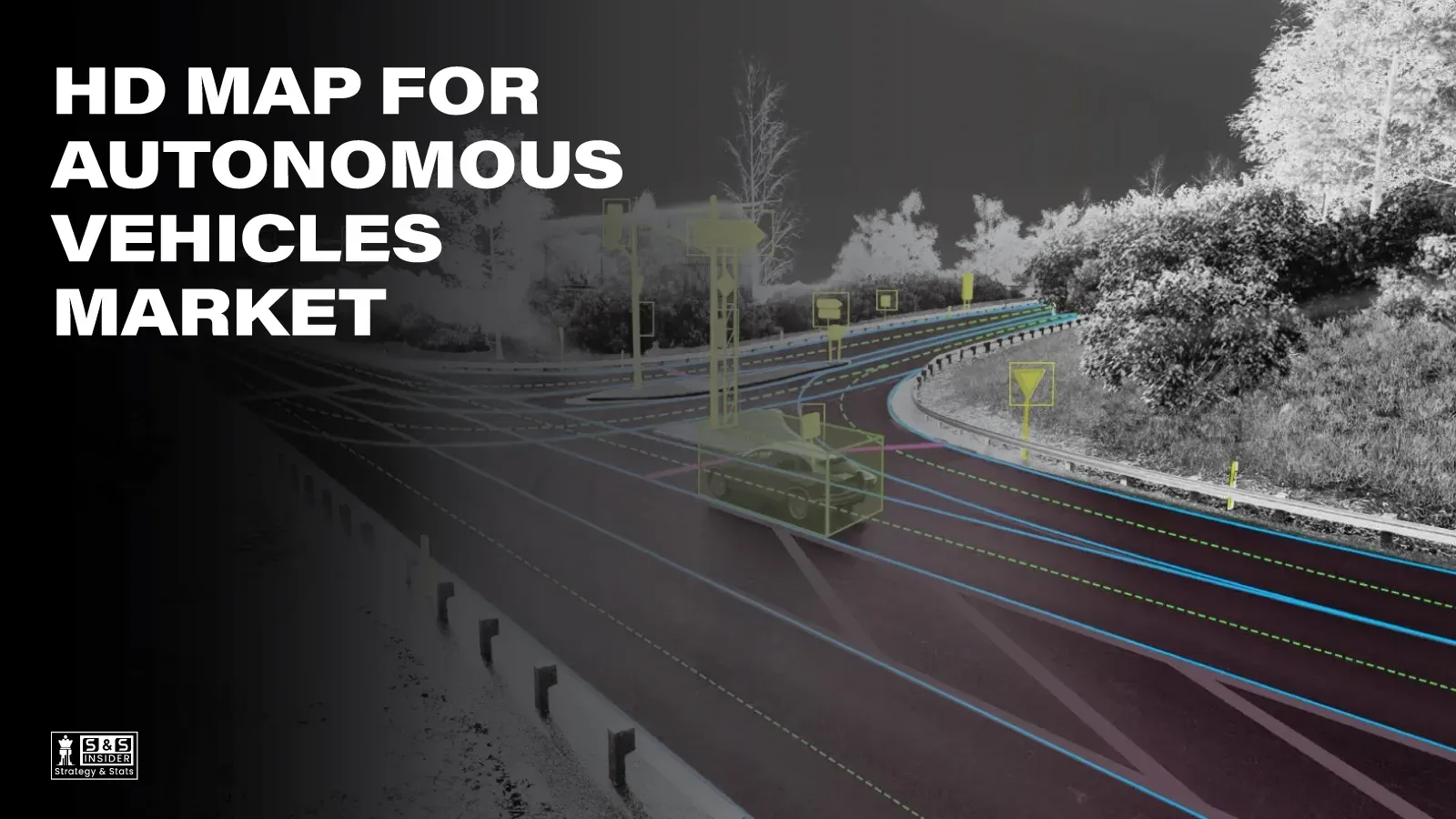
The fast development of autonomous and connected mobility has led to a significant change in the importance of digital maps in today’s transport sector. Solutions of HD Map for Autonomous Vehicles Market offer accurate data about road geometry, lane markings, traffic infrastructure, road borders, and other elements of environment that allow autonomous vehicles to operate in challenging driving conditions. In contrast to regular navigation maps, HD mapping solutions are suitable for lane-level positioning and localization. Thus, they become indispensable for ADAS and autonomous driving.
According to SNS Insider, the HD Map for Autonomous Vehicles Market is estimated to be worth USD 2.59 billion in 2024 and further forecasted to reach USD 22.97 billion by 2032, growing at a CAGR of 31.48% during 2025-2032. Some of the factors contributing towards market growth include an increase in autonomous vehicles usage, increased demand for accurate navigation, incorporation of artificial intelligence and LiDAR sensors, V2X technology, development of smart cities, and sustained investments in intelligent transportation systems. The market value in the U.S. was USD 0.73 billion in 2024 and is anticipated to touch USD 6.38 billion by 2032.
Gain Actionable Intelligence on this Market - Request a Sample Report
Leading HD Map Companies and Their Market Influence
1. TomTom
 TomTom is a well-known developer of digital maps and navigation solutions used in autonomous driving and other advanced vehicular solutions. The firm’s high definition maps integrate the information about the vehicle’s location and navigation information into one product in order to increase positioning accuracy and road safety. Nowadays, the company employs cloud solutions, artificial intelligence, and sensor information in order to update and keep map databases up to date. In 2024, TomTom partnered with Mitsubishi Electric in developing a solution that would integrate ADAS HD Maps of TomTom and High-Definition Locator of Mitsubishi Electric.
2. Waymo
 Waymo has secured a foothold in the domain of autonomous mobility by creating high-end mapping, perception and self-driving capabilities. The self-driving cars of Waymo require precise data about the surroundings to have an understanding of the road structures, intersections, and other infrastructure around. Waymo keeps developing and updating their mapping capabilities for safe navigation. It is reported that Waymo started mapping the streets of Tokyo in 2025 using manually driven vehicles to provide high-quality 3D representation for its self-driving capability.
3. HERE Technologies
 HERE Technologies offers location intelligence and HD maps for the benefit of automotive manufacturers and mobility providers. The mapping technologies offered by HERE Technologies are based on the integration of artificial intelligence, sensors, location, and cloud services to offer lane-level position and enhanced navigation. The close relationship of the company with automotive manufacturers helped it expand into connected and autonomous driving. In 2025, HERE Technologies strengthened its alliance with BMW by integrating standard and HD map data in vehicles to offer lane-level position and autonomous driving.
4. NVIDIA
 The importance of NVIDIA in autonomous vehicle design is defined by the combination of such technologies as artificial intelligence, accelerated computing, simulation, and automotive software. Thanks to this platform, automobile manufacturers and technology companies are able to process a vast amount of data from sensors and mapping that is needed for autonomous driving. The ecosystem of NVIDIA facilitates perception, localization, simulation, and real-time decision making for scaling up autonomous driving.
5. Baidu
 Baidu is a big company in the tech industry, which helps create autonomous driving and smart mapping solutions, especially in the Asia Pacific region. Using their technologies for autonomous mobility and digital mapping, they are able to provide precision in location, route planning, and navigation of vehicles. With a concentration on artificial intelligence, cloud computing and connected vehicles, Baidu can help in developing location-based autonomous solutions. Expansion of smart city projects and autonomous driving solutions in China is another area where Baidu can benefit from.
6. Mapbox
 Mapbox offers digital map technology to enable navigation and mobility solutions, as well as connected car technologies. The company’s cloud-based mapping platform allows organizations to include location-based data, visualization, navigation, and real-time geography into their mobility solutions. Since there is a need for dynamic location information in autonomous and semi-autonomous vehicles, scalable cloud-based platforms like Mapbox will offer frequent updates on location data.
Next Phase of Development in the HD Mapping Industry
The future of HD mapping technology for self-driving cars is expected to rely on real-time updating, artificial intelligence, sensor fusion, cloud-based services, and vehicle to everything technology. Updating the map regularly would be critical because of changes that might occur such as construction works, weather changes, traffic regulations, road rules, etc. It should be noted that the cost of HD map generation and updating could reach $1,000 per kilometer but further developments might decrease this cost.
The North American region holds the leading position in the global market, holding around 39% of the market share in 2024. However, the fastest growth will be seen in the Asia Pacific region, which is forecast to grow at a CAGR of 33.81% through 2032. Additionally, commercial mobility, commercial vehicles and map updates and maintenance will also see swift growth.
In the upcoming years, cooperation between auto manufacturers, tech firms, map-makers, government and smart infrastructure creators is going to be key. As autonomous driving advances toward wider adoption, HD maps are expected to play an ever-increasingly crucial role as the digital backbone of safer transportation and mobility systems around the world.



