
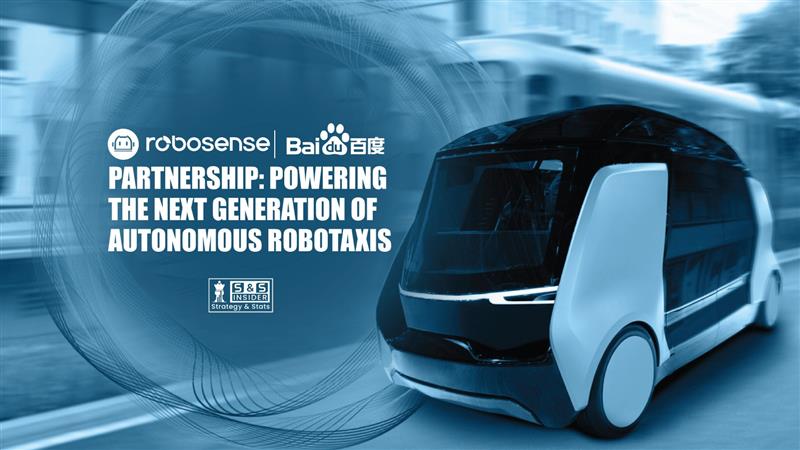
The global race toward fully autonomous mobility is accelerating, with technology companies and automakers investing heavily in advanced sensing, artificial intelligence, and robotics technologies. A significant step forward in this evolution comes from the collaboration between RoboSense, a leading LiDAR technology provider, and Baidu’s Apollo Go, one of the world’s largest autonomous ride-hailing platforms.
RoboSense recently secured an exclusive design win to supply LiDAR systems for Baidu’s next-generation Apollo Go Robotaxi fleet, reinforcing the growing role of advanced sensing technology in enabling safe and scalable driverless transportation. The LiDAR solution integrates RoboSense’s EM4 digital LiDAR and E1 solid-state LiDAR to provide full 360-degree perception coverage for Level 4 autonomous driving systems.
The Rise of Robotaxi Services:
Autonomous ride-hailing services, commonly known as robotaxis, are rapidly transforming urban transportation. These vehicles rely on sophisticated combinations of sensors, artificial intelligence, and high-performance computing systems to navigate roads without human intervention.
Among global players in the robotaxi ecosystem, Baidu’s Apollo Go platform has emerged as a major pioneer. The service has expanded across several cities and has already completed millions of autonomous rides, demonstrating the real-world potential of driverless mobility services.
According to SNS Insider's report on Robotaxi Market, the market is witnessing rapid expansion as cities adopt autonomous ride-hailing platforms to improve transportation efficiency and reduce congestion. Growing investments in autonomous mobility infrastructure, along with advancements in AI-powered navigation systems, are accelerating the commercialization of robotaxi services globally.
RoboSense’s Role in Autonomous Perception:
LiDAR (Light Detection and Ranging) technology plays a critical role in enabling autonomous driving systems. By emitting laser pulses and measuring their reflections, LiDAR sensors generate detailed three-dimensional maps of a vehicle’s surroundings, allowing autonomous vehicles to accurately detect objects, pedestrians, and road conditions.
RoboSense’s integrated LiDAR architecture combines two advanced technologies:
-
EM4 Digital LiDAR, which serves as the primary perception sensor
-
E1 Solid-State LiDAR, which monitors blind spots and enhances environmental coverage
Together, these sensors create a dual-LiDAR architecture capable of delivering complete environmental awareness, a key requirement for safe Level 4 autonomous driving.
According to SNS Insider's LiDAR Market report, the global LiDAR market is experiencing strong growth due to increasing adoption across autonomous vehicles, robotics, smart infrastructure, and mapping technologies. Advancements in sensor accuracy, cost efficiency, and compact design are making LiDAR systems more accessible for large-scale deployment in autonomous mobility solutions.
Supporting Large-Scale Robotaxi Deployment:
One of the most significant challenges facing autonomous mobility companies is scaling their technologies from pilot testing programs to large-scale commercial fleets.
Baidu’s Apollo Go platform has been aggressively expanding its robotaxi services across multiple cities. The company is working to integrate autonomous driving technologies directly into production vehicles, allowing robotaxis to operate safely and efficiently in complex urban environments.
By integrating RoboSense’s advanced LiDAR systems directly into the next-generation Apollo Go vehicles, the partnership aims to support factory-built robotaxi fleets capable of large-scale deployment.
Sensor Fusion and Autonomous Safety:
Autonomous vehicles rely on sensor fusion, a process in which data from multiple sensors, including LiDAR, radar, cameras, and ultrasonic sensors, is combined to create a comprehensive understanding of the surrounding environment.
LiDAR plays a particularly important role in this system because it provides extremely accurate spatial data regardless of lighting conditions. This capability enables autonomous vehicles to detect obstacles and navigate safely even in challenging environments such as nighttime or heavy traffic.
The dual-sensor LiDAR architecture developed by RoboSense helps eliminate blind spots and ensures reliable detection of objects around the vehicle, which is essential for robotaxi services operating in densely populated urban areas.
The Expanding Autonomous Vehicle Ecosystem
Beyond robotaxis, autonomous technologies are transforming the broader mobility landscape. Autonomous systems are being integrated into passenger vehicles, logistics fleets, delivery robots, and smart city infrastructure.
According to SNS Insider's Autonomous Vehicles Market report, the market is expanding rapidly as advances in artificial intelligence, sensor technologies, and high-performance computing continue to enhance vehicle automation capabilities. Increasing investments by automotive manufacturers and technology companies are accelerating the development and commercialization of autonomous transportation solutions worldwide.
The Future of Autonomous Transportation:
The collaboration between RoboSense and Baidu highlights the growing importance of partnerships within the autonomous driving ecosystem. Sensor manufacturers, artificial intelligence developers, and mobility platforms must work together to create reliable and scalable autonomous systems.
Robotaxi services have the potential to transform urban transportation by offering:
-
Reduced traffic congestion
-
Lower transportation costs
-
Improved road safety
-
Greater accessibility for passengers
However, achieving widespread adoption will require continued technological innovation, supportive regulatory frameworks, and extensive real-world testing.
Conclusion:
RoboSense’s exclusive design win with Baidu’s Apollo Go marks an important milestone in the advancement of autonomous mobility. By supplying high-precision LiDAR perception systems for the next generation of robotaxis, RoboSense is helping accelerate the transition toward fully driverless transportation.
As the robotaxi industry continues to evolve, technologies such as LiDAR, artificial intelligence, and advanced sensor fusion will play a critical role in shaping the future of mobility. Partnerships like the one between RoboSense and Baidu demonstrate how collaborative innovation is bringing the vision of safe and scalable autonomous transportation closer to reality.


