
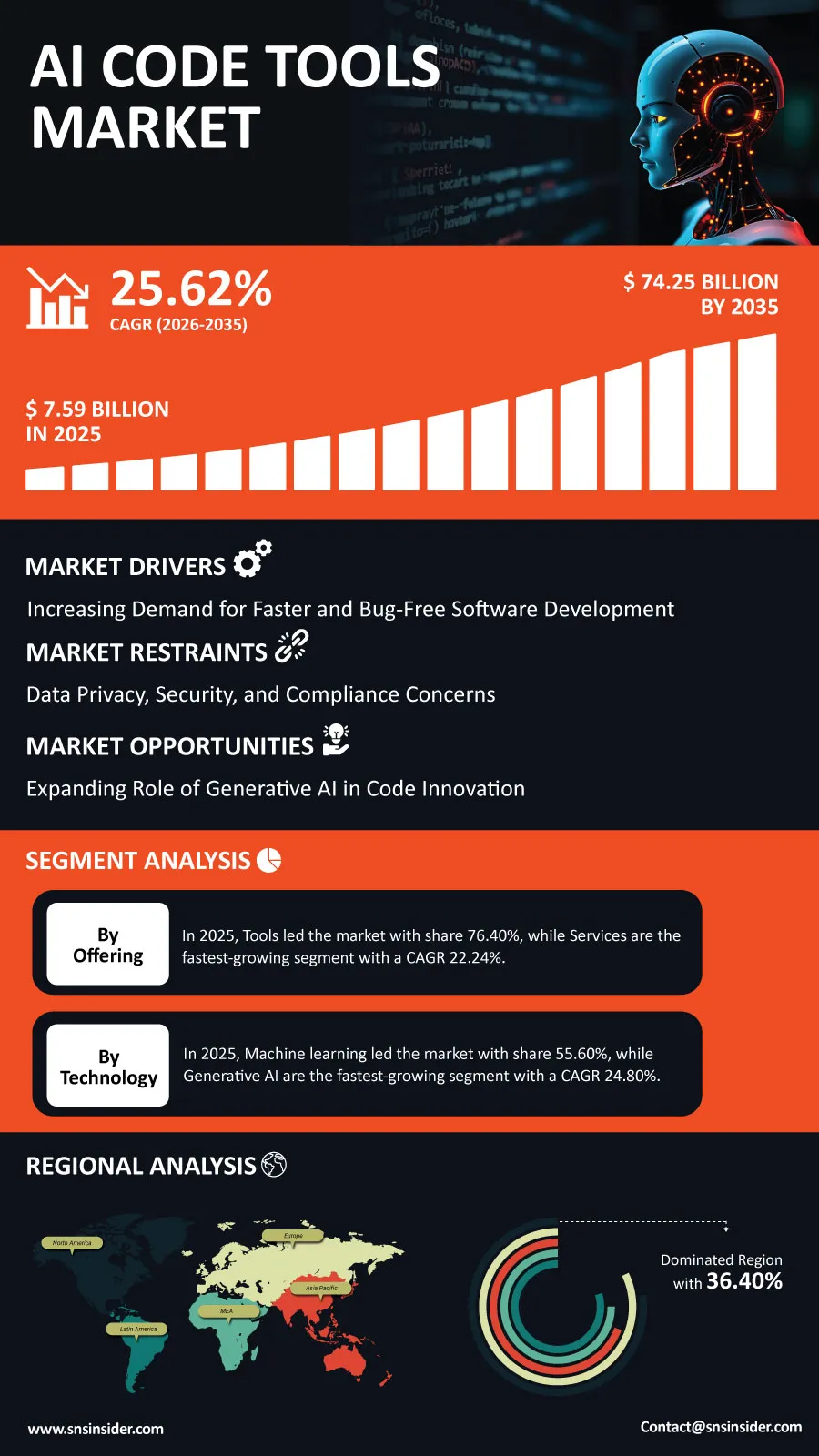
The global AI Code Tools Market is entering a new phase of growth as organizations increasingly integrate artificial intelligence into software engineering to improve speed, efficiency, and code quality. “According to a recent study by SNS Insider, the global AI Code Tools Market size valued at USD 7.59 billion in 2025, is anticipated to grow to USD 74.25 billion by 2035, registering a CAGR of 25.62% over the 2026–2035 forecast period.”
The development of software has become a vital function within the business environment, thus forcing companies to incorporate smart code creation tools that ease the development process and decrease timeframes. Code creation software is assisting developers to automate their coding process, spot issues within the development process, and enhance cooperation in engineering environments.
Continuous investments in digital transformation, cloud-native software development, and enterprise automation have led to the growing need for artificial intelligence-assisted software engineering. Additionally, businesses have been incorporating advanced language models in their engineering processes to ease building, testing, and deploying software applications.
To Get Detailed Insights on the AI Code Tools Market – Request a Sample Report
Enterprise AI Adoption Creates Significant Market Opportunities
Organizations from different sectors are making additional investments in developer tools supported by artificial intelligence as they become more competitive on software innovation. Firms are focusing on finding tools that will boost productivity among developers while ensuring the integrity of the application development process.
Another factor that is opening up additional prospects for AI code tools is the rapid growth of low-code and no-code development frameworks. These frameworks are enabling collaboration between professional developers and business users while fast-tracking application deployment without hiring more engineers.
Advancements in generative AI continue to reshape software creation by enabling natural language-driven development experiences. As AI models become more capable of producing production-ready code, organizations are expected to increase adoption across product engineering, DevOps, cybersecurity, and enterprise application modernization initiatives.
Key Market Insights Highlight Changing Technology Adoption
Based on offering, tools are estimated to account for 76.40% of global market revenue in 2025 as enterprises increasingly deploy AI-powered coding assistants across software development environments. Services are expected to register the fastest growth through 2035 as organizations seek consulting, implementation, customization, and workforce training.
By deployment model, cloud platforms are projected to hold 81.20% of market revenue in 2025 due to scalability, simplified deployment, and seamless integration with modern development ecosystems. On-premises deployment is anticipated to expand at the fastest pace over the forecast period as organizations with strict security and compliance requirements strengthen internal AI infrastructure.
In terms of technology, machine learning is expected to capture 55.60% of market revenue in 2025 owing to its widespread use in intelligent code recommendations and automated software optimization. Generative AI is forecast to deliver the fastest growth through 2035 as enterprises increasingly utilize natural language-based application development capabilities.
Generative AI Accelerates the Evolution of Software Engineering
The software development world is changing quickly because of how deeply the use of AI will be incorporated into the engineering process. Platforms for software development have already started using artificial intelligence in areas such as code generation, testing, documentation, vulnerability checking, and deployment, thus allowing companies to create better software faster.
Companies have also started creating intelligent development environments for increasing cooperation between programmers, cybersecurity specialists, and operations managers. Those environments help with CI/CD and reduce manual efforts in various software projects.
With the growing number of digital products offered by organizations, artificial intelligence-based coding tools will become key technologies used for application modernization and migration to the cloud.
North America Held 36.40% of the AI Code Tools Market Share in 2025; Asia Pacific Projected to Register the Fastest CAGR Through 2035
The North American region held 36.40% share in terms of total market revenue in 2025 owing to high enterprise AI adoption rate, well-established cloud infrastructure, significant research activities, and robust software ecosystem. The U.S. continues to be the driving force behind regional demand owing to the use of AI-based development platforms in enterprise technology.
The Asia Pacific region will hold the highest CAGR through 2035 due to growth in digital economies, increased cloud adoption, presence of talented software engineers, and increasing investments in AI technologies. Nations such as China and India are increasingly adopting AI in enterprise software development, providing huge opportunities for solution providers.
The Europe region continues to be an important contributor to market growth as enterprises continue making investments in responsible AI deployment, secure software engineering, and digital transformation.
Industry Participants Expand AI Development Capabilities Through Innovation
Competition across the AI Code Tools Market continues to intensify as technology providers invest in advanced large language models, intelligent software engineering platforms, and enterprise-grade AI development solutions. Vendors are strengthening product portfolios with features that improve developer productivity, automate software maintenance, and enhance secure application development across enterprise environments.
Key companies operating in the global AI Code Tools Market include Microsoft, OpenAI, Amazon Web Services (AWS), Google, IBM, Meta, xAI, JetBrains, Replit, Tabnine, Sourcegraph, Salesforce, Datadog, Lightning AI, Moolya, Qodo, Anthropic, Hugging Face, Diffblue, and CodiumAI.
An SNS Insider analyst Sakshi Kale commented, "Artificial intelligence is transforming software development from a manual programming process into an intelligent engineering workflow. Organizations investing in AI-powered coding platforms, developer productivity solutions, and enterprise automation technologies are expected to gain significant competitive advantages as demand for faster software delivery continues to accelerate."
About the Author

Get in touch




