
GENERATIVE AI MARKET REPORT SCOPE & OVERVIEW:
Get more information on Generative AI Market - Request Free Sample Report
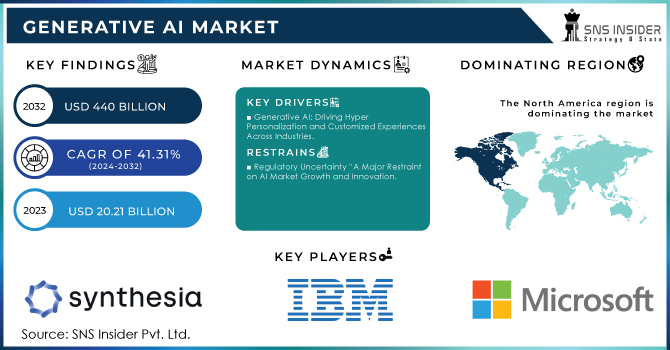
The Generative AI Market Size was valued at USD 20.21 Billion in 2023 and is expected to reach USD 440 Billion by 2032 and grow at a CAGR of 41.31% over the forecast period 2024-2032.
Generative AI, a subfield of artificial intelligence, is rapidly reshaping various industries by enabling machines to create new content, such as text, images, and code. Fueled by advancements in technologies like super-resolution, text-to-image conversion, and text-to-video conversion, generative AI is finding widespread applications across sectors.
One notable example is the integration of generative AI into the gaming industry. This technology is revolutionizing game development by enhancing player experiences, automating content creation, and even generating entirely new game worlds. The pandemic further accelerated the adoption of AI technologies, with many organizations turning to AI-powered tools for tasks like remote work, virtual collaboration, and medical diagnostics. The healthcare AI market, in particular, is projected to exceed USD 370.14 billion by 2032, driven by innovations like generative AI in medical imaging and diagnostics.
Generative AI's versatility extends beyond gaming and healthcare. In fields such as finance, marketing, and customer service, it's being used for tasks like fraud detection, personalized marketing campaigns, and automated customer support. For example, AI-driven chatbots in customer service are estimated to save businesses over $11 billion annually by 2025. Moreover, generative AI has the potential to revolutionize content creation, making it easier and more efficient for businesses to produce high-quality content. With the global digital content creation market projected to surpass $38 billion by 2030, AI is poised to play a crucial role in this expansion.
However, the widespread adoption of generative AI is not without its challenges. One significant hurdle is the lack of skilled AI professionals. A recent report revealed that 87% of companies worldwide are facing a talent shortage in AI roles. As the demand for AI expertise grows, there is a pressing need to invest in AI education and training programs. Additionally, the high implementation costs associated with generative AI can be a barrier for smaller businesses. The average cost of deploying AI solutions can range from $20,000 to $1 million, depending on the complexity and scale of the project.
Despite these challenges, generative AI presents a tremendous opportunity for businesses and industries. Its ability to automate tasks, improve efficiency, and create new products and services has the potential to drive significant economic growth. McKinsey estimates that AI could add up to $13 trillion to the global economy by 2030, with generative AI playing a crucial role in this growth. As generative AI continues to evolve, we can expect to see even more innovative applications and transformative impacts across various sectors, from entertainment and healthcare to finance and marketing.
GENERATIVE AI MARKET DYNAMICS
KEY DRIVERS:
-
Generative AI: Driving Hyper-Personalization and Customized Experiences Across Industries
Generative AI is revolutionizing content creation by enabling highly personalized and customized experiences tailored to individual preferences. This technology leverages advanced algorithms to analyze vast amounts of data, allowing businesses to generate content that resonates with specific audiences on a deeper level. One prominent application is personalized recommendations, where generative AI suggests products, services, or content based on a user's unique behaviors and preferences. For example, it’s estimated that personalized product recommendations powered by AI can increase sales by 10-30%, as seen on platforms like Netflix and Spotify, which use AI to curate personalized playlists and viewing recommendations.
Design customization is another area where generative AI is making a significant impact. By analyzing user preferences, AI can create unique designs for products such as clothing, digital artwork, or even website layouts, ensuring that customers receive personalized experiences. In fact, companies using AI-driven design are reported to achieve up to a 20% increase in customer engagement. Virtual avatars are also being transformed by generative AI, allowing users to create digital representations of themselves for use in gaming, social media, or virtual meetings. The market for virtual avatars is expected to reach $528 million by 2027, driven by AI-enabled customization. As a result, generative AI is becoming a key driver in delivering hyper-personalized experiences across various industries, improving customer satisfaction, and fostering brand loyalty.
RESTRAIN:
-
Regulatory Uncertainty “A Major Restraint on AI Market Growth and Innovation”
A lack of clear and consistent regulations poses a significant challenge for businesses operating in the AI space, creating uncertainty that can hinder growth and innovation. The absence of standardized guidelines makes it difficult for companies to navigate legal and ethical considerations, especially in industries where AI's role is rapidly expanding, such as healthcare, finance, and autonomous vehicles. According to a report, 62% of business leaders consider regulatory uncertainty to be a major barrier to the adoption of AI technologies. This regulatory ambiguity can slow down AI deployment as companies become cautious about potential legal risks and compliance issues. The complexity is further amplified by varying regulations across regions, making it difficult for global companies to implement AI solutions consistently.
For instance, the European Union's proposed AI Act aims to regulate AI by categorizing systems based on risk levels, but it has raised concerns about stifling innovation and adding to compliance costs. Report predicts that by 2025, 30% of large organizations will encounter AI regulatory compliance issues, leading to delays in product launches and market expansion.
Without a unified regulatory framework, businesses in the AI sector face challenges in scaling their operations, limiting their ability to fully capitalize on AI's potential in the global market.
GENERATIVE AI MARKET SEGMENTS
BY PRODUCT TYPE
In 2023, the software component segment dominated the generative AI market with a 62% revenue share, driven by increasing concerns over data privacy, fraud, and AI capabilities. Companies like H&M and Adidas are utilizing generative AI for innovative clothing designs and custom footwear, streamlining design processes. The generative AI software market is projected to grow at a CAGR of 41.31% through 2032.
Meanwhile, the service segment is expected to witness the fastest growth, fueled by rising demand for cloud-based AI solutions for fraud detection, data protection, and risk modeling. AWS’s launch of Amazon Bedrock in April 2023 exemplifies the trend, positioning generative AI services for a robust CAGR of 41.31% by 2032.
BY END USER
In 2023, the media & entertainment segment led the generative AI market with a 23% revenue share, driven by AI-powered advertising and personalized content, such as BuzzFeed’s partnership with OpenAI. The segment is projected to grow significantly through 2032. Generative AI is also enhancing logistics by optimizing routes, reducing costs, and improving supply chain efficiency.
Meanwhile, the BFSI segment is expected to witness the fastest CAGR from 2024 to 2032, as AI and machine learning are increasingly used to prevent fraud, secure data, and streamline banking operations, including generating marketing content and improving ML applications.
REGIONAL ANALYSIS
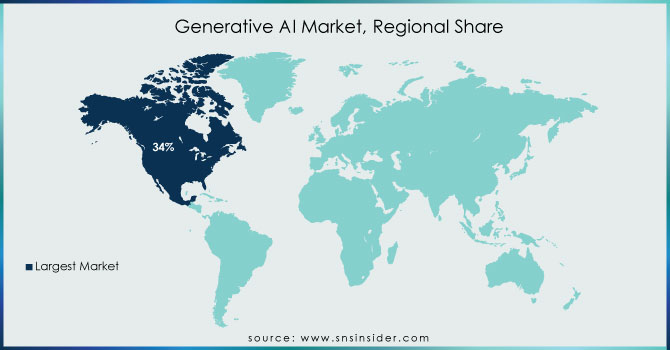
North America currently dominates the market with 34% market share, other regions, particularly Europe and Asia Pacific, are witnessing significant advancements and are poised for substantial growth.
In North America, factors such as increasing demand for AI-generated content in sectors like healthcare and media, coupled with the presence of leading technology companies and a skilled workforce, are driving the market. The region's strong focus on research and development has fostered innovation in generative AI applications.
Europe, too, is making significant growth. Government initiatives, funding programs, and a thriving startup ecosystem are nurturing the growth of generative AI. European companies are developing innovative solutions that address specific regional needs and challenges.
Asia Pacific, with its large population, rapidly growing economies, and increasing digitalization, is emerging as a major player in the generative AI landscape. The region's abundance of data and a focus on cutting-edge technologies like GANs and deep learning are fueling its growth.
The Middle East and Africa, along with South America, are experiencing steady growth, driven by digital transformation initiatives and the adoption of AI in sectors like healthcare, finance, and manufacturing. Smart city projects in these regions are also contributing to the demand for generative AI solutions.
Get Customized Report as per your Business Requirement - Request For Customized Report
Key players
Some of the major players in the Generative AI Market are Synthesia, IBM, Microsoft, Rephrase.ai, Genei AI Ltd, Google LLC, Adobe, Runway, Capgemini, Accenture, Mistral AI, Open AI and other players.
RECENT TRENDS
-
CBTS, in September 2024, unveiled a new service offering that leverages advanced generative AI to revolutionize workplace operations and expedite the implementation of Copilot for Microsoft 365.
-
Tech giants, Amazon Web Services (AWS) and SAP, joined forces in May 2024 to revolutionize cloud-based enterprise resource planning (ERP) with generative AI. This strategic collaboration aims to empower businesses with enhanced capabilities and efficiency through cutting-edge AI technology.
-
GSMA and IBM collaborated in February 2024 to promote generative AI adoption in the telecom industry. They launched the GSMA Advance's AI Training program and the GSMA Foundry Generative AI program to enhance skills and adoption.
-
OpenAI debuted Sora, a cutting-edge text-to-video AI model, in February 2024. Sora can create high-quality, one-minute videos based on user prompts. However, it's currently not publicly accessible and is limited to a select group of experts.
| Report Attributes | Details |
|---|---|
| Market Size in 2023 | US$ 20.21 Billion |
| Market Size by 2032 | US$ 440 Billion |
| CAGR | CAGR of 41.31% From 2024 to 2032 |
| Base Year | 2023 |
| Forecast Period | 2024-2032 |
| Historical Data | 2020-2022 |
| Report Scope & Coverage | Market Size, Segments Analysis, Competitive Landscape, Regional Analysis, DROC & SWOT Analysis, Forecast Outlook |
| Key Segments | • BY PRODUCT TYPE (Software, Service) • BY TECHNOLOGY (Variational Auto-encoders, Diffusion Networks, GANs, Transformers) • BY APPLICATION (Computer Vision, Predictive Analysis, Content Generation, NLP, Robotics & Automation, Chatbots & Intelligent Virtual Assistants, Others) • BY MODEL (Image & Video Generative Models, Chatbots & Intelligent Virtual Assistants, Large Language Models, Others) • BY END USER (Media & Entertainment, BFSI, Automotive & Transportation, Gaming, IT & Telecommunication, Others) |
| Regional Analysis/Coverage | North America (US, Canada, Mexico), Europe (Eastern Europe [Poland, Romania, Hungary, Turkey, Rest of Eastern Europe] Western Europe] Germany, France, UK, Italy, Spain, Netherlands, Switzerland, Austria, Rest of Western Europe]), Asia Pacific (China, India, Japan, South Korea, Vietnam, Singapore, Australia, Rest of Asia Pacific), Middle East & Africa (Middle East [UAE, Egypt, Saudi Arabia, Qatar, Rest of Middle East], Africa [Nigeria, South Africa, Rest of Africa], Latin America (Brazil, Argentina, Colombia, Rest of Latin America) |
| Company Profiles | Synthesia, IBM, Microsoft, Rephrase.ai, Genei AI Ltd, Google LLC, Adobe, Runway, Capgemini, Accenture, Mistral AI, Open AI |
| Key Drivers | • Generative AI: Driving Hyper-Personalization and Customized Experiences Across Industries |
| RESTRAINTS | • Regulatory Uncertainty “A Major Restraint on AI Market Growth and Innovation” |
Frequently Asked Questions
Ans: North America currently dominates the market with 34% market share.
Ans: A lack of clear and consistent regulations poses a significant challenge for businesses operating in the AI space, creating uncertainty that can hinder growth and innovation.
Ans: Virtual avatars are also being transformed by generative AI, allowing users to create digital representations of themselves for use in gaming, social media, or virtual meetings.
Ans: Generative AI Market size was USD 20.21 billion in 2023 and is expected to Reach USD 440 billion by 2032.
Ans: The Generative AIe Market is expected to grow at a CAGR of 41.31%.
