
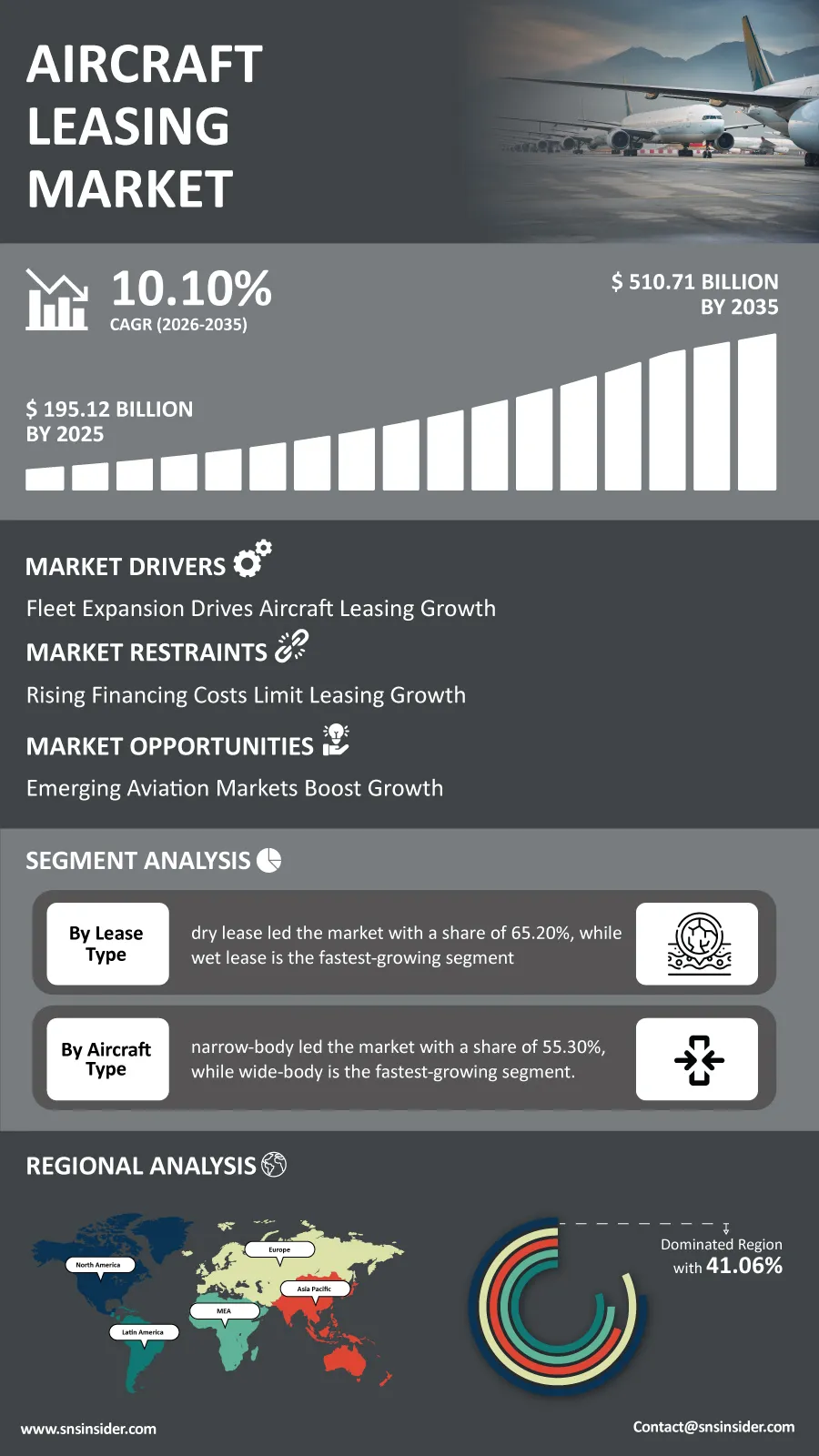
The Global Aircraft Leasing Market is projected to see strong growth in the years to come because of the increasing preference of airlines for flexible aircraft acquisition methods due to increasing demand of passengers. “According to a recent study by SNS Insider, the global Aircraft Leasing Market size valued at USD 195.12 Billion in 2025, is anticipated to grow to USD 510.71 Billion by 2035, registering a CAGR of 10.10% over the 2025–2035 forecast period.”
Aviation industry is at the cusp of entering into the next era of fleet modernization, where there is need to strike a perfect balance between increasing demand for travel and efficient utilization of financial resources. It has been recognized as an optimal form of financing that allows airlines to bring in newer planes fast enough and operate efficiently without requiring too much up-front money.
With increasing air connectivity all over the world, aircraft lessors have assumed greater significance in helping fleets achieve modernization. Increasing demand for fuel-efficient planes and changing sustainability targets of airlines and competitors has made aircraft leasing a popular choice among carriers.
To Get Detailed Insights on the Aircraft Leasing Market – Request a Sample Report
Fleet Modernization and Airline Expansion Create New Growth Opportunities
Commercial aviation is undergoing heavy investments in aircraft of a newer generation that can boost fuel efficiency and cut down on operating costs. Airlines are speeding up the process of fleet replacement and fleet enlargement for the opening of additional domestic and international routes, thus offering a positive environment for aircraft leasing firms.
Additional growth in the aviation industry witnessed in the emerging countries will help drive the demand for leasing services since regional airlines will try to expand their operations with less financial risk involved. In addition, higher cargo transportation needs and development of e-commerce logistic activities will help boost the demand for leased aircraft by freight carriers.
Additionally, financial institutions and leasing companies have also started employing novel financial structuring methods that help the airlines effectively cope with their liquidity issues and seasonal nature during uncertain times within the market.
Key Market Insights Highlight Shifting Industry Demand
With regard to lease type, the dry lease held 65.20% share of revenue generated in the market globally in 2025 due to the preference for more operational control without taking on the burden of ownership by airlines.
Conversely, the wet lease will register the highest growth in the next ten years as more and more airlines need the option of flexibility in terms of capacity for launching routes, seasonal traffic, and fleet shortages.
In terms of aircraft type, the narrow body accounted for 55.30% of revenue generated in the market in 2025 because of efficiency in domestic and regional networks. On the other hand, the wide body aircraft will experience the highest growth as international passenger travel and long-haul cargo transport recover.
Regarding lease duration, long-term leasing contributed 60.40% revenue in 2025 because it helps in planning the fleet in an organized manner for stable airlines. However, short-term leasing will grow at the highest rate as airlines try to adapt to changes in the market.
Commercial airlines continued dominating in the lessee category accounting for 72.80% revenue in 2025. The cargo operator is expected to exhibit the highest growth rate in the forecast period.
Operational Flexibility and Sustainable Aviation Remain Strategic Priorities
The aviation industry is becoming ever more interested in preserving its operational flexibility through minimized capital-heavy investment. Through leasing, airlines can bring new technology-equipped planes into their fleets to enhance fuel efficiency, passenger comfort, and performance regarding environmental sustainability within a shorter period than with acquisitions.
Aviation fleet operators are concurrently increasing their portfolio using aircraft from new generation that is aligned with the new sustainable goals within the aviation sector. Investments in digital asset management, predictive maintenance, and portfolio diversification have also improved the competitive edge of global leasing companies.
As the aviation industry becomes more volatile, flexible leasing arrangements are likely to be a crucial element of fleet management for airlines, enabling them to cope with volatility while fostering business expansion.
North America Accounted for 41.06% Market Share in 2025; Asia Pacific Forecast to Expand at a 10.88% CAGR by 2035
North America is expected to represent 41.06% share in the global Aircraft Leasing Market in 2025 backed by its strong finance sector, existing leasing firms, and investments made in the replacement of their fleets. A well-established financial market and the presence of commercial aviation industry are contributing to the region's dominance.
The Asia-Pacific region is forecasted to be the leading growing region with a CAGR of 10.88% over the next decade. Factors such as fast-growing urban centers, rise in disposable income levels, development of budget carriers, and increased government funding for air transport facilities are contributing to leasing opportunities in countries such as India, China, and Southeast Asia.
Industry Participants Strengthen Global Leasing Portfolios
There is intense Competition within the Aircraft Leasing Industry as major lessors continue growing their aircraft fleets internationally, utilizing fuel-efficient aircraft, and building strong partnerships with airlines around the world. Diversifying portfolios, managing the digital fleet, and building long-term customer relationships have been the key focus areas.
Key companies operating in the global Aircraft Leasing Market include AerCap Holdings N.V., Avolon, SMBC Aviation Capital, Air Lease Corporation, BOC Aviation, BBAM Aircraft Leasing & Management, ICBC Leasing, DAE Capital, Nordic Aviation Capital (NAC), Boeing Capital Corporation, CDB Aviation, AviLease, Avia Solutions Group, Aircastle, AerCap GECAS, Macquarie AirFinance, Genesis Lease, Elix Aviation Capital, Amedeo, and ICBC Financial Leasing.
An SNS Insider analyst Santosh Bhul commented, "Growing airline fleet modernization programs, increasing passenger traffic, and the industry's preference for capital-efficient expansion strategies continue to strengthen demand for aircraft leasing worldwide. Companies offering flexible financing models, diversified aircraft portfolios, and next-generation fleet solutions will be well-positioned to benefit from the aviation sector's long-term growth trajectory."
About the Author

Get in touch




