
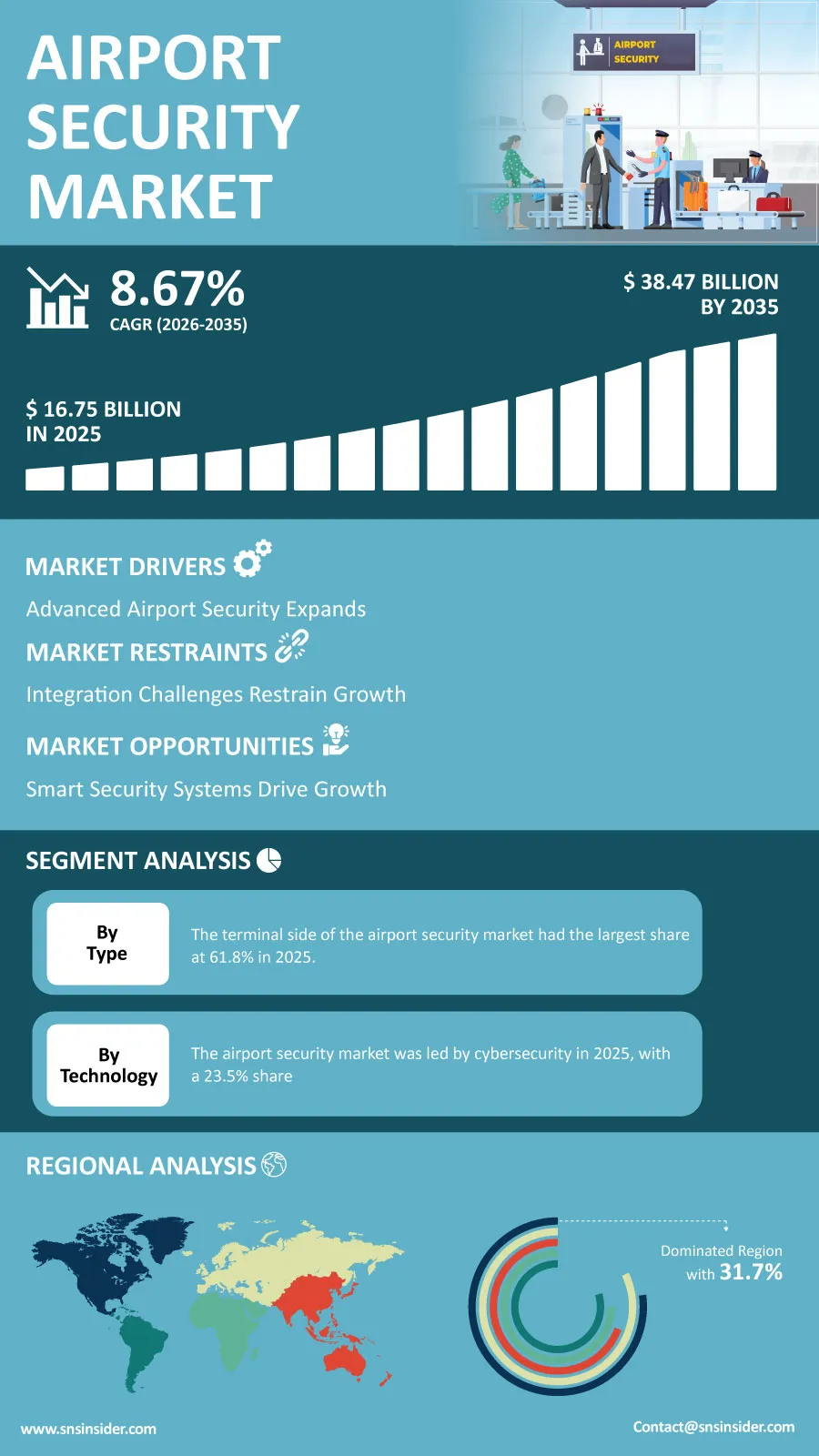
The global Airport Security Market is entering a period of sustained expansion as airports worldwide invest in intelligent screening, digital surveillance, biometric identification, and cybersecurity infrastructure to address evolving threats and rising passenger volumes. According to a recent study by SNS Insider, the global Airport Security Market size valued at USD 16.75 billion in 2025, is anticipated to grow to USD 38.47 billion by 2035, registering a CAGR of 8.67% over the 2026–2035 forecast period.
The increasing revival and growth of the international flights are exerting more demands on the airports to ensure that they enhance security without causing any delays to their customers. Moreover, the increasing threats of terrorism, hacking, access issues, and drones are prompting the airports to embrace layered security structures.
The current trend in the airports includes the adoption of security ecosystems that integrate surveillance systems, access control, screening, and cybersecurity. Cloud computing, artificial intelligence, and digital simulation technologies are being used by airports to enhance their situational awareness.
To Get Detailed Insights on the Airport Security Market – Request a Sample Report
Smart Airport Investments Create New Growth Opportunities
Modernization of airport infrastructure presents a great chance for the growth of the security technology sector. Operators require technology that can be easily scaled in order to fit terminals, airside assets, bag areas, and restricted access areas without affecting the compatibility with the current system.
There is also increased interest in biometric authentication, as airports seek ways to ensure better identification of passengers together with speedier handling of them during check-in process. Biometric scanning such as facial recognition and touchless authentication will help in cutting down manual identity verifications.
Additionally, the emergence of cloud-based control platforms provides a platform for central management of the airport security operations. The use of real-time analysis, artificial intelligence powered video surveillance, and predictive analysis allows identifying irregularities and coordinating actions.
Key Market Insights Highlight Shifting Demand Patterns
By type, terminal security dominated the market with a 61.8% revenue share in 2025. High passenger density and the extensive use of screening checkpoints, boarding gates, biometric systems, and surveillance technologies continue to drive investment in terminal environments. Airside security is projected to be the fastest-growing segment through 2035 as airports strengthen protection against drone incursions, unauthorized access, runway threats, and other emerging risks.
Based on technology, cybersecurity accounted for 23.5% of market revenue in 2025 as airports increasingly depend on interconnected digital platforms for passenger processing, baggage handling, flight operations, and infrastructure management. Perimeter security is anticipated to register the fastest growth during the forecast period, supported by increasing deployment of thermal imaging, motion sensors, ground surveillance radar, and automated intrusion detection systems.
By airport size, facilities handling more than 50 million passengers annually led the market with a 32.6% share in 2025. Their complex operating environments and substantial passenger throughput encourage investment in advanced screening, biometric authentication, and AI-enabled monitoring. Airports serving 15–30 million passengers are projected to experience rapid growth as regional connectivity expands and developing markets invest in modular security systems capable of scaling alongside passenger demand.
AI and Biometric Technologies Reshape Airport Security Operations
The security sector at airports is going through a technological revolution, where more powerful threat detection and enhanced customer convenience are being sought. The use of video analysis through artificial intelligence is helpful for detecting abnormal behavior in crowds and quickening incident assessment, while biometrics aid in faster identification of individuals.
In addition, the increasing application of digital twins and simulation technologies is also opening up opportunities for security planning. Airports can simulate the movement of passengers, emergency situations, and possible weaknesses before making any changes to their operations.
North America Commands 31.7% Market Share in 2025 While Asia Pacific Delivers a 9.49% CAGR Through 2035
North America is anticipated to continue to retain its dominant status, holding a 31.7% share of global market revenue by 2025. Well-established airport infrastructure, stringent security standards within the aviation sector, and early adaptation of biometric, cybersecurity, surveillance, and screening technology will help North America sustain its dominance.
The Asia Pacific region is likely to emerge as the fastest growing regional market, with a compound annual growth rate of 9.49% till 2035. The high rate of airport construction and increased traffic are among the factors driving rapid deployment of security technology solutions in the region.
As emerging aviation markets expand their airport networks, demand for flexible, cloud-connected, and automated security platforms is expected to increase significantly.
Industry Participants Focus on Integrated Security Innovation
Competition within the global Airport Security Market is centered on integrated platforms that combine screening, surveillance, biometrics, cybersecurity, and access management. Leading companies are investing in AI-enabled detection, digital identity technologies, cloud-based command systems, and solutions designed to improve both security performance and passenger throughput.
Key companies operating in the global Airport Security Market include Thales Group, Honeywell, Raytheon Technologies, Siemens, FLIR Systems, Safran, Bosch Security Systems, L3Harris, SITA, and Smiths Group.
An SNS Insider analyst Sushant Kadam commented, “The modernization of airport infrastructure and the emergence of increasingly sophisticated physical and digital threats are accelerating demand for integrated security technologies. Providers that can combine intelligent surveillance, biometric identity management, cybersecurity, and scalable cloud platforms will be well positioned to support airports as they pursue safer and more efficient passenger operations.”
About the Author

Get in touch




