
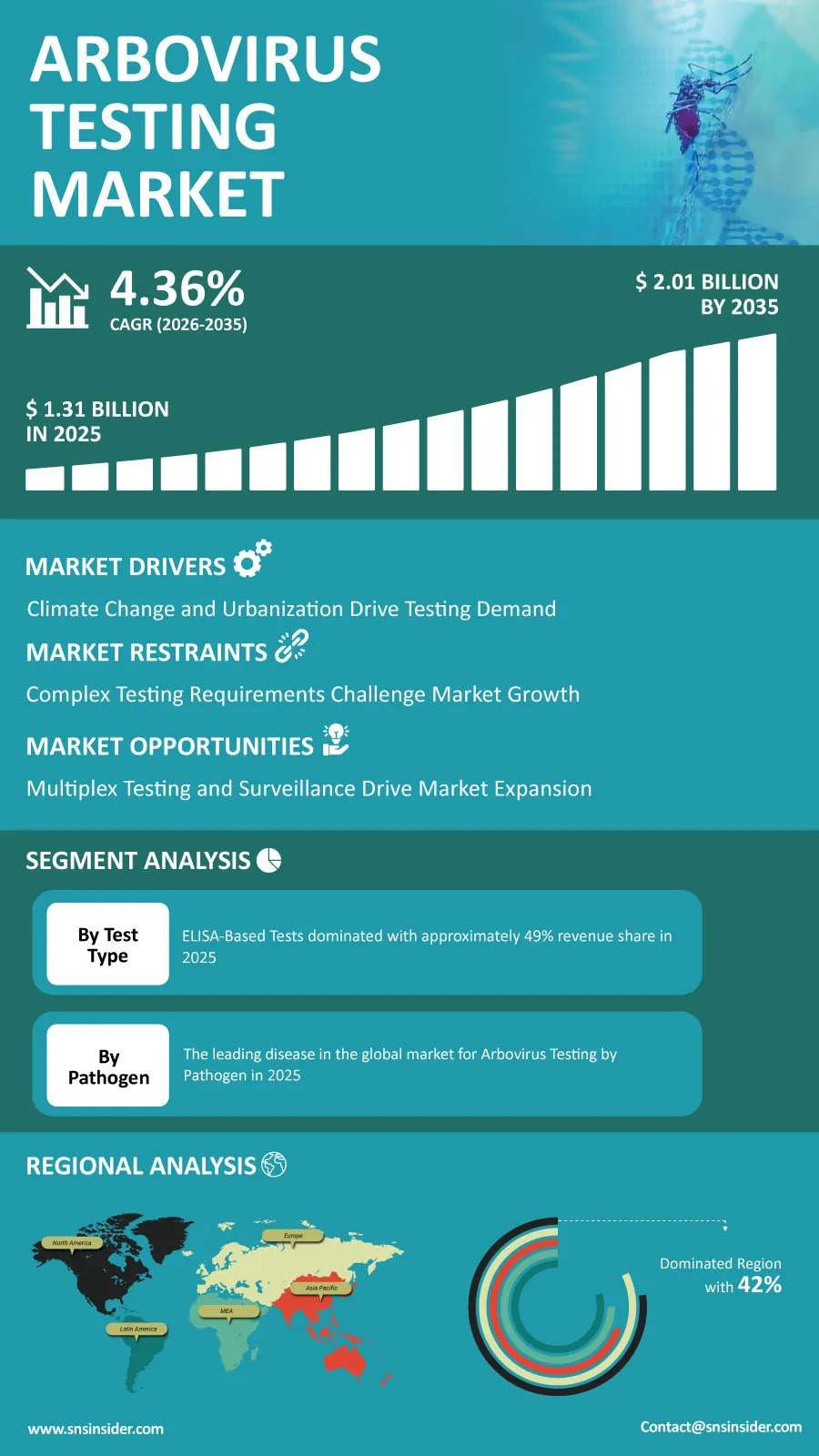
The global Arbovirus Testing Market is expected to experience sustained growth over the coming decade as healthcare systems strengthen diagnostic preparedness against emerging vector-borne diseases. “According to a recent study by SNS Insider, the global Arbovirus Testing Market size valued at USD 1.31 Billion in 2025, is anticipated to grow to USD 2.01 Billion by 2035, registering a CAGR of 4.36% over the 2026–2035 forecast period.”
There is growing worry about mosquito-borne diseases, increased surveillance in the field of public health, and increased research and investment in the area of diagnostics. Governments are also becoming increasingly concerned about outbreaks, which will result in better diagnostic systems being put in place to support quicker disease detection.
Healthcare organizations are also expanding diagnostic infrastructure to improve disease surveillance, strengthen emergency response capabilities, and support clinical decision-making during periods of increased viral transmission.
To Get Detailed Insights on the Arbovirus Testing Market – Request a Sample Report
Molecular Diagnostics Continue to Advance Disease Detection
Technological advances are revolutionizing the process of diagnosis and monitoring of arboviruses. The use of molecular testing tools, automation and workflow technologies is allowing healthcare specialists to diagnose multiple viruses much faster and more accurately than was possible using traditional testing methods.
Use of multiplex diagnostic systems is increasing the efficiency of laboratories by providing the opportunity to detect multiple types of mosquito-borne viruses simultaneously using one sample. In addition, the development of genomics and digital laboratory solutions is enhancing the capacity for epidemiological surveillance, outbreak response, and healthcare planning on a national level.
Growing collaboration between diagnostic manufacturers, research institutions, and public health agencies is expected to further accelerate innovation throughout the global arbovirus testing industry.
Key Market Findings Highlight Emerging Growth Opportunities
Among testing methods, ELISA-based tests accounted for approximately 49% of global market revenue in 2025, maintaining their position as a widely utilized diagnostic approach due to their established clinical performance and suitability for large-scale testing programs.
Meanwhile, RT-PCR-based tests are projected to register the fastest growth through 2035, supported by increasing demand for highly sensitive molecular diagnostics capable of identifying infections during the earliest stages of disease.
By pathogen, dengue testing represented the largest share of market revenue in 2025, reflecting the significant global burden associated with dengue infections and the continued expansion of surveillance programs worldwide. At the same time, Zika testing is expected to emerge as the fastest-growing pathogen segment during the forecast period, driven by ongoing maternal health screening initiatives and sustained investments in disease monitoring.
From an end-user perspective, diagnostic laboratories accounted for the largest market share in 2025, benefiting from high testing volumes and broad deployment of advanced molecular technologies. Meanwhile, hospital-based testing is expected to witness strong growth through 2035 as healthcare providers continue expanding rapid diagnostic capabilities for emergency medicine and infectious disease management.
Public Health Preparedness Drives Long-Term Market Expansion
Healthcare authorities globally, are becoming more effective in preparing for infectious diseases with the help of advanced surveillance networks, better laboratories, and enhanced diagnostic capabilities. Such activities have made countries more capable of detecting outbreaks, tracking diseases, and implementing public health measures.
International cooperation in the field of vector-borne disease surveillance along with the development of lab modernization programs will be beneficial for diagnostics firms that can offer innovations in testing.
Increasing emphasis on blood safety, maternal health screening, and travel-related infectious disease monitoring is also contributing to sustained demand for reliable arbovirus diagnostic solutions.
Regional Markets Continue to Expand
The North American market held around 42% of the worldwide market share in 2025 owing to its well-developed public health infrastructure, robust laboratory networks, and constant investments made in surveillance programs for infectious diseases. Diagnostics and technology innovations have further bolstered the market dominance of North America.
However, it is expected that Asia Pacific would be the region with the highest growth rate until 2035, owing to developments in health care infrastructure, laboratory expansion, increase in surveillance programs for mosquito-transmitted diseases, and adoption of molecular diagnostics in several countries.
Leading Companies Accelerate Diagnostic Innovation
Competition within the arbovirus testing market remains dynamic as leading diagnostics companies continue investing in molecular testing technologies, product development, laboratory automation, and global expansion strategies.
Key companies operating in the global arbovirus testing market include Roche Diagnostics, Abbott Laboratories, bioMérieux, Hologic, Thermo Fisher Scientific, Bio-Rad Laboratories, QIAGEN, SD Biosensor, Eurofins Scientific, and Siemens Healthineers.
An SNS Insider analyst Parry Kardani commented, "The growing convergence of molecular diagnostics, public health surveillance, and outbreak preparedness is reshaping the arbovirus testing landscape. Continued investment in rapid, accurate, and scalable diagnostic technologies will play a critical role in strengthening global infectious disease response capabilities over the coming decade."
About the Author

Get in touch




