
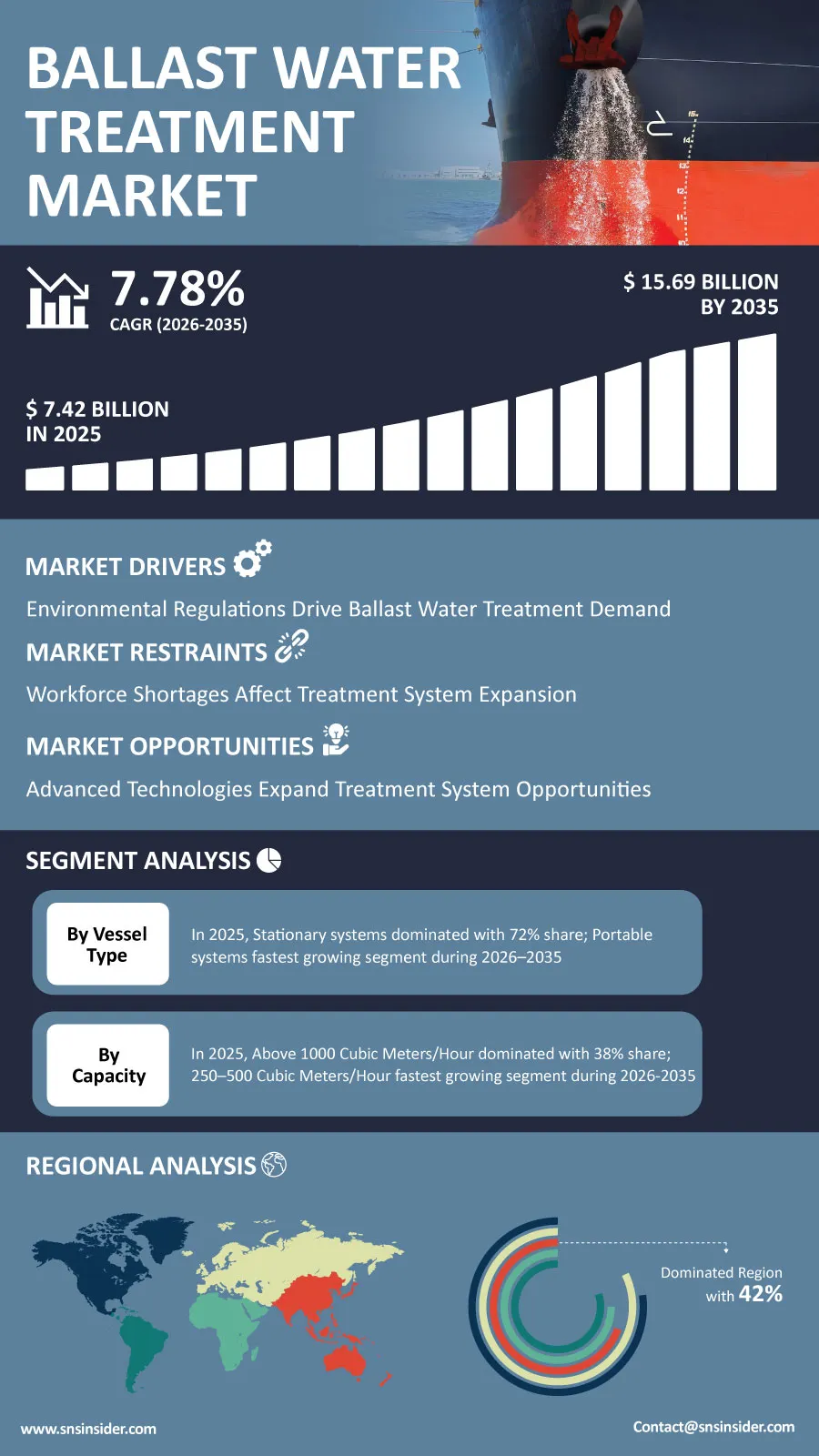
The global Ballast Water Treatment Systems Market is entering a sustained growth phase as the maritime industry intensifies efforts to protect marine ecosystems and meet increasingly stringent environmental compliance requirements. According to a recent study by SNS Insider, the global Ballast Water Treatment Systems Market size valued at USD 7.42 billion in 2025, is anticipated to grow to USD 15.69 billion by 2035, registering a CAGR of 7.78% over the 2026–2035 forecast period.
The steady increase in the number of ships engaged in maritime transport, alongside with the development of the commercial fleets, necessitates the development of reliable technologies to control the ballast water before its discharge in marine environments. Ship owners are now interested in adopting those technologies that meet regulatory standards and operate efficiently and economically.
An increase in retrofits has played an important role in the growth of the market. This is especially true as operators retrofit their current fleet to comply with international guidelines for ballast water management. Improvements in treatment technology and monitoring capabilities of the digital systems are also being witnessed.
To Get Detailed Insights on the Ballast Water Treatment Systems Market – Request a Sample Report
Regulatory Compliance and Fleet Modernization Create New Growth Opportunities
Environmental legislation regarding the release of ballast water has made the treatment system not only useful but also mandatory in the operation of any modern ship. Shipyards are investing in sophisticated technology to prevent the exchange of undesirable organisms in marine environments through ballast water discharge.
Renewal and retrofit projects present additional business opportunities for technology companies as old ships will require more advanced and compact technology to fit within their current structure without any major changes to the ship.
Innovation in technology presents yet another path for growth in the market. Technology that is energy efficient, reduces chemical usage, and automation is becoming more and more appealing for operators who wish to manage their life cycle costs.
Key Market Insights Highlight Shifting Demand Patterns
By system type, stationary systems are expected to account for approximately 72% of global market revenue in 2025, reflecting their widespread installation across large commercial vessels that require continuous ballast water management capabilities. Portable systems are projected to record the fastest growth through 2035 as smaller vessels and operators requiring greater deployment flexibility seek cost-effective treatment options.
Based on capacity, systems exceeding 1,000 cubic meters per hour are anticipated to hold 38% of market revenue in 2025, supported by extensive use aboard bulk carriers, tankers, and large container vessels. Meanwhile, the 250–500 cubic meters per hour category is expected to experience the fastest growth as demand increases from medium-sized vessels and regional maritime operations.
In terms of vessel type, bulk carriers are forecast to represent 29% of market revenue in 2025, driven by their extensive global presence and frequent ballast water management requirements. Container ships are projected to emerge as the fastest-growing vessel category as international commerce, e-commerce logistics, and containerized cargo volumes continue expanding.
By system technology, UV treatment is expected to contribute approximately 41% of market revenue in 2025 due to its effective microorganism inactivation capabilities and limited reliance on chemical agents. Chemical disinfection systems are anticipated to register the fastest growth as technological improvements enhance their suitability for high-capacity vessels and diverse operating conditions.
Digital Monitoring Strengthens Treatment System Efficiency
There is a clear trend emerging in the market toward automated and networked ballast water treatment systems. The use of digital technology makes it possible for the shipping companies to monitor their performance and ensure regulatory compliance.
Automation and diagnostics are also being employed to help reduce maintenance needs and increase reliability. On the other hand, there is growing interest in new systems that have compact designs, consume less power, and use chemical-free treatment processes in the fleet industry that seeks to lower operating costs.
Asia Pacific Leads with 42% Revenue Share While North America Advances at an 8.59% CAGR
The Asia Pacific region is estimated to dominate the regional market and earn a revenue share of around 42% of the global revenue in 2025 due to factors such as the leading shipbuilding business, large commercial shipping fleet, maritime trade and retrofit operations in countries such as China, South Korea and Japan.
The North America region is anticipated to be the fastest-growing regional market with a CAGR of 8.59% until 2035 due to factors such as strict regulatory enforcement, fleet upgrade, development of ports and increased adoption of treatment systems.
The Europe region is anticipated to form a matured regional market on the back of strong environmental regulations, presence of strong maritime infrastructure and awareness regarding threats of invasion from species. On the other hand, Latin America and Middle East & Africa regions are expected to witness sustained growth in the coming years.
Industry Participants Focus on Technology Innovation and Compliance
Competition in the global Ballast Water Treatment Systems Market remains dynamic as manufacturers focus on improving treatment performance, reducing energy consumption, and integrating digital monitoring capabilities. Companies are also developing compact systems designed to simplify retrofits and support efficient deployment across different vessel configurations.
Key companies operating in the global Ballast Water Treatment Systems Market include Alfa Laval, Wärtsilä Corporation, Xylem Inc., Veolia Water Technologies, Mitsubishi Heavy Industries Ltd., Optimarin AS, Ecochlor Inc., Hyde Marine Inc., BIO-UV Group, Panasia Co., Ltd., Samsung Heavy Industries, NK Co., Ltd., JFE Engineering Corporation, Sunrui Marine Environment Engineering Co., Ltd., ERMA FIRST ESK Engineering Solutions S.A., Desmi A/S, Headway Technology Group (Qingdao) Co., Ltd., OceanSaver AS, Aquarius Marine Co., Ltd., and Techcross Inc.
An SNS Insider analyst Sushant Kadam commented, “The growing enforcement of ballast water regulations, combined with fleet modernization and increasing environmental awareness, is creating sustained demand for advanced treatment technologies. Providers that deliver energy-efficient, compact, digitally monitored, and retrofit-friendly systems will be well positioned to capture opportunities as global shipping continues its transition toward more sustainable operations.”
About the Author

Get in touch




