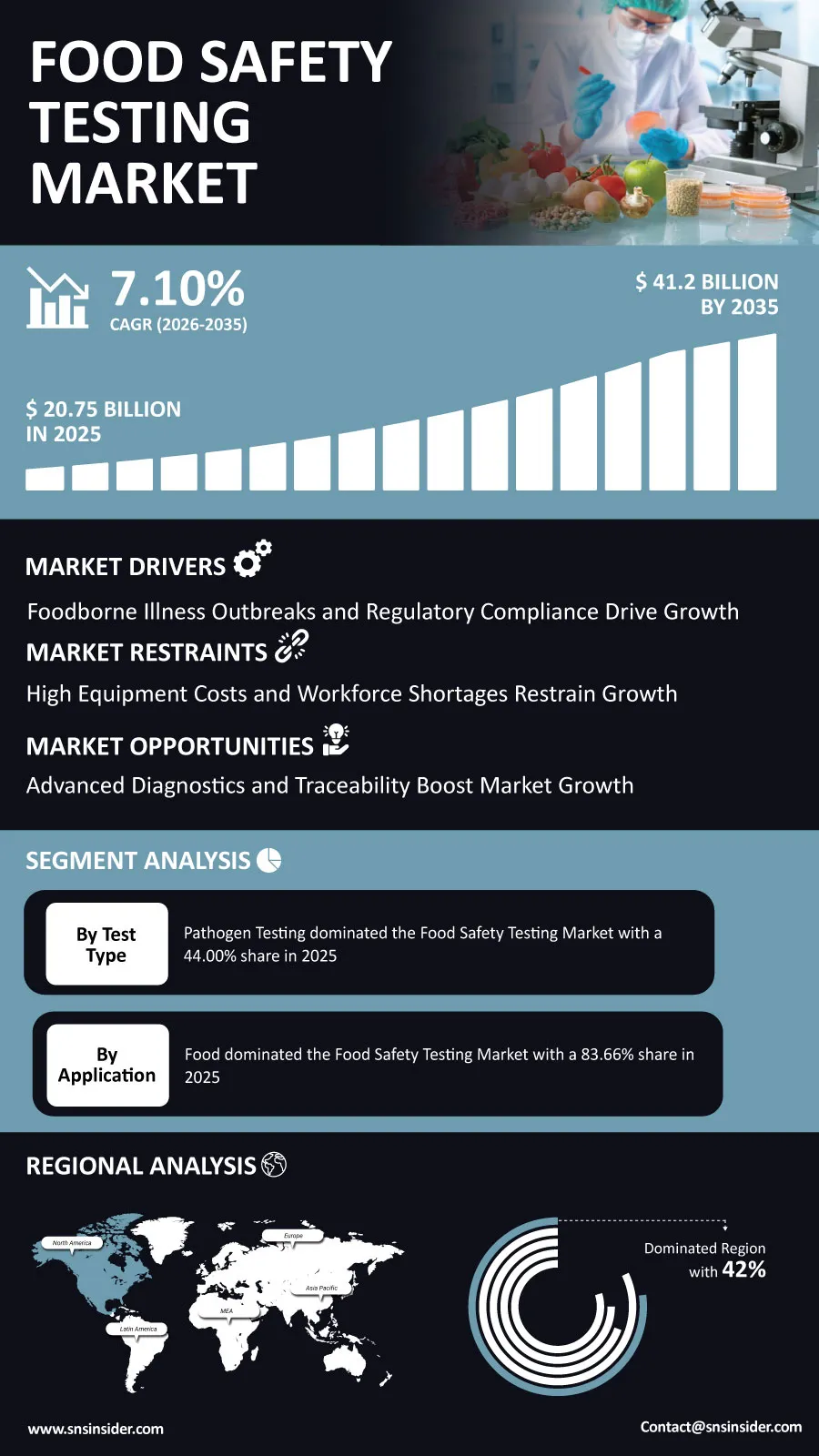
The global Food Safety Testing Market is set for significant expansion as foodborne illness outbreaks and regulatory compliance requirements continue to reshape food supply chain verification worldwide. “According to a recent study by SNS Insider, the global Food Safety Testing Market size valued at USD 20.75 billion in 2025, is anticipated to grow to USD 41.2 billion by 2035, registering a CAGR of 7.10% over the 2026–2035 forecast period.”
There have been notable changes within food safety diagnostic technology over time, due to which many testing laboratories who aim at improving speed and accuracy can take advantage of this trend. This includes the need for more advanced PCR-based assay and biosensor techniques that will provide food manufacturers with the ability to achieve rapid, reliable contamination screening. This applies in situations where food safety testing supports meat, poultry, seafood, and processed food applications. Testing laboratories are constantly working hard to ensure that their diagnostic services perform better than before in order to meet various regulatory compliance and speed requirements.
To Get Detailed Insights on the Food Safety Testing Market – Request a Sample Report
Rapid Diagnostics and Digital Traceability Create New Demand
The food safety testing market has evolved from conventional laboratory-based pathogen screening to increasingly sophisticated, point-of-need diagnostic technology. The growing investment in PCR-based assays, biosensor development, and blockchain traceability integration across testing laboratories of all sizes has required the development of more efficient and accurate food safety diagnostic products.
New diagnostic and traceability technologies can increase testing speed, improve contamination detection accuracy, and allow for expansion into increasingly diverse meat, poultry, seafood, and processed food applications. This gives food manufacturers the possibility to achieve rapid regulatory compliance verification while reducing costly product recalls.
Testing laboratories, food manufacturers, and regulatory bodies are increasingly cooperating thanks to the growing interest in developing future solutions for efficient, comprehensive food safety verification systems.
Key Market Findings Highlight High-Growth Segments
The pathogen testing segment dominated all categories in the food safety testing market share with approximately 44% in 2025 due to mandatory Salmonella, Listeria, and E. coli testing requirements. The fastest growing category is expected to be microbiological testing which will grow from USD 3.5 billion in 2024 to USD 7.5 billion by 2035, owing to growing regulatory scrutiny and technological advancements.
By application, food commanded 83.66% of market revenue in 2025 due to the fundamental role of food safety testing across the food industry supply chain. Pet food and animal feed will see the fastest growth in revenue generation at an 8.13% CAGR, driven by growing consumer awareness of pet nutrition safety.
Based on technology, traditional testing methods remained dominant due to established, widely validated laboratory protocols. On the other hand, rapid testing will be the segment recording the fastest revenue growth at an 8.3% CAGR, supported by technological advancements in PCR-based assays and biosensors.
Distributive contaminant type trends are changing as well. Microbial contamination accounted for 43.3% of market revenue owing to the persistent threat of pathogenic bacteria in perishable foods. But pesticide and residue testing will turn out to be the fastest-growing contaminant category through 2035, on the back of growing global food trade complexity.
Testing Speed, Diagnostic Accuracy, and Traceability Gain Importance
In this regard, food manufacturers and export supply chains have been looking at food safety testing services that would deliver more consistent diagnostic accuracy while requiring greater testing speed and traceability.
Innovation in PCR-based assay technology, biosensor development, and blockchain traceability integration has been making it possible for companies to come up with services that appeal to increasingly compliance-focused food manufacturers and exporters. In addition to that, increasing emphasis on point-of-need diagnostics is also making it possible for testing laboratories to find solutions that reduce turnaround time and support rapid contamination response. Such trends are likely to become even more prominent in the future.
North America Emerges as the Largest Market with Approximately 42% Regional Revenue Share Amid Strong Regulatory Infrastructure
The North America region represented the largest share of regional market revenue in 2025 at approximately 42%, owing to stringent regulatory frameworks and a highly developed food safety infrastructure. On the other hand, Asia Pacific is expected to register the highest CAGR during the forecast period through 2035, driven by growing food trade complexity and expanding food processing manufacturing capacity.
Leading Companies Drive Innovation and Competition
The environment continues to stay very dynamic since players continue innovating on PCR-based assay technology and biosensor development as well as forming partnerships in order to enhance their position in the industry. Some of the major companies that operate in the global food safety testing market are SGS, Eurofins Scientific, Bureau Veritas, Intertek Group, Thermo Fisher Scientific, Agilent Technologies, Bio-Rad Laboratories, ALS Limited, Mérieux NutriSciences, and Microbac Laboratories.
An SNS Insider analyst Santosh Bhul commented, "The growing global emphasis on food supply chain transparency and regulatory compliance is creating sustained demand for rapid, accurate food safety diagnostic technology. Testing laboratories that successfully combine PCR-based assay innovation, biosensor development, and digital traceability capability will be best positioned to capitalize on emerging opportunities across meat, poultry, seafood, and processed food segments."
About the Author

Get in touch