
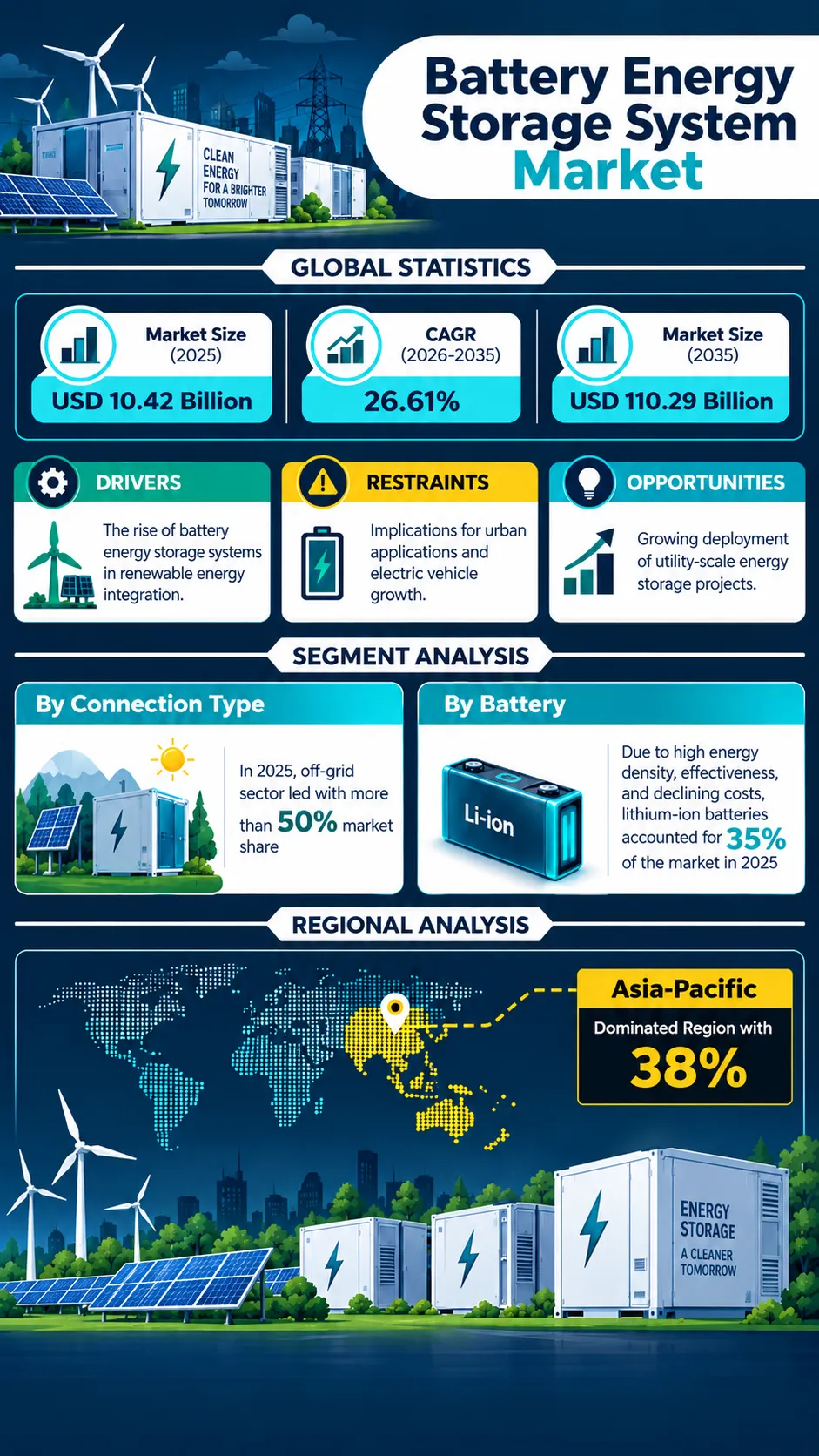
The global Battery Energy Storage System Market is entering a period of accelerated expansion as utilities, businesses, and households invest in flexible power infrastructure to support renewable generation and strengthen electricity reliability. “According to a recent study by SNS Insider, the global Battery Energy Storage System Market size valued at USD 10.42 billion in 2025, is anticipated to grow to USD 110.29 billion by 2035, registering a CAGR of 26.61% over the 2026–2035 forecast period.”
The fast growth in the addition of both wind and solar power is leading to changes in electricity systems and the growing need for solutions that will manage variable power production. Batteries store excess electricity and use it during peak periods or low production of renewables, thus establishing a link between clean production and reliable power.
The investments are becoming more popular not only in utility projects but also at the residential, commercial, and industrial scales. The declining prices of batteries, technological advances in storage systems, and government-supported programs for clean energy are pushing more customers to consider BESS usage.
To Get Detailed Insights on the Battery Energy Storage System (BESS) Market – Request a Sample Report
Renewable Energy Expansion Continues to Create New Growth Opportunities
The rapid adoption of renewable energy sources is considered to be one of the most important factors that drive battery storage investments. Solar and wind farms generate energy unpredictably, thus resulting in both oversupply and shortages. Battery energy storage systems give more opportunities to manage the timing of generation and consumption of energy.
Yet another potential source is distributed energy solutions. Both domestic and commercial consumers want to find alternative options to traditional backup sources of power, along with optimizing their electricity usage. The battery can help achieve all three objectives, including peak load management, backup power, and increased use of renewable energy on-site.
Storage technology is also creating more opportunities for grid modernization. High-level BESS systems fitted with smart controllers have potential to help with frequency regulation, load balancing, and grid resilience as energy grids manage to generate more renewable energy.
Key Market Insights Highlight Shifting Demand Patterns
By connection type, Off-grid systems contributed to over 50% of revenue from the market in 2025 owing to the demand coming from isolated areas, telecommunication networks, mining projects, and regions where grid access is difficult. At the same time, on-grid systems will continue to post the highest CAGR until 2035 owing to their application for managing renewable energy and electrical loads.
Based on battery type, the lithium-ion technology was anticipated to have a share of roughly 35% in 2025 owing to the matured production infrastructure, high energy density, and wide application scope. The flow battery systems will be the fastest-growing technology over the forecast period owing to their scalability and ability to provide long-duration storage.
By application, residential segment emerged as the leader, taking over more than 41% of revenue share in 2025. Increasing usage of solar energy by individuals and energy independence programs are driving the demand for the same. The commercial segment is projected to witness the highest CAGR through 2035 as businesses seek solutions for peak-demand management, operational continuity, and improved energy efficiency.
Smarter Storage Technologies Strengthen Grid Flexibility
BESS is adopting more intelligent energy management systems that integrate batteries along with digital controls, renewable energy sources, and grid management systems. The more advanced systems are capable of reacting quickly to any changes in the demand and supply of electricity, thereby enhancing the efficiency of storage assets.
Moreover, large-scale projects are increasingly becoming capable of grid forming and have intelligent control systems. Such trends can help stabilize grids with high levels of renewables while generating additional revenues from grid services.
Regional Markets Demonstrate Strong Investment Momentum
Asia-Pacific held around 38% of the market in 2025, thus being the leading regional market. China, Japan, India, and other big economies increase the usage of energy storage technology in order to integrate renewable energy and boost industrialization and modernization of the electric power grid.
North America is expected to exhibit the highest CAGR through 2035 owing to rising renewable power capacity installations, grid reliability, and favorable energy policies. Increasing deployment across residential, commercial, and utility applications is strengthening the regional outlook.
Europe is also advancing in deployment of storage technologies owing to the reduction of carbon emissions and growing renewable power generation. Latin America and the Middle East & Africa regions create new opportunities due to solar energy generation projects and off-grid electrification.
Industry Participants Focus on Scale and Technology Innovation
The competitive landscape is becoming increasingly dynamic as energy companies, battery manufacturers, technology providers, and renewable developers expand their storage portfolios. Companies are concentrating on larger project capacities, improved battery performance, intelligent energy-management systems, and integrated renewable-storage solutions.
Key companies operating in the global Battery Energy Storage System Market include Tesla, LG Energy Solution, Samsung SDI, Panasonic, Siemens, GE Renewable Energy, Fluence, ABB, Honeywell, Schneider Electric, BYD, Saft, JinkoSolar, Eaton, VARTA, NGK Insulators, CATL, Duracell, Kraftpowercon, and Engie.
An SNS Insider analyst Santosh Bhul commented, “The rapid expansion of renewable generation is creating a structural need for flexible energy storage across electricity networks and distributed applications. Advances in battery technology, declining system costs, and increasing investment in grid modernization are positioning BESS as a critical component of the global energy transition.”
About the Author

Get in touch




