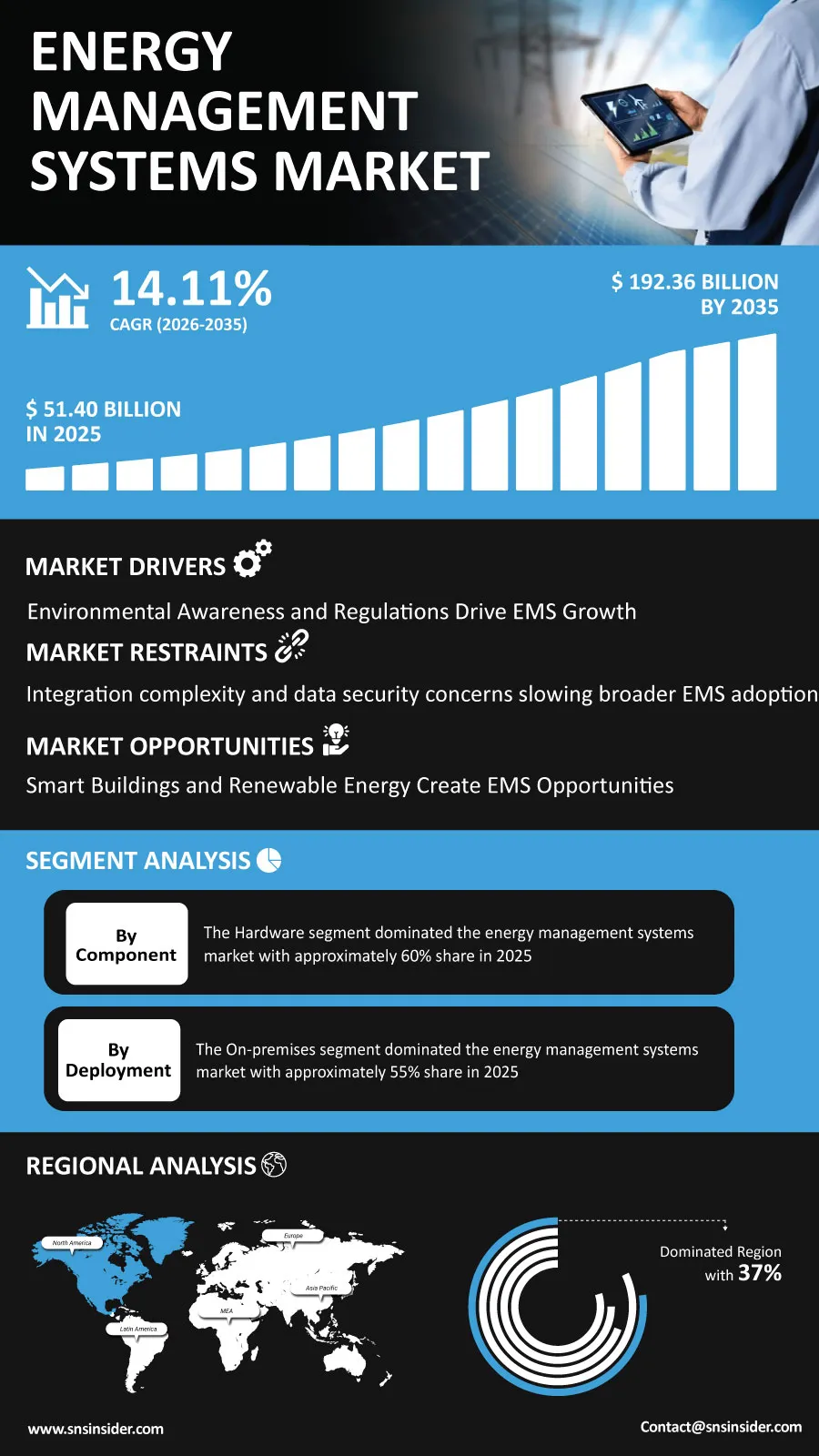
The global Energy Management Systems Market is entering a strong expansion phase as businesses, industrial operators, and building owners prioritize energy efficiency, cost control, and emissions reduction. According to a recent study by SNS Insider, the global Energy Management Systems Market size valued at USD 51.40 billion in 2025, is anticipated to grow to USD 192.36 billion by 2035, registering a CAGR of 14.11% over the 2026–2035 forecast period.
Higher electricity prices and the pressure of sustainability are making companies embrace solutions that give them insight into their consumption behavior and performance. The EMS solutions have become an integrated part of the company’s overall digital ecosystem by providing integration of meters, sensors, automation tools, and analytics.
The growing trend of using renewable energy sources creates yet another need for a company to invest in technology. The companies using renewable energy sources such as solar, wind energy, battery energy, and electric cars need smart energy solutions.
To Get Detailed Insights on the Energy Management Systems Market – Request a Sample Report
Smart Infrastructure Investment Creates New Growth Opportunities
Energy efficiency has become a priority in manufacturing plants, office buildings, data centers, utility companies, and homes. While companies are interested in simply monitoring the system, they are also demanding automated solutions which will be able to detect the inefficiencies, predict energy use, and suggest measures of improving performance.
Decarbonization, smart grid, and energy efficiency policies are also enhancing the economic case for EMS implementation by giving incentives, promoting efficiency, and making corporations adopt their sustainability agenda.
Cloud-based systems are also providing new possibilities to small companies. With a scalable software solution, a company can get remote monitoring and energy management services without the need for a large on-site infrastructure.
Key Market Insights Highlight Shifting Demand Patterns
By component, hardware was expected to maintain its leadership with approximately 60% of global market revenue in 2025, supported by demand for meters, sensors, controllers, and other equipment required for energy data collection and management. Software is projected to be the fastest-growing component as organizations adopt AI-assisted analytics, predictive maintenance, and automated optimization capabilities.
Based on type, Industrial Energy Management Systems were anticipated to account for more than 65% of market revenue in 2025. High industrial energy consumption and the potential for measurable cost savings continue to support adoption across factories and processing facilities. Home Energy Management Systems are expected to record the fastest growth as smart thermostats, connected appliances, rooftop solar, batteries, and residential automation become increasingly integrated.
By deployment, on-premises systems were projected to hold approximately 55% of market revenue in 2025, reflecting the requirements of organizations seeking direct control over energy data and infrastructure. Cloud-based deployment is expected to expand at the fastest pace through 2035, supported by lower upfront requirements, remote accessibility, and scalability across multiple facilities.
AI and Renewable Integration Reshape Energy Management
There is an increasing shift from just consumption measurement to predictions and automation of energy optimization through EMS systems. This is because artificial intelligence can be used to detect operational trends, identify unusual consumption patterns, and perform preventive maintenance in order to avoid production interruptions due to equipment failure.
The incorporation of renewable sources of energy is also another emerging aspect. EMS can coordinate both renewable sources of energy and regular electricity generation and storage facilities in order to optimize energy consumption in the organization.
Increased demand for cybersecurity measures is also affecting product development as energy infrastructure connectivity leads to more digital access points. Consequently, vendors are improving data security, system monitoring, and compliance measures in addition to energy management measures.
North America Leads with 37% Revenue Share While Asia Pacific Drives Future Energy Management Market Growth
North America is estimated to continue as the largest regional market with an approximate revenue share of 37% of the total revenue generation in 2025. The region’s advanced digital infrastructure, heavy energy consumption in industries, and energy efficiency programs are contributing towards growing use of this technology. The US contributes around 82.5% of the total revenue generated from the North American region.
Asia Pacific is estimated to emerge as the fastest growing regional market up till 2035 owing to factors such as industrialization, urbanization, investments in smart grid solutions, and installation of renewable energy systems. China contributes around 40.6% of the total revenue generated from the Asia Pacific region.
Industry Participants Focus on Digital and Integrated Solutions
Competition in the Energy Management Systems Market is intensifying as technology providers expand their capabilities across automation, analytics, connected devices, renewable integration, and cloud platforms. Companies are increasingly developing integrated solutions designed to connect energy management with broader building, industrial, and grid-management ecosystems.
Key companies operating in the global Energy Management Systems Market include Siemens AG, Schneider Electric SE, General Electric (GE), Honeywell International Inc., Johnson Controls International plc, ABB Ltd., Emerson Electric Co., Rockwell Automation Inc., Eaton Corporation plc, IBM Corporation, Hitachi Ltd., Delta Electronics Inc., Mitsubishi Electric Corporation, Enel X, GridPoint Inc., Panasonic Corporation, Cisco Systems Inc., Huawei Technologies Co., Ltd., Legrand SA, and Itron Inc.
An SNS Insider analyst Sushant Kadam commented, “The accelerating transition toward efficient, connected, and lower-carbon energy infrastructure is creating a broad opportunity for EMS providers. Vendors that combine intelligent analytics, renewable integration, cybersecurity, and scalable cloud capabilities will be well positioned to support organizations as energy management becomes increasingly central to operational strategy.”
About the Author

Get in touch