
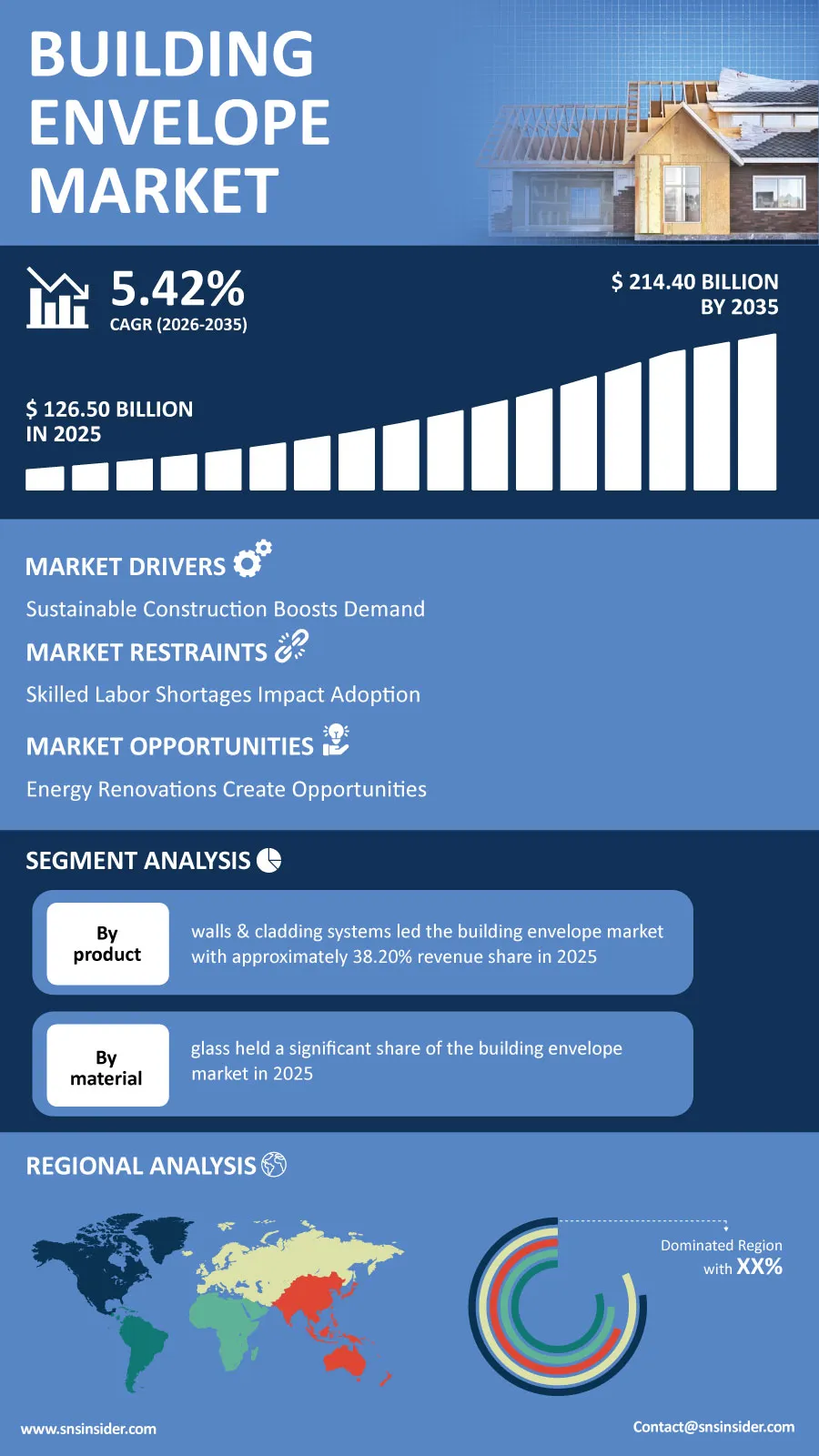
The Global Building Envelopes Market is expected to grow steadily as there will be an increasing emphasis on the use of energy-efficient construction and low carbon infrastructure in the coming years. “According to a recent study by SNS Insider, the global Building Envelope Market size valued at USD 126.50 Billion in 2025, is anticipated to grow to USD 214.40 Billion by 2035, registering a CAGR of 5.42% over the 2026–2035 forecast period.”
The growing focus of reducing the energy consumption within buildings have put Appraisal envelope systems at the forefront for residential, commercial as well as industrial development. Gone are the days of conventional designs: high-performance walls, roofing systems, insulated facades, windows and doors are now essential elements in achieving better thermal performance, indoor comfort and durability over time. With construction activity picking up in both developed and emerging economies, demand for modern envelope solutions remains robust.
Construction technologies are also swiftly improving, driving further advantages in the industry. Manufacturers are bringing more integrated insulation materials and composite cladding systems that increase resistance to weathering while lowering operational energy costs by combining active solutions, like smart glazing. The growing adoption of prefabricated construction methods also drives the expansion of the market by accelerating installation velocity and project completion efficiency.
To Get Detailed Insights on the Building Envelope Market – Request a Sample Report
Sustainable Construction and Building Retrofits Create Significant Growth Opportunities
Worldwide transition towards sustainable infrastructure is now providing new opportunities for building envelope manufacturers. Governments are pouring vast sums into energy-efficient renovation programs aimed at keeping old buildings up to the current technical standard whilst improving them in terms of greenhouse gas emissions. Such initiatives have triggered large-scale acceptance of advanced insulation, high-performance roofing, and energy-efficient façade systems.
Meanwhile, smart Buildings are fueling the need for innovative envelope technologies capable of integrating photovoltaic roofing, electrochromic glass, intelligent ventilation systems and sensor-enabled monitoring. Those rising investments in eco-friendly materials, recyclable materials and low carbon production techniques are projected to drive demand for manufactured products through both residential as well as commercial construction projects.
Key Market Insights Highlight Shifting Demand Patterns
The product segment is further sub-segmented into Walls & Cladding Systems, Roof Systems, Floor Systems and other systems. It is expected to be the fastest growing area of development through 2035, driven by more widespread adoption of energy-efficient fenestration and smart building technologies.
According to material, Glass held the largest market share during 2025 due to its increasing applications in curtain wall systems, modern façades, and demand for energy-efficient glazing solutions. High Surface, Metal and Composite Materials are expected to have quick growth due to their strength, light weight materials and fit for level development.
End use-wise, the Residential segment accounted for around 42.40% share of overall market revenue in 2025 owing to ongoing housing development & renovation projects across the world. Owing to uplifting investments in office buildings, healthcare facilities, educational institutions, hospitality projects and data centers, the Commercial segment is anticipated to witness the highest growth during the forecast period.
Advanced Building Technologies Accelerate Industry Transformation
Innovation remains prominent in the building envelope world as manufacturers create systems that provide greater energy performance while aiding sustainable building goals. Advancements in materials production, such as smart glazing technologies, insulated composite panels, treatment and upgrades to waterproofing membranes and high-performance roofing materials are now achieving building efficiencies while simultaneously preserving design freedom.
Meanwhile digital platforms for design, building information modelling (BIM) and automated manufacturing processes are making each step of the construction lifecycle more accurate. It allows developers to ensure envelope performance but at the same time, minimizes installation duration, operational cost and waste of materials.
North America Accounted for the Largest Regional Revenue in 2025; Asia Pacific to Register the Fastest Growth Through 2035
In 2025, North America continued to be the largest regional market with extensive residential renovation activity combined with commercial construction investment and increasingly stringent building energy regulations in the United States and Canada. Different government incentives to promote energy-efficient retrofitting will keep driving the demand for such advanced envelope solutions across the region.
Amongst regional markets, Asia Pacific should be the fastest growing through 2035. Fast growing urbanisation rate, increasing infrastructure development and residential construction in China, India, South Asia make large spaces and good opportunities for manufacturers. The increasing adoption of sustainable construction materials and green building practices also underpins long-term regional growth.
Industry Participants Focus on Innovation and Sustainable Product Development
Competition within the global building envelope market is heated as top manufacturers bolsters their research and development capabilities to expand production capacity to cater rising demand for energy-efficient construction materials. To capitalize on competitive advantages, companies are still investing in higher-performing insulation technologies, recyclable products, smart building integration and sustainability as manufacturing practices.
Key companies operating in the global Building Envelope Market include Saint-Gobain SA, Owens Corning, Kingspan Group plc, Rockwool International A/S, BASF SE, DuPont de Nemours Inc., GAF Materials Corporation, Sika AG, Etex Corp, 3M Company, Knauf Insulation, Dow Inc., Tremco Inc., Johns Manville, Armstrong World Industries, Henkel AG, H.B. Fuller Company, Bostik SA, National Gypsum, and Yuanda China Holdings Ltd.
An SNS Insider analyst Himanshu Sharma commented, "Growing investments in sustainable infrastructure, stricter energy-efficiency standards, and the rapid adoption of smart building technologies are transforming the global building envelope industry. Manufacturers that continue advancing high-performance materials, integrated building solutions, and environmentally responsible production processes are expected to capture significant long-term growth opportunities as construction markets increasingly prioritize building efficiency and carbon reduction."
About the Author

Get in touch




