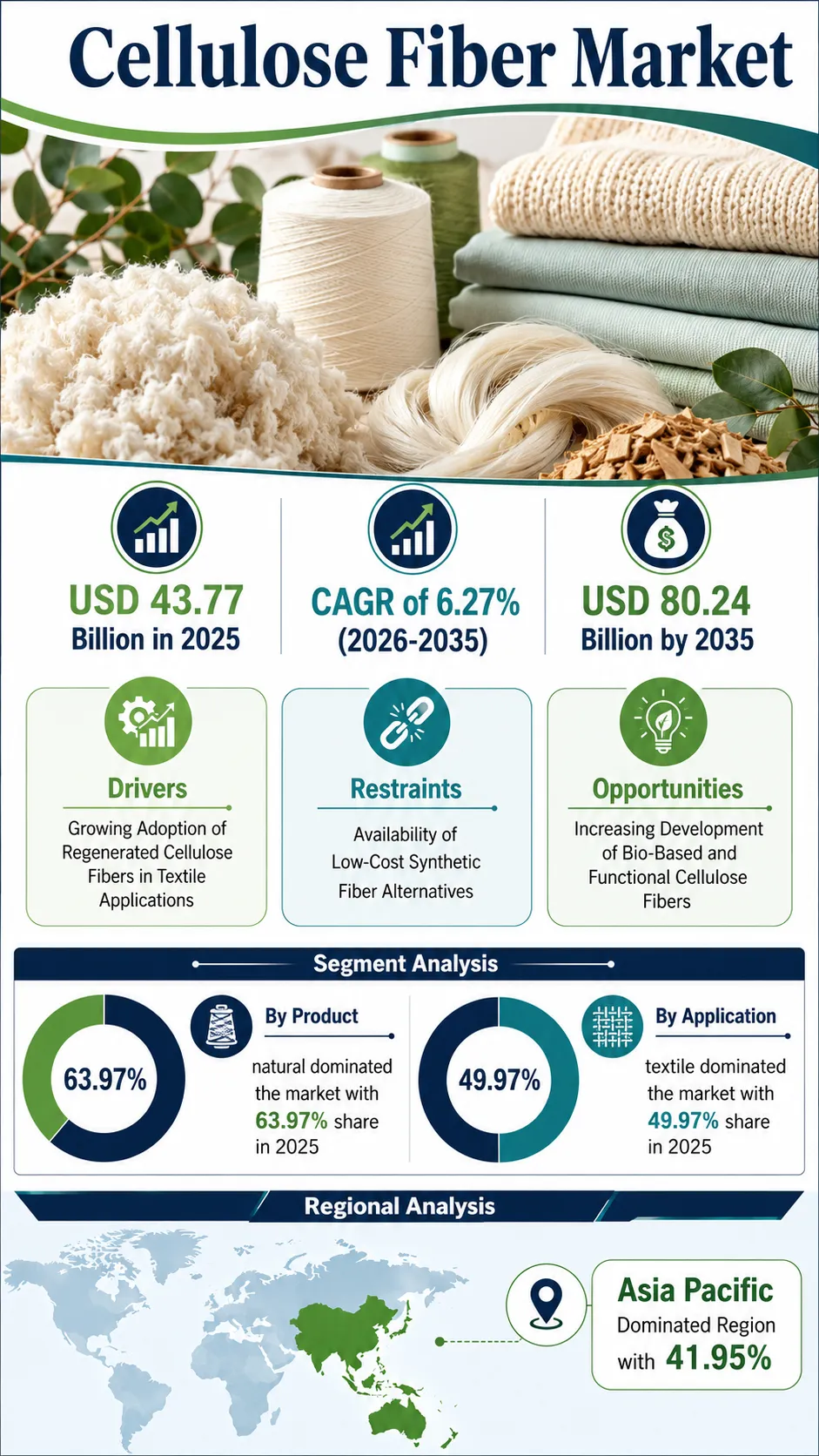
The global Cellulose Fiber Market is entering a period of sustained expansion as textile producers, hygiene manufacturers, and industrial buyers seek alternatives to conventional synthetic materials. “According to a recent study by SNS Insider, the global Cellulose Fiber Market size valued at USD 43.77 Billion in 2025, is anticipated to grow to USD 80.24 Billion by 2035, registering a CAGR of 6.27% over the 2026–2035 forecast period.”
The demand for textile fibers is being influenced by evolving material requirements, investment in renewable feedstocks, and advances in fiber processing. The textile apparel industry is starting to consider regenerated cellulose fibers as alternatives in terms of comfort and moisture management, while fiber producers are investigating their potential applications in hygiene articles and technical textiles.
To Get Detailed Insights on the Cellulose Fiber Market – Request a Sample Report
Sustainable Materials and Functional Fibers Create New Industry Opportunities
The move towards eco-friendly materials is driving investments into cellulose fibers and cellulose fiber products. There are ongoing attempts to optimize fiber manufacturing processes, use more recycled cellulose fibers, and introduce more sustainable raw material supply methods. Such activities make sense due to growing demand for materials which possess both ecological and performance characteristics.
The area of innovation is not limited by cellulose fibers used in clothing production only. Innovations in technology and materials have already created cellulose fibers that demonstrate improved performance characteristics such as high strength, moisture management, antibacterial qualities, and thermoregulation.
Key Market Insights Highlight Shifting Demand Patterns
On the basis of product type, Natural Cellulose Fibers was the largest segment with a share of 63.97% in 2025, due to rising demand for biodegradable and plant-based fibers. The segment of Synthetic Cellulose Fibers is expected to grow at the highest CAGR of 7.70% between 2026 and 2035, due to growing development in the area of functionality and durability.
On the basis of application type, Textiles dominated the industry with 49.97% of revenue share in 2025, due to wide range of applications in apparels, household items, and fashion textiles. The segment of Hygiene is projected to record the highest CAGR of 8.21% in the forecast period, due to demand for absorbent and biodegradable materials in personal care products.
In terms of distribution channels, Direct Sales was the most prevalent one holding a market share of 72.95%. This is due to the significant role of stable supply channels, technical requirements, and bulk purchases. In terms of the CAGR of growth rate, it is anticipated that the fastest growing distribution channel will be Online Sales with 8.13% growth rate.
Advanced Fiber Technologies Strengthen Manufacturing Capabilities
Technological advancements continue to play an important role in the advancement of the cellulose fiber industry. Manufacturers continue to advance their technologies by adopting new lyocell technology processes, effective fiber spinning techniques, and more effective material conversion processes. The adoption of such technologies has continued to enable them to manufacture more consistent and eco-friendly products.
The trend towards bio-sourced cellulose fiber has led to more research on renewable biomasses and agricultural wastes as alternative sources of feedstock. On the other hand, initiatives related to circular textiles have increased focus on cellulose recycling technologies. All these have been important in enabling manufacturers to develop more sustainable fiber products.
Asia Pacific Leads While North America Records Strong Growth
Asia Pacific dominated the global Cellulose Fiber Market with a 41.95% revenue share in 2025. Its leadership is supported by a large textile manufacturing base, established production capacity, and strong demand from China, India, Japan, South Korea, and Southeast Asia. Growing investments in sustainable manufacturing and regenerated fiber production continue to reinforce the region's position.
North America is projected to be the fastest-growing regional market through 2035, expanding at a CAGR of 7.62%. The region is benefiting from increasing adoption of sustainable materials across textile, hygiene, and industrial applications. In the United States, the market is expected to rise from USD 10.10 billion in 2025 to USD 21.47 billion by 2035, at a CAGR of 7.86%.
Industry Participants Focus on Innovation and Sustainable Production
Competition in the global Cellulose Fiber Market remains centered on product development, manufacturing efficiency, and sustainable sourcing. Leading companies are expanding their capabilities in regenerated fibers, recycled materials, and specialized textile solutions to meet evolving customer requirements.
Key companies operating in the global Cellulose Fiber Market include Lenzing AG, Grasim Industries Limited, Sateri Holdings Limited, Tangshan Sanyou Chemical Fiber Co., Ltd., Eastman Chemical Company, Sappi Limited, Rayonier Advanced Materials Inc., Kelheim Fibres GmbH, Daicel Corporation, Fulida Group Holdings Co., Ltd., Jiangsu Aoyang Technology Co., Ltd., CFF GmbH & Co. KG, Celanese Corporation, Asahi Kasei Corporation, Spinnova Plc, Borregaard ASA, Celotech Chemical Co., Ltd., ENKA GmbH & Co. KG, Shandong Helon Textile Sci. & Tech. Co., Ltd., and Thai Rayon Public Company Limited.
An SNS Insider analyst Himanshu Sharma commented, "The growing preference for renewable materials, combined with advances in regenerated and functional fiber technologies, is creating new opportunities across textiles, hygiene, and industrial applications. Companies that strengthen sustainable sourcing, improve manufacturing efficiency, and develop performance-oriented cellulose fiber solutions are expected to remain well positioned as global buyers continue to reassess material choices."
About the Author

Get in touch