The global Pine-Derived Chemicals Market is on a steady growth path through 2035, as bio-based chemical demand and sustainability positioning continue reshaping raw material sourcing across adhesives, coatings, and personal care industries.
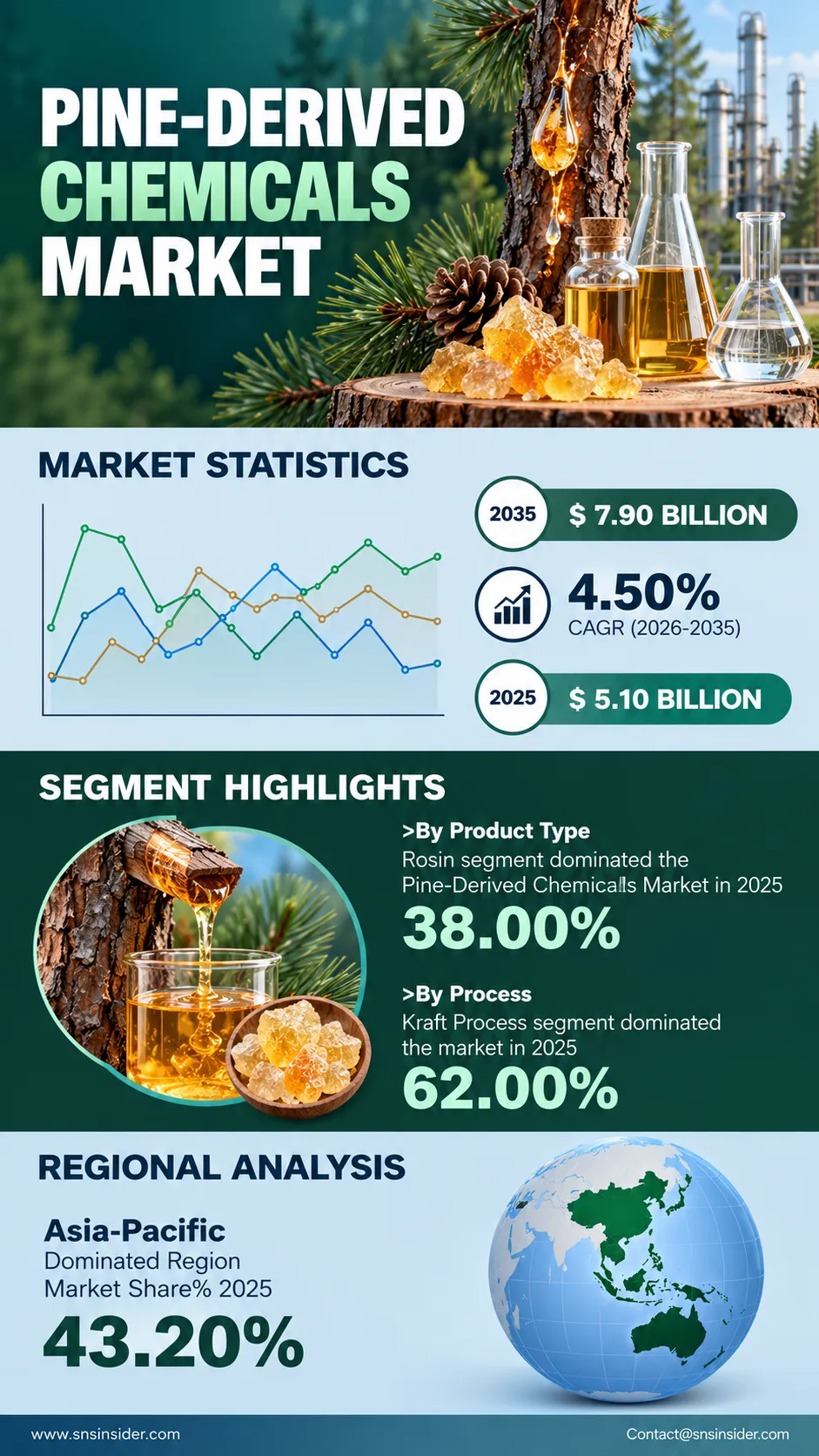
“According to a recent study by SNS Insider, the global Pine-Derived Chemicals Market size valued at USD 5.10 billion in 2025, is anticipated to grow to USD 7.90 billion by 2035, registering a CAGR of 4.50% over the 2026-2035 forecast period.”
Pine chemicals occupy a genuinely unusual spot in the broader chemical industry, most of the supply does not come from a dedicated production process at all, it is recovered as a byproduct of the kraft pulping process that paper mills already run at massive scale for entirely separate reasons. That byproduct relationship has quietly made pine chemicals one of the more cost-competitive bio-based alternatives available to manufacturers looking to reduce their petrochemical dependence.
Producer portfolios are shifting in a genuinely interesting direction right now, away from commodity crude tall oil and toward higher-value specialty derivatives, reflecting a broader industry recognition that raw byproduct recovery alone does not capture nearly as much value as refined, application-specific chemistry.
To Get Detailed Insights on the Pine-Derived Chemicals Market – Request a Sample Report
Personal Care Expansion Signals a Genuine New Growth Category
Where pine chemicals have traditionally served industrial applications like adhesives, coatings, and rubber processing, personal care formulators are increasingly adopting pine-derived surfactants and specialty ingredients for their bio-based sourcing credentials.
This crossover into personal care represents a meaningfully different demand profile than the category's traditional industrial base, since personal care applications typically command higher margins and require different purity and documentation standards than industrial chemistry.
Producers investing in personal-care-grade refining capability are positioning themselves to capture this higher-margin growth category ahead of competitors still focused primarily on industrial applications.
Key Market Findings Highlight High-Growth Segments
Rosin held the largest share of the Pine-Derived Chemicals Market in 2025, at 38.00%, reflecting its broad application base across adhesives, printing inks, and rubber processing.
Tall oil fatty acid is the fastest-growing product type, expanding at a 6.20% CAGR, pulled forward by demand across surfactants, lubricants, and personal care formulations.
By process, kraft process led with 62.00% share in 2025, while tapping process is growing fastest, at a 5.80% CAGR, as demand increases for gum-based pine chemicals with strong purity and traceability characteristics.
Construction remained the largest end-use industry at 26.00% share, but personal care is climbing fastest, at a 6.60% CAGR, as formulators seek bio-based surfactants for natural product positioning.
Specialty Refining Capability and Sustainability Credentials Anchor Competitive Positioning
Manufacturers are increasingly being evaluated on specialty refining capability and sustainability documentation nearly as much as on raw production volume, particularly among customers in coatings and personal care seeking credible bio-based alternatives.
Investment in refining crude tall oil and rosin into higher-purity, higher-value derivatives is becoming a genuine competitive differentiator among larger producers, while smaller players without that investment increasingly compete only in commodity crude product segments.
This divide is expected to sharpen further as downstream customers continue prioritizing sustainability credentials alongside cost and performance.
Asia Pacific Leads as North America Grows Fastest
Asia Pacific holds the largest share of global market revenue, anchored by the region's expanding pulp and paper industry and rapidly growing downstream demand across construction and manufacturing applications. North America, meanwhile, is growing fastest, driven by the world's largest concentration of kraft pulping capacity and producer investment in higher-value specialty derivatives.
Europe holds the second-largest share as well, anchored by France's substantial forestry industry and DRT's position as one of the world's largest pine chemical producers.
Leading Companies Drive Innovation and Competition
Competition in this market centers on specialty refining capability, feedstock security, and downstream application expertise nearly as much as on raw production scale, with significant portfolio restructuring reshaping the competitive landscape among larger producers.
Some of the major companies that operate in the global pine-derived chemicals market are Ingevity Corporation, Kraton Corporation, Eastman Chemical Company, DRT (Dérivés Résiniques et Terpéniques), Harima Chemicals Group, Inc., Forchem Oy, Arakawa Chemical Industries, Ltd., Foreverest Resources Ltd.
An SNS Insider Analyst Himanshu Sharma commented, “Pine chemicals have quietly become one of the more credible bio-based alternatives available to manufacturers looking to reduce petrochemical dependence, and the companies capturing the fastest-growing parts of this market are the ones investing in specialty refining capability rather than relying on commodity crude product sales alone. As personal care and other high-margin applications continue opening up, producers with strong feedstock security and refining sophistication are best positioned to lead.”
About the Author

Get in touch