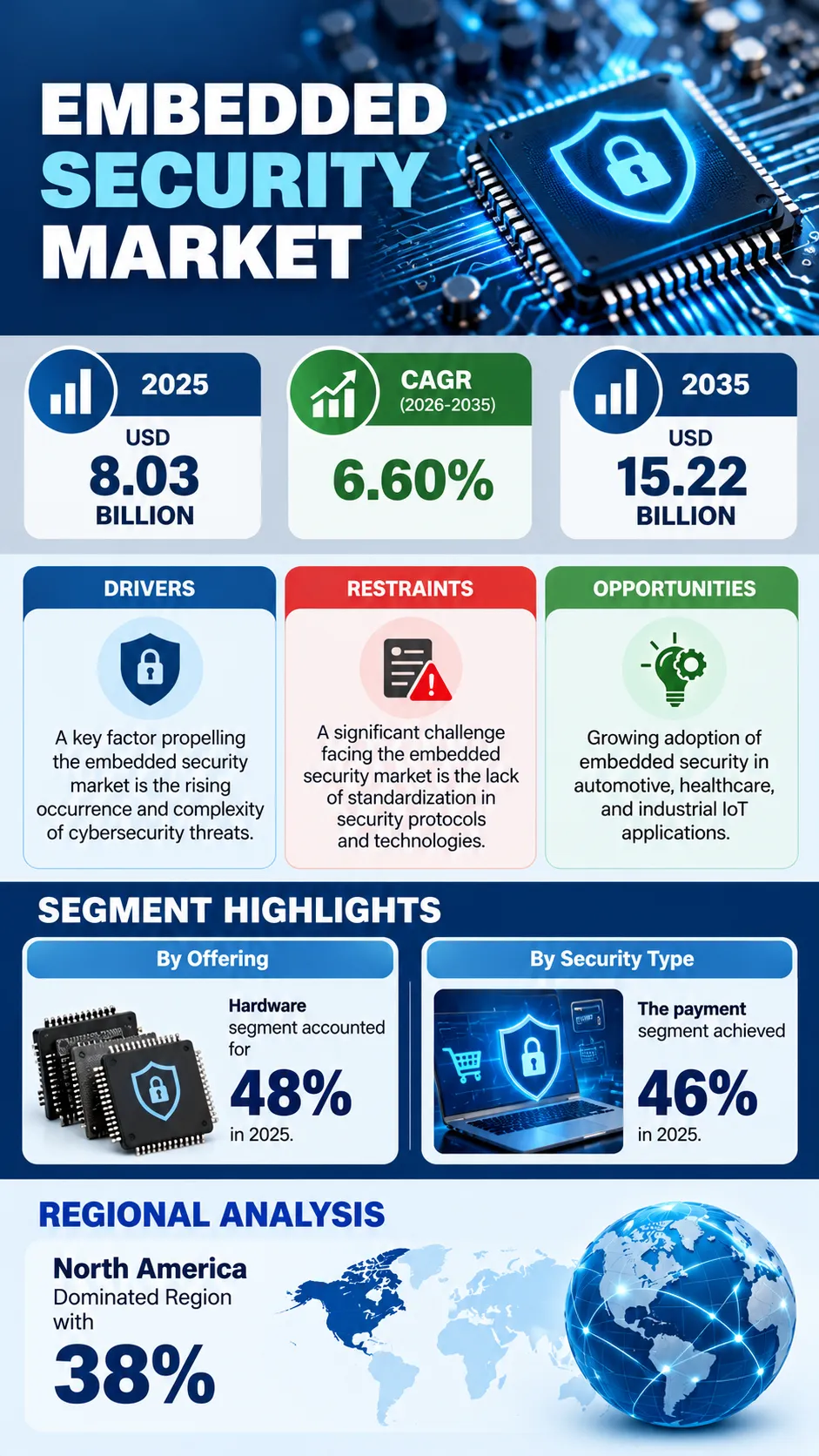
The global Embedded Security Market is projected to expand steadily as businesses and technology manufacturers strengthen protection across connected devices, digital infrastructure, and intelligent electronic systems. According to a recent study by SNS Insider, the global Embedded Security Market size valued at USD 8.03 billion in 2025, is anticipated to grow to USD 15.22 billion by 2035, registering a CAGR of 6.60% over the 2026–2035 forecast period.
Growing connectivity within automotive, industrial, consumer, and health-care devices is driving cybersecurity as an essential aspect of product development. The manufacturers are emphasizing in-built security measures to ensure confidentiality and the integrity of the information as well as protecting from any unauthorized access.
The expansion of IoT networks and connected infrastructure is further strengthening demand for security-enabled processors, trusted hardware components, and cryptographic technologies that protect devices throughout their operational lifecycles.
To Get Detailed Insights on the Embedded Security Market – Request a Sample Report
Rising Cybersecurity Investments Create New Growth Opportunities
Due to the increasing sophistication of cyber-attacks, more companies are looking to build security into electronic components and embedded software. Secure boot, encryption, trusted execution environments, and hardware authentication have become essential tools in securing devices from being tampered with or data being compromised.
Automobile makers, industrial businesses, and healthcare technology companies have been focusing on embedded security to solve security risks related to their connected systems. At the same time, changing privacy laws and device authentication regulations are prompting manufacturers to consider security at the design stage.
However, inconsistent security standards, integration issues, and cost concerns continue to pose challenges to the adoption of security solutions. Interoperability is especially critical as businesses roll out interconnected systems that require consistent security protection.
Key Market Insights Highlight Shifting Demand Patterns
By offering, hardware accounted for approximately 48% of global market revenue in 2025 due to the demand for secure elements, trusted platform modules, and hardware security modules. The services sector will experience the fastest growth rate till 2035 due to the rising need for security evaluations, protection management, consultancy, and upgrades.
Based on security type, payment applications held approximately 46% of market revenue in 2025. There are increased volumes of electronic transactions and the need to safeguard the financial information that is why there is increased demand for embedded encryption and authentication solutions. Access management and authentication is expected to grow at the highest rate due to increasing sophistication of access control systems.
Connected Devices Drive Demand for Hardware-Level Protection
Security by embedding has become more and more important as the products share confidential data in digital networks. Security by embedding is necessary in automotive systems as it is required for security of the communication and electronic control units and in industrial applications where secure device authentication and integrity of data is needed.
Security is necessary in consumer electronics for securing payments, biometric security and personal data security. In healthcare products, security is needed to protect patient data and integrity of the connected medical devices.
As embedded systems become an integral part of routine operations, it is expected that security architecture incorporating hardware security, encryption and trusted software will get more importance in the future.
North America Leads Embedded Security Market with 38% Share as Asia Pacific Accelerates Growth
North America held around 38% share of the global Embedded Security Market in 2025, owing to its continued dominance through sophisticated semiconductor technology, large investments in cybersecurity measures, and high demand from automobile, aerospace, industrial, and consumer electronics manufacturers. The U.S. continues to contribute in a big way to the market, as it was valued at USD 2.44 billion in 2025.
Asia-Pacific is expected to emerge as the fastest-growing region during 2026-2035 forecast period, as a result of growth in electronics manufacturing, automobile industry, telecommunications networks, and industrial automation systems in China, India, Japan, and South Korea.
Europe is another important market, backed by the need for data protection, as well as investments in secure automobiles and industrial solutions. On the other hand, development of digital infrastructure and increased cybersecurity awareness is aiding gradual adoption in Latin America and Middle East and Africa.
Industry Participants Focus on Secure Semiconductor Innovation
There is increasing competition among semiconductor makers to provide security-related components to more and more connected devices. Companies are focusing on tamper-proof components, integrated cryptography features, secure microcontrollers, and authentication tools to meet the evolving needs of cybersecurity.
Key companies operating in the global Embedded Security Market include Infineon Technologies, NXP Semiconductors, STMicroelectronics, Qualcomm, Microchip Technology, Renesas Electronics, Arm Holdings, Texas Instruments, Broadcom, SecureRF, onsemi, Thales Group, Maxim Integrated, Cypress Semiconductor, Atmel, Microsemi, MicroVision, Gemalto, Spyrus, and HID Global.
An SNS Insider analyst Sushant Kadam commented, “The growing complexity of connected ecosystems is making embedded protection an essential consideration across electronics manufacturing and digital infrastructure. Companies that deliver scalable hardware security, efficient authentication, and adaptable protection technologies will be well positioned to capitalize on rising demand for trusted connected devices over the coming decade.”
About the Author

Get in touch