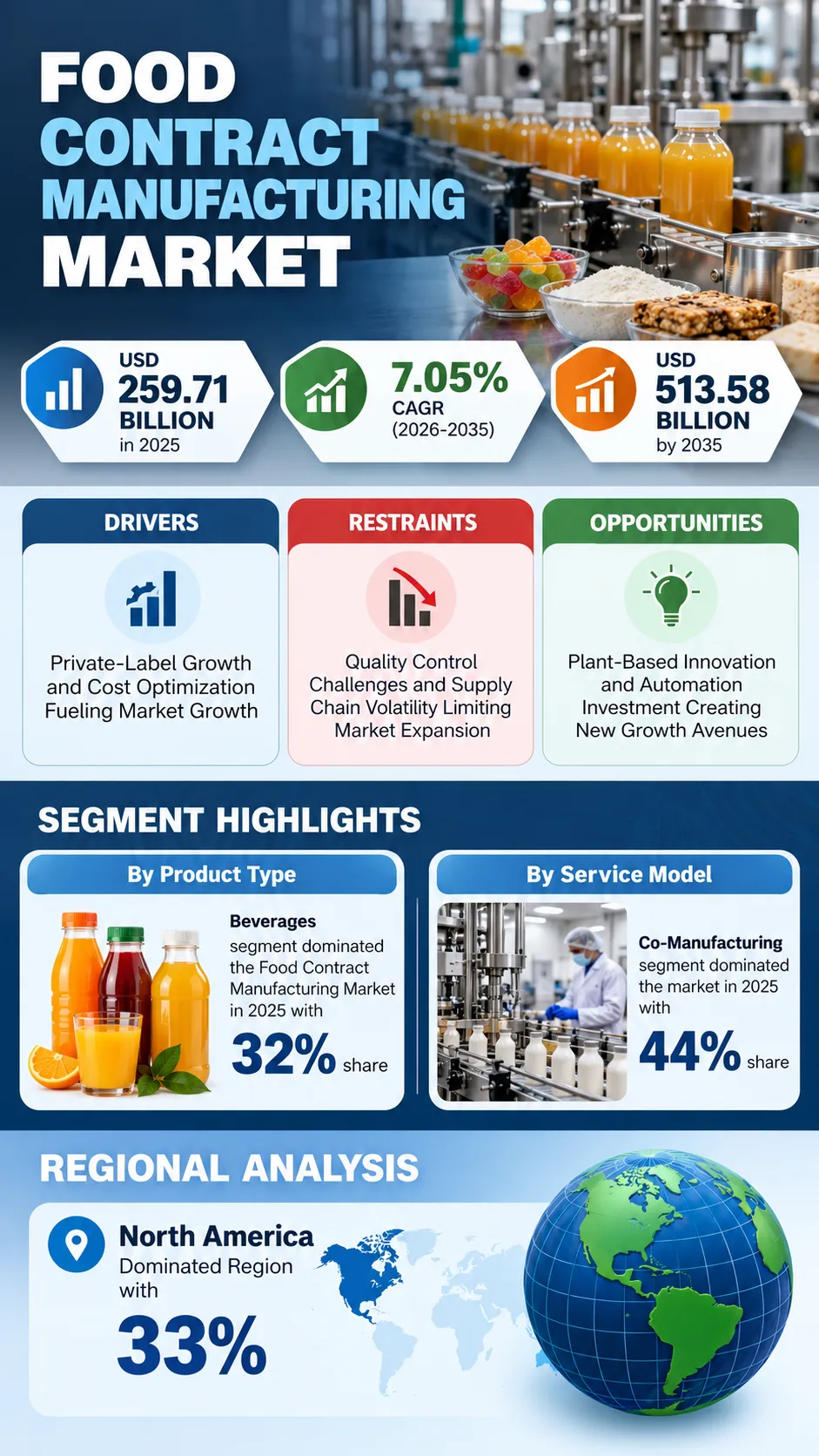
The global Food Contract Manufacturing Market is on a steady growth path through 2035, as private-label expansion and brand owners' cost optimization efforts continue reshaping how packaged food and beverages actually get made. “According to a recent study by SNS Insider, the global Food Contract Manufacturing Market size valued at USD 259.71 billion in 2025, is anticipated to grow to USD 513.58 billion by 2035, registering a CAGR of 7.05% over the 2026-2035 forecast period.”
Contract manufacturing has become close to invisible infrastructure in the packaged food industry, most consumers never think about who actually produces the private-label snack or beverage sitting in their cart, but that outsourced production model now underpins a substantial share of what fills grocery shelves worldwide. Building a dedicated food manufacturing facility can cost upward of USD 150 million, a capital commitment that makes outsourcing an obvious choice for brands focused on formulation, marketing, and distribution rather than owning physical production infrastructure.
Private-label retail growth is doing more to reshape this market right now than any single consumer food trend, as grocery chains keep investing in their own store-brand programs and lean on contract manufacturers to supply that growing volume.
To Get Detailed Insights on the Food Contract Manufacturing Market – Request a Sample Report
Private-Label Growth Reshapes Manufacturing Capacity Allocation
Private brand unit share has climbed to record highs across several major grocery categories, and that shift is directly reshaping how contract manufacturers allocate production capacity between branded and private-label customers.
This reallocation is changing competitive dynamics across the industry, as manufacturers with strong private-label relationships increasingly out-invest competitors focused primarily on serving branded customers.
Consolidation activity, including recent acquisitions and take-private transactions among major contract manufacturers, reflects how much capital is now flowing into positioning for continued private-label growth.
Key Market Findings Highlight High-Growth Segments
Beverages held the largest share of the Food Contract Manufacturing Market in 2025, at 32%, reflecting the category's standardized, high-volume production economics.
Bakery & confectionery is the fastest-growing product type, expanding at a 7.60% CAGR, pulled forward by rising demand for private-label and clean-label baked goods.
By service model, co-manufacturing led with 44% share in 2025, while private label manufacturing is growing fastest, at an 8.20% CAGR, tracking directly with private-label retail's continued expansion.
Branded food companies remained the largest end-user segment at 52% share, but private-label retailers are climbing fastest, at an 8.90% CAGR, as grocery chains deepen their store-brand investments.
Quality Consistency and Compliance Infrastructure Anchor Competitive Positioning
Brand owners are increasingly evaluating contract manufacturers on quality consistency and regulatory compliance infrastructure nearly as much as on price, particularly for larger branded customers with strict food safety documentation requirements.
Investment in automation, traceability systems, and compliance infrastructure is becoming a genuine competitive differentiator among larger manufacturers, while smaller regional players without that investment increasingly compete only for lower-complexity, price-sensitive contracts.
This divide is expected to sharpen further as food safety regulation continues tightening across major markets.
North America Leads as Asia Pacific Grows Fastest
North America holds the largest share of global market revenue, anchored by an enormous domestic food and beverage manufacturing base and well-established outsourcing habits among branded companies. Asia Pacific, meanwhile, is growing fastest, propelled by rising packaged food demand as urbanization and modern retail expansion continue across China, India, and Southeast Asia.
Europe holds a meaningful, mature share as well, shaped by strong demand for specialized co-packing services and the region's comparatively strict food safety and traceability regulations.
Leading Companies Drive Innovation and Competition
Competition in this market centers on production scale, formulation expertise, and compliance infrastructure nearly as much as on price, with significant consolidation activity reshaping the competitive landscape among larger players.
Some of the major companies that operate in the global food contract manufacturing market are Hearthside Food Solutions LLC, TreeHouse Foods, Inc., Cargill, Incorporated, Archer Daniels Midland Company, Ingredion Incorporated, Kerry Group plc, Symrise AG, Glanbia Nutritionals.
An SNS Insider Analyst Santosh Bhul commented, “Food contract manufacturing has quietly become essential infrastructure for the packaged food industry, and the companies capturing the fastest-growing parts of this market are the ones that can combine production scale with genuine formulation expertise for private-label and clean-label customers. As private-label retail keeps expanding its share of the grocery shelf, manufacturers with the compliance infrastructure and flexible capacity to serve that growth are best positioned to lead.”About the Author

Get in touch