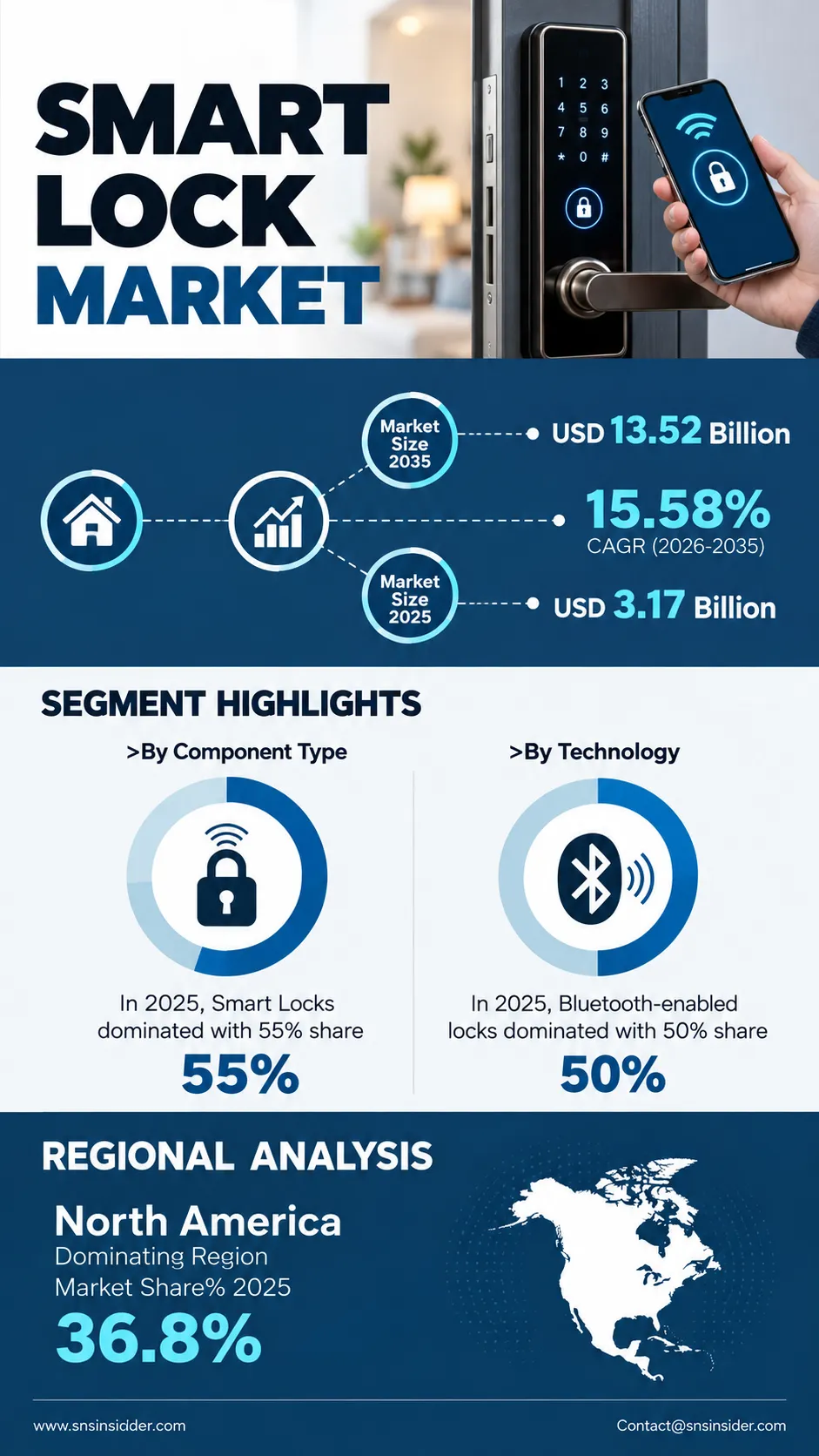
The global Smart Lock Market is gaining momentum as households, businesses, and hospitality providers increasingly adopt connected access control solutions. “According to a recent study by SNS Insider, the global Smart Lock Market size valued at USD 3.17 billion in 2025, is anticipated to grow to USD 13.52 billion by 2035, registering a CAGR of 15.58% over the 2026–2035 forecast period.”
As the need for more convenient entry management, better property security, and remote access features increases, the adoption of intelligent lock systems is being promoted. The application of smartphones, home automation, and building automation systems is enabling the use of smart locks both in domestic and commercial settings.
Technological advances related to wireless connectivity, biometric recognition, and digital authentication technology are further aiding in the development of the market. With increasing adoption of connected infrastructure, technology providers have become more interested in developing products with advanced access management and improved security.
To Get Detailed Insights on the Smart Lock Market – Request a Sample Report
Smart Home Adoption Creates New Growth Opportunities
The development of intelligent residential infrastructure is presenting a business opportunity for manufacturers of intelligent locks. This is because homeowners are becoming more interested in looking for other means apart from using traditional keys that allow remote access and digital credentials via mobile phone apps.
Property managers and hospitality establishments are also incorporating the use of access management to streamline key control operations and enhance efficiency in their operations. Intelligent locks can be used for managing check-ins of guests, employee access, and security administration.
Nevertheless, issues of cybersecurity, cost of installation, and compatibility with door locks currently in use are still relevant points. Manufacturers that pay attention to these issues will be able to solve these problems more effectively.
Key Market Insights Highlight Shifting Demand Patterns
By component type, smart locks segment accounted for around 55% of market revenue in 2025, reflecting growing demand for integrated electronic locking systems. Smart keys are projected to register the fastest growth through 2035 as digital credentials and flexible access management gain wider acceptance.
Based on technology, Bluetooth-enabled locks held around 50% market share in 2025, supported by smartphone compatibility, convenient operation, and relatively accessible implementation costs. Biometric and fingerprint-enabled locks are expected to grow fastest during the forecast period as users increasingly prioritize identity-based authentication and enhanced access control.
By application, residential installations represented around 48% of market revenue in 2025, driven by smart home adoption and demand for convenient property access. Hospitality is projected to be the fastest-growing application segment as hotels, resorts, and serviced accommodation providers expand contactless entry and automated guest management.
By end user, homeowners led by holding 50% of market revenue in 2025, reflecting rising interest in connected residential security. Hotels and resorts are projected to experience the fastest growth through 2035, supported by tourism infrastructure development and the adoption of digital property management systems.
Connected Security Technologies Transform Access Management
Increasingly, smart locks have become integrated into larger ecosystems of security rather than being used as standalone products. The integration with security cameras, doorbell cameras, alarm systems, and voice assistants provides the ability for users to link up access control with other property services.
Fingerprint recognition, encryption, and cloud-based administration are some of the developments that have added to the functionality of these products. In cases where businesses use multiple properties, access control can help in updating credentials without having to distribute physical keys.
The emergence of interoperable platforms for smart homes will also continue to have an effect on purchases, especially when consumers look for connected products that work in the current digital ecosystem.
North America Leads Smart Lock Market While Asia Pacific Advances at a 16.25% CAGR Through 2035
North America holds the promise to generate 36.8% of the Global Smart Lock Market's revenue by 2025, owing to high smart homes adoption rate, prevalent use of connected devices, and high demand for superior security systems at both residential and commercial levels. Developed technology environment along with growing hospitality sector will help in market growth.
Asia Pacific is forecasted to become the fastest-growing regional market for the coming decade, with a CAGR of 16.25% till 2035. Growing urbanization, rising disposable income, increasing constructions, and growing popularity of connected homes have driven the market in the region comprising China, India, Japan, and Southeast Asia.
Europe is reaping benefits out of the adoption of smart homes along with the investments made in connected buildings. Latin America and Middle East & Africa have emerged as lucrative regions for market participants owing to increasing urbanization and hospitality sector.
Industry Participants Focus on Product Innovation
The competition in the smart locks sector is increasing as firms work to improve on aspects such as biometrics, wireless connection, cybersecurity and integration with home automation platforms. Through partnerships with real estate developers, hospitality firms and other technology firms, the firms are working towards expanding their distribution channels.
Key companies operating in the global Smart Lock Market include August Home, Yale, Schlage, Kwikset, ASSA ABLOY, Level Home, Ring, Samsung SmartThings, Danalock, Nuki, Lockly, Eufy Security, Honeywell, ZKTeco, Ultraloq, Igloohome, CANDY HOUSE, Zebra Technologies, Alfred, and FIBARO.
An SNS Insider analyst Sushant Kadam commented, “The growing convergence of smart home technology, digital authentication, and connected building security is creating significant opportunities for smart lock manufacturers. Companies that deliver reliable cybersecurity, seamless device integration, and user-friendly access management solutions will be well positioned to benefit from rising demand across residential, commercial, and hospitality markets.”
About the Author

Get in touch