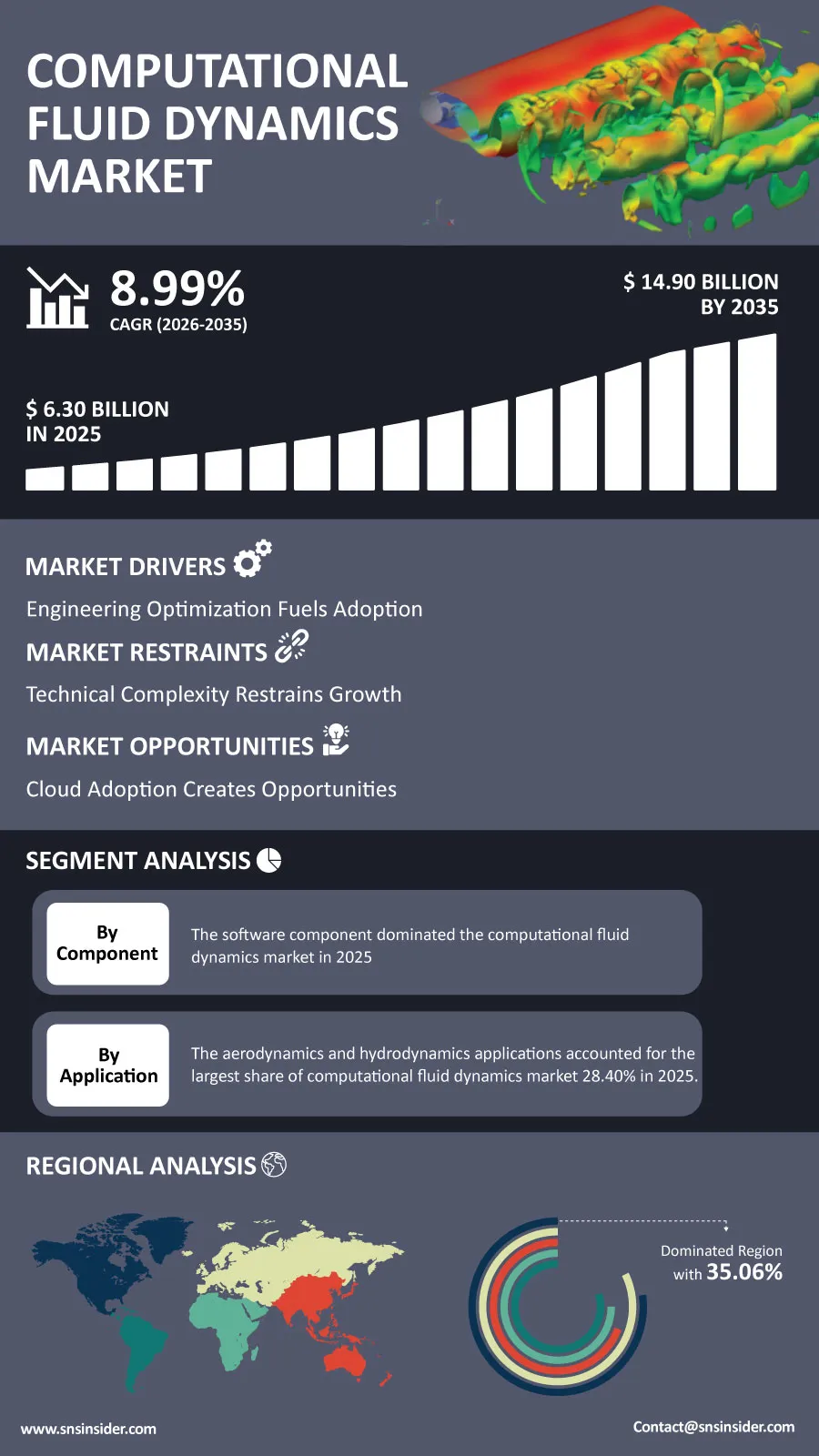
The global Computational Fluid Dynamics Market is entering a new phase of growth as manufacturers and engineering organizations accelerate digital simulation strategies to improve product performance while reducing development costs. “According to a recent study by SNS Insider, the Computational Fluid Dynamics Market size valued at USD 6.30 billion in 2025, is anticipated to grow to USD 14.90 billion by 2035, registering a CAGR of 8.99% over the 2026–2035 forecast period.”
Growing pressure to shorten product development timelines is encouraging companies to replace multiple physical prototypes with advanced digital simulations. Engineering teams are increasingly using computational fluid dynamics to evaluate airflow, heat transfer, pressure distribution, and fluid behavior before manufacturing begins, improving design accuracy while minimizing engineering risks.
The technology is also becoming more accessible as cloud computing, artificial intelligence, and high-performance computing platforms make sophisticated simulations available to organizations of all sizes. Industries ranging from aerospace and automotive to healthcare, energy, and electronics are integrating CFD into everyday product development workflows to improve operational efficiency and accelerate innovation.
To Get Detailed Insights on the Computational Fluid Dynamics Market – Request a Sample Report
Cloud-Based Engineering Platforms Create New Growth Opportunities
Simulation platforms are being improved by engineering companies by adopting cloud-based computing platforms that overcome most of the physical constraints faced with conventional deployments. Subscription-based models have allowed corporations to grow their computing capability based on project needs while reducing capital expenditure on infrastructure.
Further advancements in artificial intelligence can help change simulation by improving meshing, automating tedious engineering processes, and increasing the speed of solvers. Such features allow engineers to analyze many design options during shorter time frames and help accelerate the commercialization process of future products.
Growing demand for digital twins in industry operations opens up immense possibilities for CFD software suppliers. Virtual replicas of manufacturing machinery, energy assets, and transportation infrastructure rely greatly on simulations of fluids and heat transfer.
Key Market Insights Highlight Shifting Demand Patterns
Based on deployment mode, on-premise solutions accounted for 60.30% of market revenue in 2025 as organizations handling complex engineering workloads continue to prioritize infrastructure control and high-performance computing environments. Meanwhile, cloud-based deployment is projected to register the fastest growth through 2035 as enterprises seek greater scalability and cost efficiency.
By component, software represented 55.50% of total market revenue in 2025 due to strong adoption across engineering-intensive industries. Services are expected to witness the fastest expansion over the forecast period as organizations increasingly require implementation, consulting, customization, and technical support.
In terms of application, aerodynamics & hydrodynamics generated 28.40% of market revenue in 2025, reflecting widespread demand from transportation and industrial sectors. Multiphase flow is anticipated to record the highest growth rate through 2035 owing to expanding applications across chemical processing, energy production, pharmaceuticals, and advanced manufacturing.
Artificial Intelligence Accelerates Next-Generation Simulation Capabilities
Innovations in the field of technology bring forth new solutions which help make simulation faster without compromising the computational accuracy. Automation through AI technology, GPU, and machine learning has enabled engineering groups to run complex simulations in less time than ever before.
Computational fluid dynamics is being coupled with other digital engineering technologies like structural analysis and thermal modeling as well. With this design process, organizations can effectively optimize their products across different engineering functions and foster collaboration within distributed development teams.
North America Held 35.06% of the Computational Fluid Dynamics Market Share in 2025; Asia Pacific Projected to Register the Fastest CAGR Through 2035
The North American region held 35.06% share in terms of global market revenue in 2025, attributed to high usage in the aerospace, defense, automotive, and industrial manufacturing industries. The sustained investments in engineering software and engineering R&D have been contributing positively towards the dominance of the region.
Asia-Pacific region is anticipated to be the fastest growing region till 2035, attributed to rapid industrialization, increased manufacturing capabilities, and investments in engineering research driving adoption of simulation technology. High demands from the countries, such as China, India, Japan, and other regional economies will provide favorable conditions for software suppliers as well as engineering services providers.
The European region will continue to hold its strong position owing to investments in sustainable manufacturing, innovations in automotive industry, and renewable energy projects. Focus on energy-efficient product development will drive demand for simulation technology within the region.
Industry Participants Focus on Intelligent Simulation Platforms
Competition within the computational fluid dynamics industry continues to intensify as software developers expand cloud capabilities, integrate artificial intelligence, and strengthen multiphysics simulation portfolios. Strategic investments in scalable computing infrastructure and engineering automation are helping vendors address evolving customer requirements across industrial sectors.
Key companies operating in the global Computational Fluid Dynamics Market include Siemens Digital Industries Software, Dassault Systèmes, Autodesk Inc., COMSOL Inc., Altair Engineering Inc., Hexagon AB, Cadence Design Systems Inc., SimScale GmbH, Convergent Science Inc., AVL List GmbH, Gamma Technologies Inc., Flow Science Inc., CPFD Software LLC, Tecplot Inc., OpenCFD Ltd., BETA CAE Systems, CHAM Ltd., Cradle CFD, Flexcompute Inc., and Rescale Inc.
An SNS Insider analyst Sakshi Kale commented, "The convergence of cloud computing, artificial intelligence, and high-performance simulation technologies is reshaping engineering workflows worldwide. Organizations adopting advanced computational fluid dynamics platforms are improving design efficiency, accelerating product innovation, and reducing development costs across increasingly competitive industrial markets."
About the Author

Get in touch