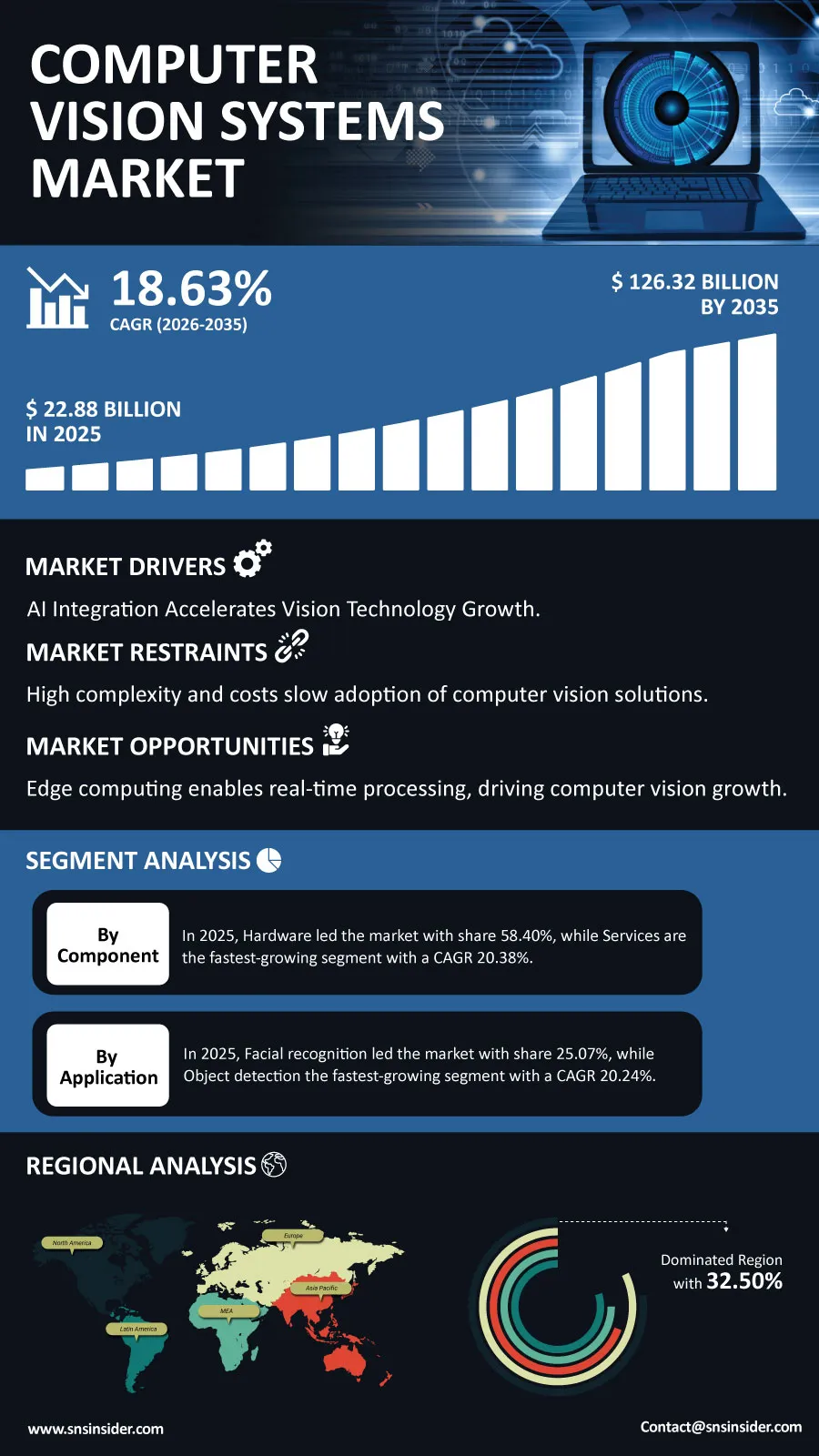
The global Computer Vision Systems Market is entering a new phase of expansion as organizations increasingly deploy artificial intelligence-powered imaging technologies to automate complex visual tasks and improve operational accuracy. “According to a recent study by SNS Insider, the global Computer Vision Systems Market size valued at USD 22.88 billion in 2025, is anticipated to grow to USD 126.32 billion by 2035, registering a CAGR of 18.63% over the 2026–2035 forecast period.”
Increases in intelligent automation investment are transforming production environments, hospitals, retailers, and transport networks globally. Businesses are adopting smart vision technology for better quality control, increased workplace safety, better customer experience, and quicker decision-making through images.
The development of artificial intelligence algorithms, powerful computing, and imaging technologies makes it possible for computer vision technology to analyze visual information in an efficient manner. The need for vision technology adoption by businesses is increasing as a result of modernization of digital infrastructures.
To Get Detailed Insights on the Computer Vision Systems Market – Request a Sample Report
AI Innovation and Industrial Automation Generate New Growth Opportunities
With the increasing adoption of autonomy, there arise immense opportunities for technology companies that develop intelligent vision systems. Companies are in need of a solution that can help detect defects, inspect machinery, track assets, analyze surroundings with little to no human input.
Edge computing, on the other hand, changes the game by bringing image processing directly to connected devices rather than depending solely on cloud infrastructure. The method eliminates any delays, speeds up response time, and helps ensure reliable operation in situations when decisions have to be made immediately.
The increasing popularity of robotics, intelligent surveillance, autonomous mobility, and smart manufacturing ensures increased future demand. In terms of prioritizing efficiency and productivity, computer vision becomes a crucial part of digital transformation.
Key Market Insights Highlight Changing Enterprise Adoption
Based on component, hardware accounted for 58.40% of global market revenue in 2025, supported by widespread deployment of advanced cameras, processors, sensors, and imaging equipment. Meanwhile, the services segment is projected to register the fastest growth through 2035 as enterprises increasingly require implementation, integration, consulting, and AI optimization services.
By deployment mode, on-premises solutions represented 65.10% of market revenue during 2025 owing to growing enterprise requirements for operational control and data security. Edge computing devices are anticipated to record the fastest expansion over the forecast period as organizations prioritize real-time analytics and low-latency processing.
In terms of application, facial recognition captured 25.07% of market revenue in 2025 because of strong adoption across identity verification and security applications. Object detection is expected to witness the highest growth rate through 2035 as industrial automation, robotics, and logistics operations increasingly depend on intelligent visual recognition.
Advanced AI Platforms Accelerate Technology Evolution
Constant innovations in the fields of artificial intelligence, deep learning, and high-resolution imagery have greatly contributed to the advancements made in the field of computer vision technology. Companies are releasing products that can perform analyses on complicated visual data at a faster rate than before.
Multimodal artificial intelligence is being incorporated into software development by developers, where such models use not only contextual data but also advanced imaging technology, which helps the model understand visual information. Such developments are being used for predictive maintenance and decision-making support systems in enterprises.
North America Held 32.50% of the Computer Vision Systems Market Share in 2025; Asia Pacific Projected to Register the Fastest CAGR Through 2035
The North American region contributed 32.50% of the total market revenues in 2025 driven by the broad implementation of artificial intelligence solutions, substantial investment in industrial automation, and innovation in technology in manufacturing, healthcare, automotive, and retail segments. It also receives strong support from research activity and continuous advancements in digital infrastructure.
The Asia-Pacific region would witness the fastest rate of growth during 2035 due to rapid industrialization, growing adoption of smart manufacturing, and rising investments in robotics and intelligent infrastructure. Growing support from governments in digital transformation and evolving AI ecosystems have also further boosted market opportunities in this region.
The Europe region continues its momentum with continuous advancement in its industrial facilities, growing initiatives for smart factories, and rising need for automated quality inspection technologies. Adoption in healthcare, automotive, and logistics industry would help boost growth in the region.
Industry Participants Prioritize AI Performance and Scalable Vision Solutions
Competition within the Computer Vision Systems Market continues to intensify as technology providers invest in advanced AI processors, edge computing capabilities, cloud integration, and intelligent imaging software. Companies are expanding research initiatives to improve processing speed, energy efficiency, and deployment flexibility while addressing growing enterprise requirements for scalable automation solutions.
Key companies operating in the global Computer Vision Systems Market include NVIDIA, Intel, AMD, Qualcomm, Ambarella, Teledyne Technologies, Omron Corporation, Keyence Corporation, Microsoft, Amazon Web Services (AWS), Google Cloud, IBM, OpenCV.ai, Roboflow, Matrox Imaging, Allied Vision Technologies, Mobileye (Intel), Tesla, Aptiv, and World Labs.
An SNS Insider analyst Sakshi Kale commented, "Growing enterprise investment in artificial intelligence, industrial automation, and intelligent imaging technologies is transforming computer vision from a specialized capability into a core digital infrastructure solution. Organizations focusing on scalable AI platforms, edge intelligence, and advanced visual analytics are expected to unlock significant long-term growth opportunities as adoption expands across multiple industries."
About the Author

Get in touch