
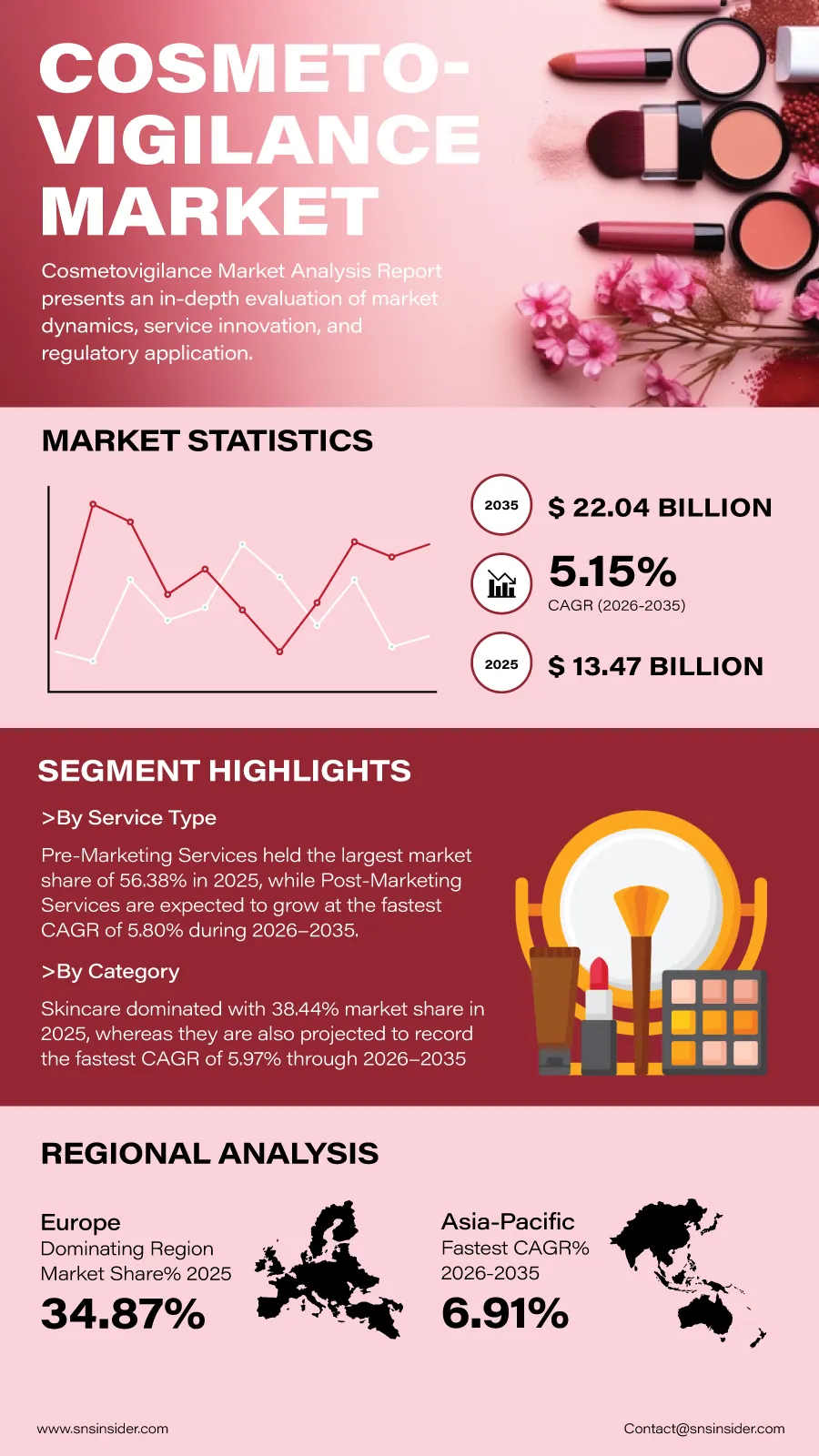
The global Cosmetovigilance Market is anticipated to grow consistently in the coming years due to increasing initiatives on the part of cosmetic manufacturers and other stakeholders in this regard. “According to a recent study by SNS Insider, the global Cosmetovigilance Market size valued at USD 13.47 billion in 2025, is anticipated to grow to USD 22.04 billion by 2035, registering a CAGR of 5.15% over the 2026–2035 forecast period.”
The cosmetic sector is experiencing a major change where firms are becoming more focused on implementing safety monitoring during all stages of the product life cycle. The rising consumer knowledge about ingredient disclosure, adverse events, and product quality makes the firms implement safety monitoring mechanisms that can quickly detect any safety issues.
In the meantime, regulatory bodies in major markets keep upping their compliance expectations, thus opening the way to innovative cosmetovigilance services that allow to conduct surveillance on products both pre- and post-commercialization.
To Get Detailed Insights on the Cosmetovigilance Market – Request a Free Sample Report
Digital Technologies Are Transforming Cosmetic Safety Monitoring
Technology is shaping the way safety information on cosmetic products is gathered, processed and managed. Through artificial intelligence and machine learning technology, companies can effectively analyze large quantities of safety-related data to uncover any potential trends and make decisions.
There has been increased integration of automated systems such as reporting, compliance and real-time monitoring in the regulatory processes. This allows for more efficient processes and helps detect issues associated with the products.
Increasing collaboration between cosmetic manufacturers, dermatologists and regulatory bodies is becoming commonplace in product safety management.
Key Market Findings Highlight Emerging Opportunities
Among service categories, pre-marketing services accounted for 56.38% of global market revenue in 2025, reflecting the industry's strong focus on product evaluation, regulatory documentation, and safety assessment before commercial launch.
Meanwhile, post-marketing services are projected to record the fastest growth through 2035, expanding at a CAGR of 5.80%, driven by increasing regulatory expectations and growing emphasis on continuous product surveillance following commercialization.
By product category, skincare represented 38.44% of total market revenue in 2025, supported by strong consumer demand and increasing focus on monitoring products designed for daily use. The skincare segment is also expected to maintain the fastest growth trajectory, advancing at a CAGR of 5.97% during the forecast period.
From a service delivery perspective, in-house operations accounted for 56.94% of market revenue in 2025, reflecting manufacturers' preference for maintaining direct oversight of regulatory and safety activities. However, contract outsourcing is expected to expand at the fastest CAGR of 5.79%, as organizations increasingly seek specialized expertise and scalable compliance solutions.
Among end users, cosmetic manufacturers held 57.51% of global market revenue in 2025, while dermatology clinics and hospitals are anticipated to register the fastest growth, recording a CAGR of 7.42% through 2035, highlighting their growing contribution to adverse event reporting and product safety monitoring.
An Infographic Representation of the Global Cosmetovigilance Market
Consumer Safety and Regulatory Compliance Continue to Shape Industry Priorities
Complexity of the global regulatory framework is leading cosmetic firms to invest in compliance within their organizations, alongside greater transparency and documentation regarding their products.
The firms are developing safety management systems, which would be capable of facilitating risk assessment, adverse event reporting, regulatory submission, and quality management processes for their products. Such actions would allow firms to improve operational efficiency while meeting new compliance requirements.
Another significant factor is the rising need for consumer trust, which is leading manufacturers to implement proactive monitoring strategies for ensuring the quality of their products.
Regional Markets Continue to Expand
The Europe market share was estimated at 34.87%, based on the well-developed regulatory framework, high consumer awareness, and the widespread application of safety regulations in the cosmetics industry. Europe is still the global leader of cosmetovigilance due to continuous regulatory reforms and active involvement of the industry.
Meanwhile, the Asia-Pacific region is expected to witness the highest growth rate with a CAGR of 6.91%, up to 2035. Increased demand for cosmetics, growing middle class population, changes in regulatory policies, and use of digital compliance tools have opened up several avenues for market players.
Industry Leaders Focus on Compliance Innovation
Competition within the cosmetovigilance market continues to evolve as service providers expand their capabilities through digital innovation, regulatory expertise, and artificial intelligence-enabled safety solutions.
Leading companies operating in the global cosmetovigilance market include Pharmalex, Freyr, Arriello, Oviya MedSafe, Cliantha Research, Parexel, ICON plc, MakroCare, Accenture, and QPS.
An SNS Insider analyst Parry Kardani commented, "Cosmetic product safety is becoming a strategic priority for manufacturers operating in an increasingly regulated and consumer-driven marketplace. The integration of digital technologies, advanced analytics, and proactive surveillance practices is expected to redefine cosmetovigilance over the coming decade while creating new opportunities for specialized service providers."
About the Author

Get in touch




