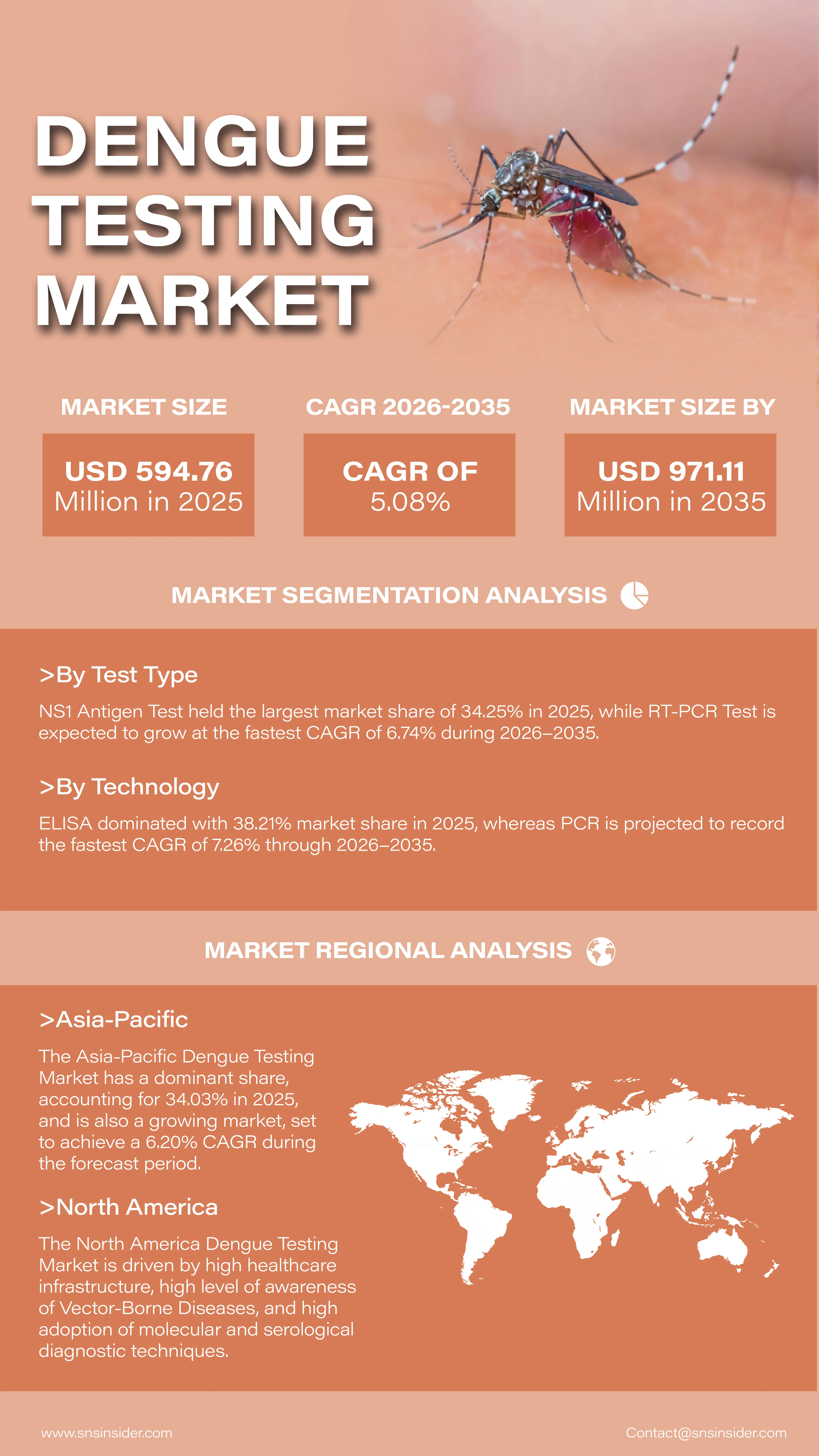
The global Dengue Testing Market is expected to witness steady expansion over the next decade as healthcare systems strengthen infectious disease surveillance and improve access to rapid diagnostic technologies. “According to a recent study by SNS Insider, the global Dengue Testing Market size valued at USD 594.76 million in 2025, is anticipated to grow to USD 971.11 million by 2035, registering a CAGR of 5.08% over the 2026–2035 forecast period.”
The importance of timely detection of diseases, improved lab services, and better preparation of public health is resulting in the growing need for accurate diagnoses both at endemic and emerging areas. Testing capacity is being increased by governments, medical professionals, and international health organizations so that it can help make better clinical decisions and disease monitoring.
As vector-borne diseases remain a significant public health concern, investments in advanced diagnostic technologies are expected to play a critical role in improving outbreak response and strengthening healthcare resilience worldwide.
Innovation in Diagnostic Technologies Enhances Disease Detection
Continued improvements in laboratory-based diagnostic methods are helping to improve the efficiency of dengue diagnosis processes. Modern technologies allow doctors to diagnose diseases at an early stage and provide better clinical management and surveillance of infections.
The increasing use of molecular diagnostics, automation in laboratory practice, and portable technologies is helping healthcare providers to provide timely results and increase their efficiency. This technology provides wider opportunities for conducting tests not only in large hospitals but also in other institutions such as community clinics and public health centers.
At the same time, manufacturers are trying to develop technologies that will make test procedures easier to conduct but still allow the processing of large volumes of tests in seasons of outbreaks.
Key Market Findings Highlight Emerging Growth Opportunities
Among test categories, NS1 antigen tests accounted for 34.25% of global market revenue in 2025, reflecting their widespread adoption for early-stage dengue detection across healthcare facilities.
Meanwhile, RT-PCR testing is projected to register the fastest growth through 2035, advancing at a CAGR of 6.74%, driven by increasing demand for highly sensitive molecular diagnostic methods and expanding laboratory capabilities.
Technology trends continue to evolve rapidly. ELISA represented 38.21% of total market revenue in 2025, maintaining its importance in diagnostic laboratories and public health surveillance programs. At the same time, PCR-based technologies are expected to record the fastest growth, expanding at a CAGR of 7.26% during the forecast period, supported by continuous advancements in molecular diagnostics.
By product category, test kits held 52.25% of global market revenue in 2025, reflecting their widespread use across hospitals, diagnostic laboratories, and community healthcare settings. Reagents and consumables are anticipated to experience the fastest growth at a CAGR of 6.43%, supported by increasing testing volumes and recurring laboratory demand.
Among end users, hospitals accounted for 40.12% of market revenue in 2025, while public health laboratories are expected to emerge as the fastest-growing segment, expanding at a CAGR of 5.47% through 2035, reflecting increasing investments in national disease surveillance programs.
An Infographic Representation of the Global Dengue Testing Market
Public Health Preparedness Continues to Drive Market Expansion
Improvement of infectious disease surveillance has become a major health care issue in many countries. Health organizations are improving lab networks and making it easier to have better diagnostics and quick tests available for early identification and containment of outbreaks.
Greater cooperation between health care facilities, test makers, and government bodies has helped in quicker use of new technologies in the field of testing. It helps not only improve surveillance but respond to new challenges in public health.
Regional Markets Continue to Present Strong Growth Potential
In 2025, the Asia Pacific region made up 34.03% of the world market revenue due to the growing infrastructure for healthcare facilities, improved access to diagnostics, and investments in the management of infections. The region continues to be an important market due to monitoring initiatives and the usage of more advanced tests.
Also, Asia Pacific is expected to show the highest regional CAGR of 6.20% up until 2035 due to healthcare modernization, lab capacity, increased awareness, and government focus on the management of vector-borne diseases.
Industry Leaders Continue to Advance Diagnostic Innovation
There is still competition in the dengue testing industry as there is continuous investment by the companies in the field of molecular diagnostics, rapid tests, lab automation, and surveillance of infectious diseases. Innovation and collaboration in this field play an important role in ensuring the improvement of testing methods and laboratory efficiency.
Leading companies operating in the global dengue testing market include F. Hoffmann-La Roche, Abbott Laboratories, Thermo Fisher Scientific, Siemens Healthineers, Bio-Rad Laboratories, QIAGEN, Hologic, Danaher Corporation, Becton, Dickinson and Company, and bioMérieux.
An SNS Insider analyst Parry Kardani commented, "Growing emphasis on early diagnosis, stronger infectious disease surveillance, and continuous advances in molecular and point-of-care diagnostics are reshaping the global dengue testing landscape. Organizations investing in rapid, accurate, and scalable diagnostic technologies are expected to benefit from expanding healthcare demand over the coming decade."
About the Author

Get in touch