
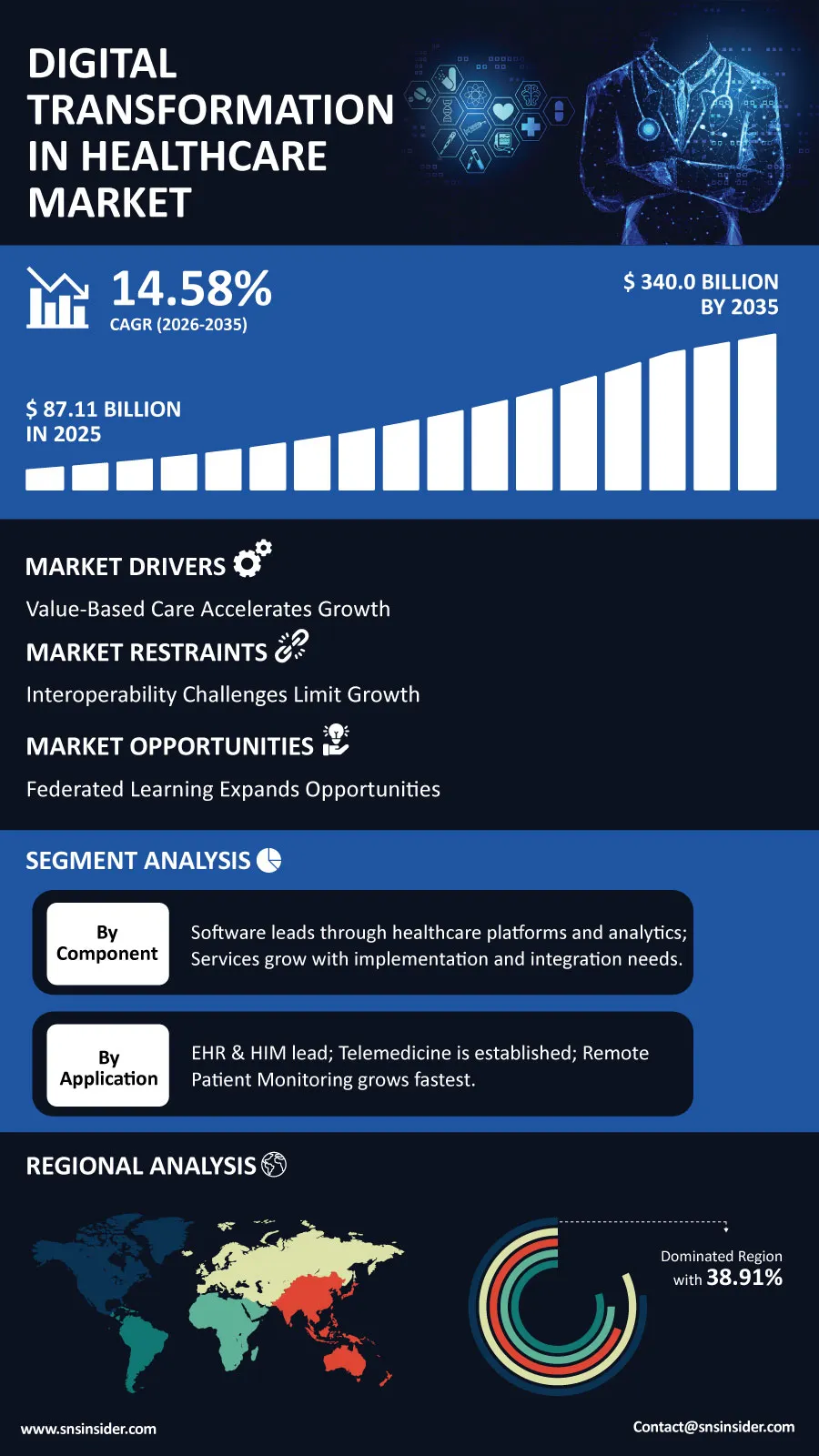
The global Digital Transformation in Healthcare Market is entering a new phase of innovation as healthcare providers increasingly adopt intelligent technologies to improve patient outcomes, streamline operations, and strengthen clinical decision-making. "According to a recent study by SNS Insider, the global Digital Transformation in Healthcare Market size valued at USD 87.11 billion in 2025, is anticipated to grow to USD 340.0 billion by 2035, registering a CAGR of 14.58% over the 2026–2035 forecast period."
There is an increased investment in the development and deployment of AI-based diagnostic tools, cloud computing technologies for healthcare applications, connectivity devices, and analytics systems by healthcare institutions around the world in order to increase the quality of care provision amidst rising operating expenses. The rising trend towards personalization of care, increase in virtual healthcare services, and government support for digital health projects is transforming the existing healthcare landscape.
To Get Detailed Insights on the Digital Transformation in Healthcare Market – Request a Sample Report
AI and Connected Healthcare Technologies Transform Clinical Operations
The healthcare industry is becoming more reliant on digital technology in increasing efficiency during diagnosis, planning for treatment, and managing patients over the long term. Artificial intelligence has been helping doctors interpret imaging tests quickly, predict possible outcomes, and automate the process of record-keeping. Cloud computing helps to access patient information wherever the care occurs.
Medical devices, wearable technologies, and remote monitoring tools are facilitating the process of chronic disease monitoring outside the hospital setting. Digital patient engagement, telehealth applications, and intelligent scheduling software can also help increase access to healthcare and decrease the administrative workload of the health practitioners.
Key Market Findings Highlight High-Growth Opportunities
Healthcare providers accounted for approximately 45.33% of market revenue in 2025, reflecting continued investments by hospitals, diagnostic centers, and integrated healthcare networks. Patients represent the fastest-growing end-user segment and are projected to expand at a 16.95% CAGR through 2035 as consumer adoption of telehealth, wearable devices, and digital care platforms continues to rise.
Artificial Intelligence remained both the dominant and fastest-growing technology segment in 2025, supported by widespread applications in clinical documentation, diagnostic imaging, predictive analytics, and drug discovery. IoT-enabled connected medical devices also continue to gain momentum through remote monitoring and smart healthcare infrastructure.
Software solutions generated the largest component revenue as healthcare organizations increasingly deployed SaaS platforms, clinical decision support systems, and healthcare analytics. Professional services continue expanding alongside implementation, integration, cybersecurity, and managed service requirements.
Among applications, Electronic Health Records and Health Information Management maintained the largest installed base, while Remote Patient Monitoring emerged as the fastest-growing application due to expanding use of wearable devices and home-based monitoring technologies. Telemedicine also remains a major contributor following sustained virtual care adoption.
Digital Innovation Improves Healthcare Accessibility and Efficiency
Healthcare providers are now concentrating on technologies that help streamline clinical processes and provide more personalized patient care. The use of automation technologies for clinical documentation, intelligence systems for communications with patients, and predictive care management technologies is making physicians’ work easier while increasing productivity.
There is also growing focus on cybersecurity, governance of data, and interoperability in the wake of greater amounts of data exchange via cloud-based platforms. This trend of investment in secure digital ecosystems will persist as healthcare organizations increasingly implement AI technologies and exchange cross-platform data.
Regional Markets Maintain Strong Investment Momentum
North America continued to be the largest regional market during 2025, accounting for an estimated 38.91% share of total revenue. United States contributed almost 85.4% of the regional revenue due to developed healthcare IT infrastructure, regulations, robust technological investments, and wide adoption of digital healthcare solutions. The revenue generated by the U.S. market stood at an estimated USD 28.03 billion in 2025 and is anticipated to increase up to almost USD 99.5 billion by 2035 at a CAGR of 13.45%.
Asia Pacific region will register the highest CAGR of 16.95% over 2025-2035 driven by continuous investment in digital healthcare infrastructure, artificial intelligence innovations, and interconnected healthcare systems. China contributed an estimated 40.6% of the revenues in the Asia Pacific region during 2025.
Europe continues advancing healthcare modernization through national digital health initiatives, with the United Kingdom contributing approximately 24.8% of regional revenues. The UAE represented 29.3% of Middle East & Africa revenues, while Brazil accounted for 43.8% of Latin American market revenue during 2025.
Industry Leaders Expand Digital Healthcare Capabilities
Competition across the digital healthcare landscape continues to intensify as major technology providers introduce advanced AI platforms, cloud-based healthcare infrastructure, and intelligent clinical workflow solutions. Strategic partnerships, product innovation, and expanding interoperability capabilities remain central to long-term competitive positioning.
Major companies operating in the global Digital Transformation in Healthcare Market include Oracle Health (Cerner), Epic Systems Corporation, Philips Healthcare, Siemens Healthineers AG, GE HealthCare Technologies Inc., IBM Corporation, McKesson Corporation, Allscripts Healthcare Solutions, Microsoft Corporation (Azure), Amazon Web Services Inc., Google Cloud (Alphabet Inc.), Cisco Systems Inc., SAP SE, Salesforce Inc., Qualcomm Inc., Teladoc Health Inc., Veeva Systems Inc., Meditech, Change Healthcare (Optum), and Inovalon Holdings Inc.
An SNS Insider analyst Parry Kardani commented, "Healthcare organizations are entering a technology-driven transformation era where artificial intelligence, cloud computing, connected devices, and advanced analytics are becoming foundational capabilities. Companies delivering secure, interoperable, and clinically impactful digital solutions will be well positioned to capture long-term growth opportunities across the evolving global healthcare ecosystem."
About the Author

Get in touch




