
Digital Transformation in Healthcare Market Report Scope & Overview:
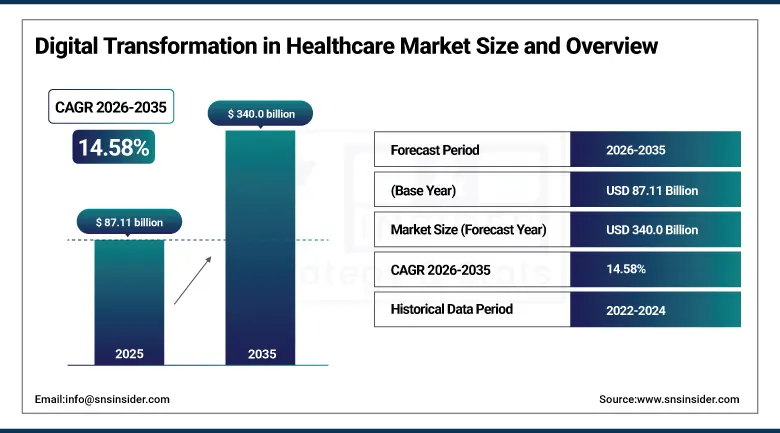
The Digital Transformation in Healthcare Market was valued at USD 87.11 billion in 2025 and is expected to reach USD 340.0 billion by 2035, growing at a CAGR of 14.58% from 2026–2035.
Digital transformation in healthcare represents the comprehensive integration of advanced digital technologies including artificial intelligence, Internet of Things connected medical devices, cloud computing, big data analytics, blockchain-based data security, and mobile health applications into the full spectrum of healthcare delivery, administration, clinical decision-making, drug discovery, and patient engagement functions that collectively constitute the modern healthcare system. Unlike the narrower concept of healthcare IT adoption that characterised the industry's first digital wave focused on electronic health record implementation and administrative billing system digitalization, the current digital transformation phase encompasses a fundamental reimagining of how healthcare is organised, delivered, and experienced, with digital technology enabling care models including continuous remote patient monitoring, AI-augmented clinical diagnosis, predictive population health management, and personalized precision medicine that have no direct analogue in the pre-digital healthcare landscape.
The World Health Organization's 2025 digital health strategy report confirming that digital health technologies could save 10 million lives annually and reduce healthcare costs by up to 20% if fully deployed across global healthcare systems provides the most compelling systemic justification for digital transformation investment, framing it not merely as operational efficiency improvement but as a public health imperative whose full realization requires sustained and accelerating investment across all healthcare system components.
Market Size and Forecast
-
Market Size in 2026E: USD 99.80 Billion
-
Market Size by 2035: USD 340.0 Billion
-
CAGR: 14.58% from 2026 to 2035
-
Fastest Growing Region: Asia Pacific
-
Largest Region: North America
To Get more information on Digital Transformation in Healthcare Market - Request Free Sample Report
Digital Transformation in Healthcare Market Trends
-
Generative AI is reducing clinical documentation burden through automated notes, coding, and patient communication, helping address physician burnout.
-
Remote patient monitoring using wearables, home devices, and biosensors enables continuous tracking and early intervention for chronic conditions.
-
AI-driven diagnostic imaging is improving disease detection accuracy and supporting faster, more efficient radiology and pathology workflows.
-
Cloud healthcare platforms are unifying patient data across systems, enabling better care coordination, population health management, and AI training.
-
Digital front door solutions like chatbots, portals, and telehealth tools are streamlining patient access, triage, and appointment management.
U.S. Digital Transformation in Healthcare Market Outlook
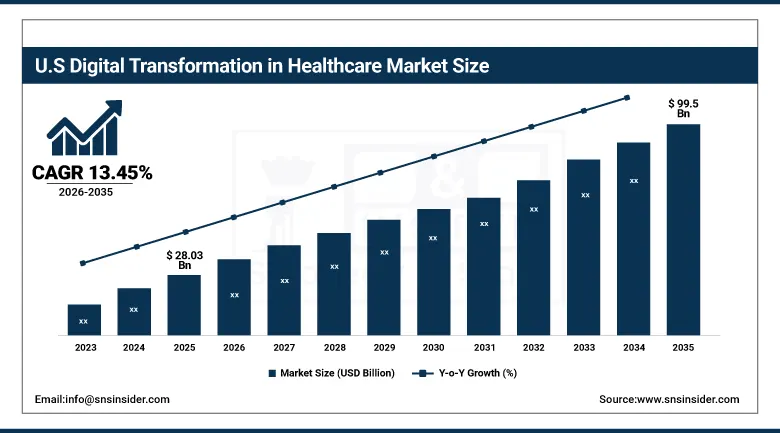
The U.S. Digital Transformation in Healthcare Market was valued at approximately USD 28.03 billion in 2025 and is expected to reach approximately USD 99.5 billion by 2035, growing at a CAGR of 13.45%.
The United States commands the world's most commercially developed healthcare digital transformation market through the combination of the highest absolute healthcare expenditure that creates both the largest problem of healthcare cost and quality and the largest economic motivation for technology-enabled improvement, the most mature health IT adoption culture that has completed foundational EHR implementation and is now investing in advanced analytics, AI, and interoperability as the second transformation wave, and the most active health technology venture capital ecosystem that has generated thousands of digital health companies competing to solve every aspect of the healthcare system's operational and clinical challenges with technology. Federal programmes including the 21st Century Cures Act's interoperability mandates, the HIPAA Privacy Rule's progressive evolution toward patient data access rights, and CMS's value-based care programmes that reward outcome improvement over procedure volume collectively create the regulatory and financial framework that motivates provider digital transformation investment.
The American Medical Association's 2025 physician survey confirming that clinical documentation burden consumed an average of 15.6 hours per physician per week, equal to approximately 37% of total working time, provides a direct measurement of the administrative inefficiency that AI-powered clinical documentation and workflow automation tools are targeting, creating a compelling personal motivation for physician champion adoption that drives technology adoption from within clinical organizations rather than through top-down IT procurement mandates.
Digital Transformation in Healthcare Market Segment Analysis
-
By End User, Healthcare Providers dominated with approximately 45.33% in 2025; Patients are the fastest-growing end user at a CAGR of 16.95% as rising demand for telehealth consultations, wearable devices, and personalized care applications increases patient direct technology engagement.
-
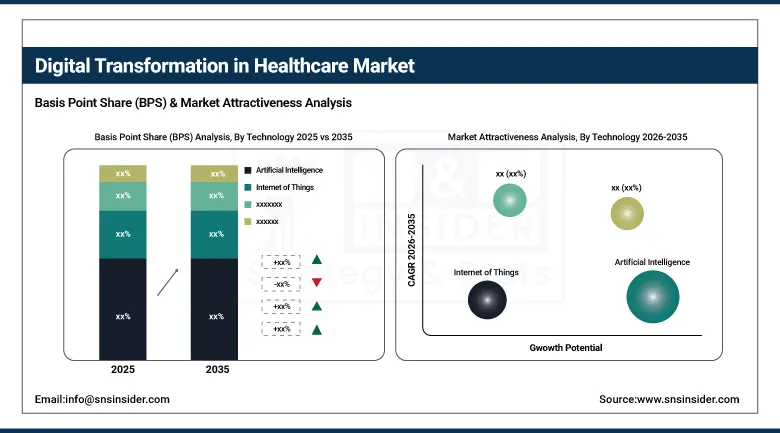
By Technology, Artificial Intelligence is the dominant and fastest-growing technology through its applications in diagnostic imaging, clinical documentation, drug discovery, and predictive analytics that are transforming every dimension of healthcare clinical and operational performance; IoT connected medical devices represent a large and growing segment through continuous remote monitoring and smart hospital equipment management.
-
By Application, EHR and Health Information Management represents the foundational digital health application serving the largest installed base; Telemedicine is a large and well-established application following its COVID-19-driven adoption surge; Remote Patient Monitoring is the fastest-growing application as wearable and home monitoring device proliferation enables continuous care outside clinical facilities.
-
By Component, Software dominated through the healthcare SaaS platforms, clinical decision support systems, and analytics applications that constitute the primary value-generating layer of healthcare digital transformation; Services are growing as implementation, integration, and managed services support for complex healthcare digital transformation programmes require substantial professional services investment alongside technology.
By Technology, AI dominates, IoT is a strong growth segment
Artificial Intelligence retained the dominant and fastest-growing technology position in the Digital Transformation in Healthcare Market in 2025, as the extraordinary breadth of AI applications across clinical decision support, diagnostic imaging, natural language processing for clinical documentation, predictive analytics for patient risk stratification, drug discovery, and administrative automation collectively represent the most commercially diverse and clinically impactful technology category in healthcare digital transformation.
IoT connected medical devices represent the infrastructure layer of healthcare's real-time data collection capability, where the proliferation of FDA-cleared medical-grade wearable sensors, continuous glucose monitors, cardiac rhythm monitors, blood pressure wearables, and smart inpatient monitoring equipment is creating the continuous patient data streams that AI analytics platforms require to provide actionable clinical insights beyond what episodic measurement at discrete clinic visits can capture.
By End User, Healthcare Providers dominate, Patients are expected to grow fastest
Healthcare Providers retained the dominant end-user position with approximately 45.33% of the Digital Transformation in Healthcare Market in 2025, as hospital systems, physician practices, diagnostic imaging centers, and integrated health networks represent the primary institutional investors in healthcare digital transformation whose capital expenditure and operational improvement motivations drive the largest individual technology procurement decisions in the market.
Patients are the fastest-growing end-user segment at a CAGR of 16.95% through 2035, reflecting the progressive shift in healthcare delivery models toward patient-centered and consumer-oriented models where patients are active participants in their health management through the digital health platforms, wearable devices, and telehealth services that enable continuous engagement with their health status and care team beyond the episodic clinic visit model that traditional healthcare delivery has been built around.
Regional Insights
|
Region |
Major Country |
Share within Region, 2025 (%) |
|---|---|---|
|
North America |
United States |
85.4% |
|
Europe |
United Kingdom |
24.8% |
|
Asia Pacific |
China |
40.6% |
|
Middle East & Africa |
UAE |
29.3% |
|
Latin America |
Brazil |
43.8% |
North America Digital Transformation in Healthcare Market Insights
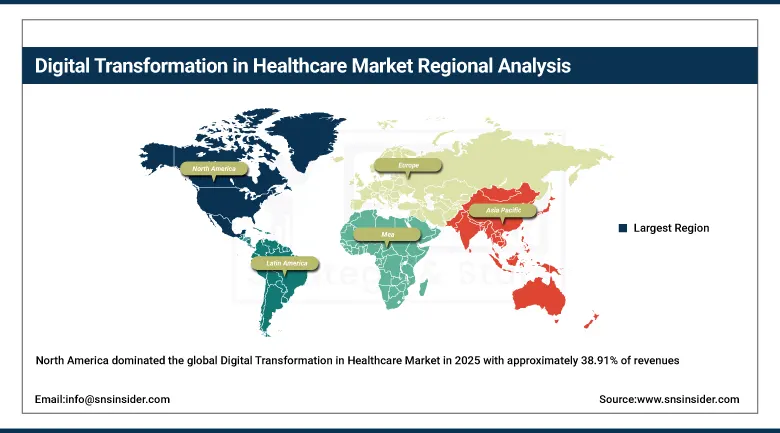
North America dominated the global Digital Transformation in Healthcare Market in 2025 with approximately 38.91% of revenues, with the United States accounting for approximately 85.4% of North American revenues as the most commercially advanced healthcare technology market globally. The region's leadership reflects the combination of the highest absolute healthcare technology investment in the world, the most mature EHR adoption providing the digital data foundation for advanced analytics and AI applications, the most active health technology start-up ecosystem, and the progressive federal regulatory framework that has mandated interoperability, patient data access, and clinical decision support integration standards that create compliance-driven investment demand across the entire U.S. healthcare provider market.
Get Customized Report as per Your Business Requirement - Enquiry Now
Europe Digital Transformation in Healthcare Market Insights
Europe is a large and technically sophisticated healthcare digital transformation market characterised by the European Health Data Space initiative creating a pan-European framework for health data sharing, national digital health strategies in the United Kingdom, Germany, France, Sweden, and Denmark that have established comprehensive electronic health record, telemedicine, and digital health service infrastructures, and the GDPR's health data privacy requirements that shape how healthcare organizations collect, process, and share patient data in digital transformation implementations. The United Kingdom accounts for approximately 24.8% of European revenues through the NHS's extensive digital health programme encompassing GP Connect data sharing, NHS App patient engagement platform, and the AI diagnostics investment programme that is deploying commercial AI diagnostic tools across NHS clinical pathways.
Asia Pacific Digital Transformation in Healthcare Market Insights
Asia Pacific is the fastest-growing healthcare digital transformation market with a CAGR of 16.95%, driven by extraordinary government digital health investment across China, India, South Korea, Japan, Singapore, and Australia whose national digital health strategies are creating the regulatory frameworks, technology standards, and procurement programmes that accelerate commercial healthcare digital transformation adoption. China accounts for approximately 40.6% of Asia Pacific revenues through its combination of the world's most ambitious national digital health infrastructure programme, the extraordinary scale of Chinese technology company investment in healthcare AI, and the government-mandated adoption of electronic health records and telemedicine platforms across China's enormous hospital network that is creating the largest single-country healthcare IT adoption programme in history.
MEA & Latin America Digital Transformation in Healthcare Market Insights
The Middle East and Africa and Latin America are growing healthcare digital transformation markets where government investment in healthcare technology modernization, expanding private healthcare sector investment in digital patient experience, and the particular urgency of using technology to extend healthcare access beyond the physical clinic infrastructure that is insufficient for underserved populations in both regions are creating healthcare digital transformation adoption dynamics. UAE leads MEA revenues at approximately 29.3% through its world-class private hospital digital health infrastructure, government digital health strategy including the Dubai Health Authority's comprehensive digital health ecosystem, and the high per-capita healthcare technology investment that characterizes the Gulf states' healthcare modernization programmes.
Growth Drivers: Advancements in AI for clinical decision support, combined with increased telehealth adoption post-pandemic and value-based care models incentivizing digital healthcare delivery.
The primary structural growth drivers for the Digital Transformation in Healthcare Market are the maturation of AI technology to the point where commercial clinical-grade diagnostic and decision support applications are achieving demonstrated clinical outcomes that justify procurement investment by sceptical clinical organizations who have previously resisted technology adoption claims that outpaced evidence, combined with the permanent normalization of telehealth as a mainstream care delivery channel following its emergency pandemic deployment that exposed its capability to the full spectrum of healthcare professionals and patients who had not previously engaged with virtual care despite its pre-pandemic availability.
Restraints: Limited data interoperability, physician resistance to workflow changes and liability concerns, and rising cybersecurity risks in healthcare digital systems.
A significant restraint on the Digital Transformation in Healthcare Market is the persistent fragmentation of healthcare data across incompatible EHR systems, legacy clinical information systems, and unconnected medical device data repositories that prevents the longitudinal patient data integration that population health management, AI model training, and value-based care quality measurement require. Despite federal interoperability mandates, the practical challenge of assembling complete patient records across the typical patient's multiple provider relationships remains a significant operational barrier that limits the analytical value extractable from existing digital health investments.
Opportunities: Ambient clinical intelligence reducing physician documentation workload, federated learning enabling secure multi-institution AI training, and digital health initiatives improving access for underserved populations.
The commercialization of ambient clinical intelligence, where AI-powered audio and visual processing of clinical encounters automatically generates structured clinical documentation without physician or scribe manual transcription, represents the most immediately impactful quality of life improvement available to the physician workforce whose documentation burden has driven epidemic rates of burnout and career exit that threaten healthcare workforce sustainability in every major healthcare system globally. Federated learning approaches to clinical AI development, where model training occurs across distributed datasets at multiple healthcare institutions without centralizing individual patient data, enable the large and diverse training datasets that robust clinical AI models require while satisfying data privacy and sovereignty requirements that prevent direct data sharing across institutional and national boundaries.
Recent Developments:
-
November 2025: The global Digital Transformation in Healthcare Market was confirmed at USD 87.11 billion as healthcare providers across all major geographies accelerated AI, cloud, and IoT investment following regulatory clarity on clinical AI deployment frameworks and growing evidence of measurable clinical and operational outcome improvement from deployed digital health programmes.
-
2025: Epic Systems expanded its AI-powered ambient clinical documentation capability across its hospital client base, with the Nebula integrated AI platform generating clinical notes from physician-patient conversations and demonstrating physician documentation time reduction of 45 to 60 minutes per day in early adopter deployments whose time saving is being reinvested in direct patient care contact.
-
2025: Microsoft expanded its Azure for Health cloud platform with new healthcare-specific AI model capabilities including Azure Health Bot for patient engagement, Health Data Services for clinical data integration, and Azure AI for clinical decision support that position Microsoft as a comprehensive healthcare digital transformation platform provider competing with established healthcare IT vendors.
Digital Transformation in Healthcare Market Key Players
-
Cerner Corporation (Oracle Health)
-
Epic Systems Corporation
-
Philips Healthcare
-
Siemens Healthineers AG
-
GE HealthCare Technologies Inc.
-
IBM Corporation (Watson Health)
-
McKesson Corporation
-
Allscripts Healthcare Solutions
-
Microsoft Corporation (Azure)
-
Amazon Web Services Inc.
-
Google Cloud (Alphabet Inc.)
-
Cisco Systems Inc.
-
SAP SE
-
Salesforce Inc.
-
Qualcomm Inc.
-
Teladoc Health Inc.
-
Veeva Systems Inc.
-
Meditech
-
Change Healthcare (Optum)
-
Inovalon Holdings Inc.
Digital Transformation in Healthcare Market Report Scope:
| Report Attributes | Details |
|---|---|
| Market Size in 2025 | USD 87.11 Billion |
| Market Size by 2035 | USD 340.0 Billion |
| CAGR | CAGR of 14.58% From 2026 to 2035 |
| Base Year | 2025 |
| Forecast Period | 2026-2035 |
| Historical Data | 2022-2024 |
| Report Scope & Coverage | Market Size, Segments Analysis, Competitive Landscape, Regional Analysis, DROC & SWOT Analysis, Forecast Outlook |
| Key Segments | • By Technology (Artificial Intelligence, Internet of Things, Big Data & Analytics, Cloud Computing, Blockchain, Others) • By Component (Hardware, Software, Services) • By End User (Healthcare Providers, Payers, Healthcare IT Companies, Patients) • By Application (Telemedicine, EHR & Health Information Management, Remote Patient Monitoring, Clinical Decision Support, Drug Discovery, Others) |
| Regional Analysis/Coverage | North America (US, Canada), Europe (Germany, UK, France, Italy, Spain, Russia, Poland, Rest of Europe), Asia Pacific (China, India, Japan, South Korea, Australia, ASEAN Countries, Rest of Asia Pacific), Middle East & Africa (UAE, Saudi Arabia, Qatar, South Africa, Rest of Middle East & Africa), Latin America (Brazil, Argentina, Mexico, Colombia, Rest of Latin America). |
| Company Profiles | Cerner Corporation, Epic Systems Corporation, Philips Healthcare, Siemens Healthineers AG, GE HealthCare Technologies Inc., IBM Corporation, McKesson Corporation, Allscripts Healthcare Solutions, Microsoft Corporation, Amazon Web Services Inc., Google Cloud, Cisco Systems Inc., SAP SE, Salesforce Inc., Qualcomm Inc., Teladoc Health Inc., Veeva Systems Inc., MEDITECH, Change Healthcare, and Inovalon Holdings Inc.. |
Frequently Asked Questions
The Digital Transformation in Healthcare Market is expected to grow at a CAGR of 14.58% from 2026 to 2035.
What
The Digital Transformation in Healthcare Market was valued at USD 87.11 billion in 2025.
AI technology maturation enabling clinical-grade diagnostic and decision support combined with post-pandemic telehealth normalization, value-based care model adoption creating financial incentives for digital delivery, and the healthcare sector's urgent need to address physician burnout, care access gaps, and cost efficiency through technology-enabled care model innovation.
Healthcare Providers dominated with approximately 45.33% of revenues in 2025.
North America dominated with approximately 38.91% of revenues in 2025.
