
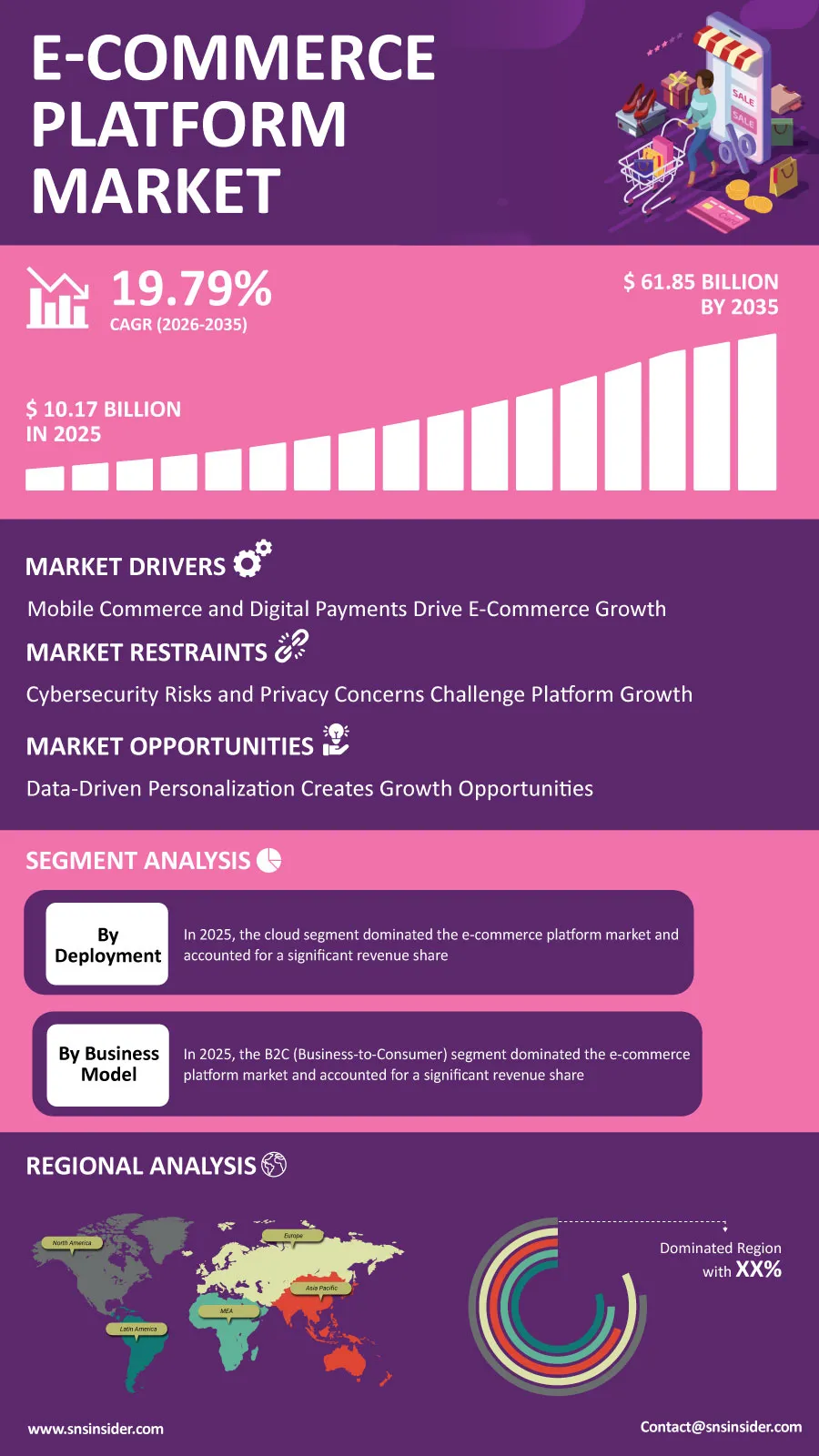
The global E-commerce Platform Market is about to witness the dawn of its next era of rapid expansion due to the digital transformation undertaken by the companies to adapt to evolving customer requirements. “According to a recent study by SNS Insider, the global E-commerce Platform Market size valued at USD 10.17 billion in 2025, is anticipated to grow to USD 61.85 billion by 2035, registering a CAGR of 19.79% over the 2026–2035 forecast period.”
Retailers and consumer-oriented companies are developing intelligent digital storefronts that facilitate better transaction management, customer interaction, and seamless shopping experiences from different sales channels. The rising significance of personalized commerce, payment eco-systems, and merchandising solutions continues to change the approach to developing platforms.
With the help of cloud computing, automation, and analytical capabilities offered by AI, organizations are able to create online stores more quickly and efficiently manage their inventories, fulfill orders, and interact with customers. As digital commerce becomes an integral part of the business strategy, the ability to scale up and innovate becomes critical.
To Get Detailed Insights on the E-commerce Platform Market – Request a Sample Report
AI, Mobile Commerce, and Digital Retail Investments Create New Growth Opportunities
Increased investment in digital transformation is leading businesses to upgrade their traditional commerce systems with scalable and intelligent platforms.
Businesses are adopting more sophisticated platforms which help them with multilingual websites, omnichannel inventory management, and customer interaction through websites, mobile applications, and social commerce.
Artificial intelligence is increasingly becoming an important factor for distinguishing platforms in terms of product recommendation, automation of customer services, fraud detection, and improved marketing performance. Through advanced analytics, merchants are able to analyze the purchase behavior and implement pricing strategies which increase customer loyalty.
The subscription-based business model, direct-to-consumer business model, and development of digital payments ecosystem are providing more opportunities for platform vendors. With increasing need for agility, the demand for commerce platforms is likely to stay robust throughout the forecast period.
Key Market Insights Highlight Shifting Demand Patterns
Deployment-wise, the cloud segment is expected to have the highest market share contribution in 2025 owing to fast deployment, scalability, and lower infrastructure cost. The on-premise segment will post the highest CAGR through 2035 because companies that demand high compliance and data governance will continue to invest in building infrastructure dedicated to their use.
Based on the business model, the Business-to-Consumer (B2C) segment is expected to post the highest market revenue in 2025 because of the continued growth of online retail and digital customer engagement. The Direct-to-Consumer (D2C) segment is expected to grow at the fastest pace because companies will increasingly develop direct relations with their consumers, thus lessening their dependency on third parties.
Considering the enterprise size, large enterprises are expected to lead in the market because of large investments made in digital transformation, while SMEs are expected to show the fastest growth rate thanks to the growing availability of low-cost cloud commerce solutions. By the application, the apparel & fashion segment will be leading in terms of revenue, while the healthcare segment will post the fastest growth through 2035.
Intelligent Commerce Technologies Accelerate Digital Retail Transformation
The continual innovations in fields like artificial intelligence, automation, predictive analysis, and payment integration have changed the way that businesses run their commerce platforms. There is an increasing number of intelligent functionalities being developed by software vendors to make their commerce platform automated for merchandising, search functionality, and inventory allocation, while offering a high level of personalization.
In addition to this, there is an increased focus on security and compliance for digital transactions, while the use of APIs is becoming more and more important for connecting commerce platforms with ERP, CRM, logistics, and marketing solutions.
North America Held the Largest Share of the E-commerce Platform Market in 2025; Asia Pacific Projected to Register the Fastest CAGR Through 2035
North America held the largest regional share of the global E-commerce Platform Market in 2025 due to highly developed digital infrastructure, extensive online shopping culture, advanced payment solutions, and continuous innovations made by technology providers. Continuous investments of enterprises in customer experience and omnichannel commerce continue to strengthen the regional dominance of the market.
The Asia Pacific region is projected to post the highest CAGR over 2025-2035 with an increase in internet connectivity, smartphones, digital payments, and more involvement of SMEs in online business transactions. The growth in consumer spending and digital economy programs creates a conducive environment for further market growth in the region.
Europe maintains steady growth with the adoption of the digitalization programs and focus on secure transactions, cross-border trade, and sustainable retail operations. In turn, Latin America and the Middle East & Africa are characterized by growing platform adoption owing to the development of digital infrastructure and online consumer engagements.
Industry Participants Focus on AI Innovation and Global Commerce Expansion
The competition in the global E-commerce Platform Market is expected to be fierce as major market players focus on artificial intelligence, cloud commerce technology, cybersecurity, automation, and digital payment solutions. Strategic partnerships, platform developments, and expansion plans play an important role in their growth strategies.
Key companies operating in the global E-commerce Platform Market include Amazon, Alibaba Group, JD.com, Pinduoduo, Shopify, eBay, MercadoLibre, Rakuten, Flipkart, Sea Limited, Coupang, Zalando, Wayfair, Carrefour, Ocado, BigCommerce, SHEIN, Adobe Commerce (Magento), and Wix.
An SNS Insider analyst Sakshi Kale commented, "The next decade of digital commerce will be defined by intelligent automation, personalized customer engagement, and highly scalable cloud-based platforms. Organizations that successfully integrate AI, omnichannel capabilities, and secure digital infrastructure will be well positioned to capitalize on evolving global commerce opportunities."
About the Author

Get in touch




