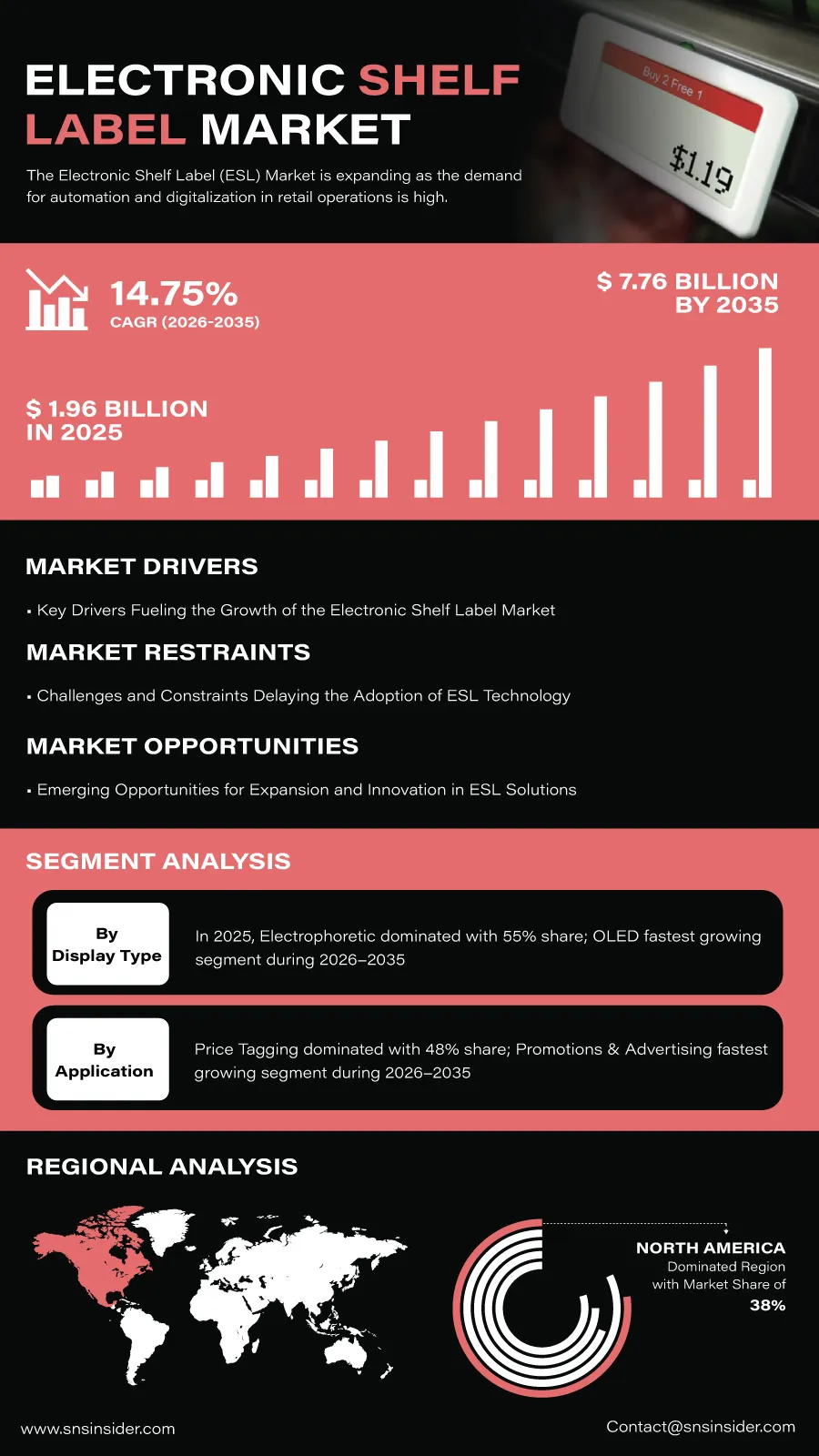
The global Electronic Shelf Label Market is gaining momentum as retailers accelerate digital transformation initiatives to improve pricing accuracy, streamline store operations, and deliver more responsive shopping experiences. “According to a recent study by SNS Insider, the global Electronic Shelf Label Market size valued at USD 1.96 billion in 2025, is anticipated to grow to USD 7.76 billion by 2035, registering a CAGR of 14.75% over the 2026–2035 forecast period.”
Retailers are now relying on digital shelf solutions to minimize the need for manual price adjustments, improve inventory visibility, and ensure alignment between shelf displays and the point-of-sale system. The growth of omnichannel retailing and high demands for up-to-date product information are also spurring investments in automated retail stores.
With technological breakthroughs in areas such as electronic paper display, wireless connectivity, and cloud management systems, ESLs are now capable of doing much more than ever before and represent one of the key elements of next-gen retail.
To Get Detailed Insights on the Electronic Shelf Label Market – Request a Sample Report
Retail Automation Creates New Growth Opportunities
With increased focus on efficiency, it is now becoming common for supermarkets, hypermarkets, and specialized stores to consider alternative labels rather than traditional paper-based labels. ESL technology enables the retailer to manage price changes centrally, be flexible and coordinate marketing activities across different locations.
Integration with software, such as inventory management systems and analytics systems is providing further scope for the vendors to exploit. This will help companies keep their shelves in sync with their inventory without involving themselves in unnecessary administrative work.
There is also significant potential in the emerging markets as retailers upgrade their stores with modern infrastructure and technologies. However, the issues related to initial cost, technical integration, and technical requirements cannot be ignored.
Key Market Insights Highlight Shifting Demand Patterns
By display type, electrophoretic displays accounted for approximately 55% of global market revenue in 2025, supported by their low energy consumption, clear readability, and suitability for frequently updated retail pricing. OLED displays are projected to be the fastest-growing segment through 2035 as retailers explore richer visual presentations for premium merchandise, promotional messaging, and interactive shopping experiences.
Based on communication technology, radio frequency (RF) solutions held around 50% market share in 2025, reflecting their established role in large-scale retail deployments. Bluetooth Low Energy (BLE) is expected to record the fastest growth during the forecast period, supported by its energy efficiency and potential to enable proximity-based customer engagement and connected retail applications.
By application, price tagging was forecasted to hold around 48% of market revenue in 2025, driven by retailers' need to maintain accurate pricing across extensive product assortments. Promotions and advertising are projected to grow fastest as digital labels increasingly support targeted offers, product information updates, and data-driven promotional strategies.
By end user, supermarkets and hypermarkets were projected to reach 52% of market revenue in 2025 owing to their extensive inventories and frequent pricing changes. Specialty retail is anticipated to experience the fastest growth as fashion, electronics, and luxury retailers adopt digital labels to improve product presentation and pricing flexibility.
Connected Store Technologies Reshape Retail Operations
The integration of ESL systems with software, inventories, and stores will help improve coordination in pricing, merchandising, and stocking. Using automatic updates will eliminate the discrepancies between the price shown and that charged at the checkout because the employees will be busy doing other tasks such as serving customers.
The use of energy-saving screens and the developments in wireless communication will make it easier for ESLs to be adopted in various sectors. The use of artificial intelligence and retail analytics in store management systems will make the ESL systems useful for dynamic pricing and promotions.
North America Captures 38% of Market Revenue as Asia Pacific Accelerates Smart Store Investments
North America is predicted to continue being the foremost regional market in terms of value, contributing about 38% of total global revenue by 2025. This growth can be attributed to factors such as existing infrastructure in the retail sector, automation investments, and high interest in store connectivity solutions in the US and Canada.
Asia Pacific is anticipated to witness the highest CAGR of 16.2% through 2035. Contributing factors include rapid urbanization in the region, development of organized retail networks, and growing investments in smart store concepts in countries like China, India, Japan, and South Korea.
The United States also represents a significant national market, with revenue projected to increase from USD 0.68 billion in 2025 to USD 2.85 billion by 2035, reflecting a CAGR of 15.10%.
Industry Participants Focus on Innovation and Integration
Electronic Shelf Label Market competition is becoming fiercer as vendors are coming up with networked display technologies, cloud-managed platforms and integrated retail automation solutions. Vendors are focusing on energy efficiency, wireless connectivity, software flexibility and marketing capabilities in line with new demands of the retailers.
Key companies operating in the global Electronic Shelf Label Market include Advantech Inc., Displaydata Limited, E Ink Holdings Inc., Herbert Retail Limited, M2COMM, Opticon Sensors Europe B.V., Diebold Nixdorf Incorporated, Teraoka Seiko Co. Ltd., SoluM, SES-imagotag, and Samsung Electronics Co. Ltd.
An SNS Insider analyst, Sushant Kadam, commented, “The transition toward connected retail environments is strengthening demand for electronic shelf labels that combine pricing automation with real-time inventory visibility. Providers that deliver scalable systems, efficient displays, and seamless integration with retail software will be well positioned to benefit from expanding smart store investments over the coming decade.”
About the Author

Get in touch