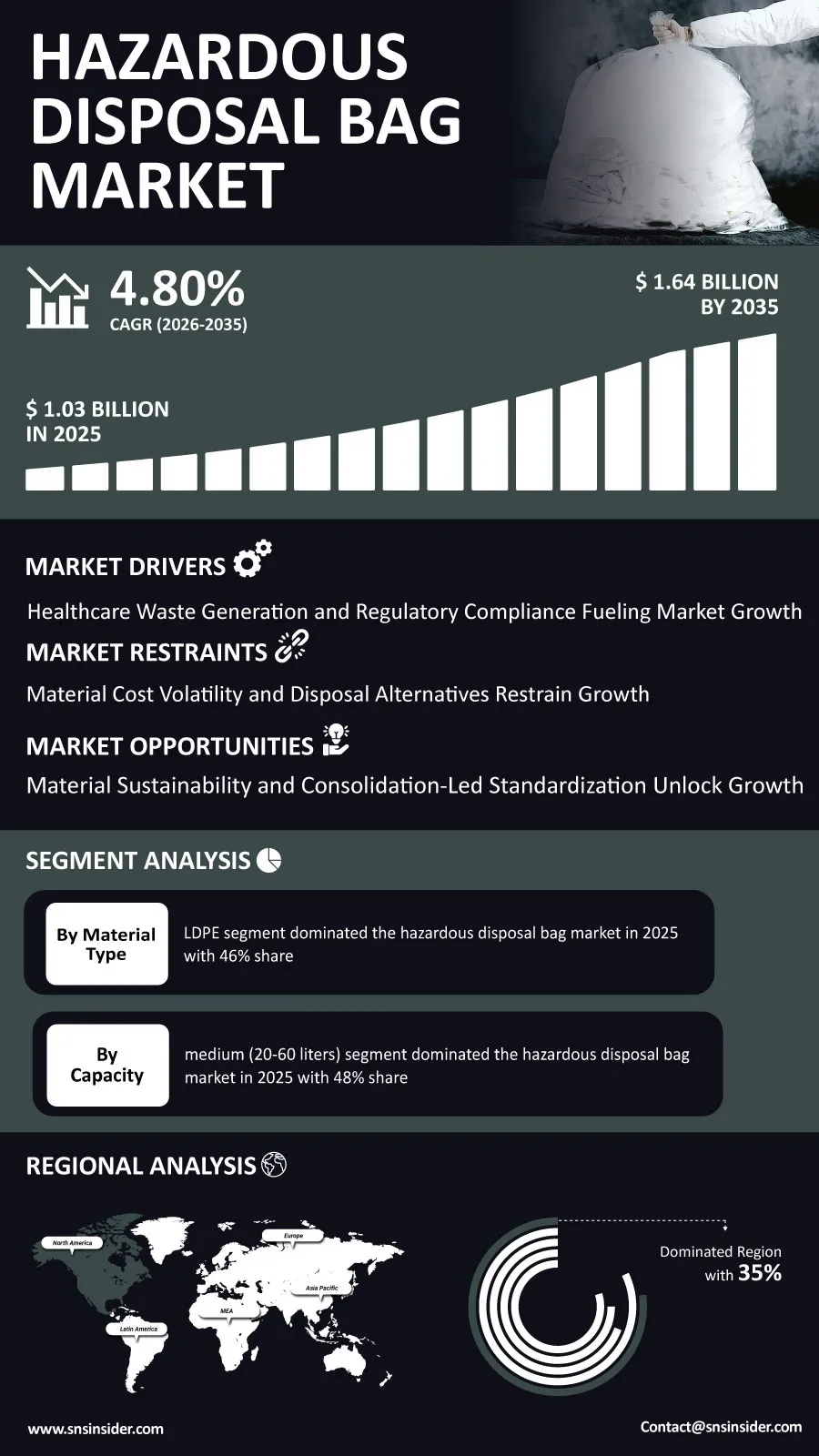
The global Hazardous Disposal Bag Market is on a steady growth path through 2035, as rising healthcare waste generation and tightening regulatory frameworks continue reshaping hazardous waste containment requirements worldwide. “According to a recent study by SNS Insider, the global Hazardous Disposal Bag Market size valued at USD 1.03 billion in 2025, is anticipated to grow to USD 1.64 billion by 2035, registering a CAGR of 4.80% over the 2026-2035 forecast period.”
A hazardous disposal bag rarely gets much attention as a packaging category, but it plays a genuinely consequential role in keeping healthcare workers, waste handlers, and the broader public safe from infectious and chemical hazards that would otherwise spread unchecked through an ordinary waste stream. More than 67% of healthcare institutions now rely on dedicated disposal bags to manage this risk while meeting regulatory and safety standards.
Consolidation on the service side is reshaping who actually specifies and procures these bags, as WM's USD 7.2 billion acquisition of Stericycle brought the country's largest solid waste and medical waste disposal operations under one roof, concentrating purchasing decisions among fewer, larger buyers.
To Get Detailed Insights on the Hazardous Disposal Bag Market – Request a Sample Report
Waste Management Consolidation Reshapes Procurement Dynamics
Large-scale consolidation among waste management service providers is changing how hazardous disposal bags get specified and purchased, as combined entities standardize requirements across much larger customer networks than either predecessor company managed independently.
This is leading to a situation where there will be scale benefits for suppliers that are able to cater to the compliance and volume demands of these buyers. There will also be cross selling possibilities within the combined waste management portfolio, thereby determining which disposal bags will dominate the market in the coming years.
There are certain specifications associated with such bags, which will be determined by these combined waste management portfolios.
Key Market Findings Highlight High-Growth Segments
-
Healthcare held the largest share of the Hazardous Disposal Bag Market in 2025, at 41%, reflecting the sheer volume of infectious and biohazardous waste that hospitals and clinics generate daily.
-
Laboratories & research is the fastest-growing end-use industry, expanding at a 6.70% CAGR, pulled forward by expanding pharmaceutical and biotechnology R&D activity worldwide.
-
By material type, LDPE led with 46% share in 2025, while biodegradable materials are growing fastest, at a 7.40% CAGR, as sustainability pressure builds across healthcare and industrial customers.
-
Biohazard bags remained the largest bag type at 44% share, but chemical waste bags are climbing fastest, at a 7.20% CAGR, driven by tightening industrial chemical waste containment regulation.
Regulatory Compliance and Containment Reliability Anchor Competitive Positioning
Buyers are increasingly evaluating disposal bag suppliers on regulatory compliance documentation and containment reliability nearly as much as on price, particularly among larger healthcare systems and industrial operations.
Investment in biodegradable material formulations and specialized containment engineering is becoming a genuine competitive differentiator among larger manufacturers, while smaller suppliers without that investment increasingly compete only in commodity, price-sensitive segments.
This divide is expected to sharpen further as waste management consolidation concentrates purchasing power among fewer, larger buyers with more rigorous supplier requirements.
North America Leads as Asia Pacific Grows Fastest
North America holds the largest share of global market revenue, anchored by well-established healthcare systems and strict environmental regulations mandating proper waste disposal. Asia Pacific, meanwhile, is growing fastest, propelled by the region's rapidly expanding pharmaceutical industry and growing healthcare infrastructure across China and India.
Europe holds a substantial share as well, shaped by comprehensive waste management regulation and well-established healthcare systems across the region.
Leading Companies Drive Innovation and Competition
Competition in this market centers on regulatory compliance capability, material innovation, and service network scale nearly as much as on price, with significant consolidation activity reshaping the competitive landscape among the largest waste management providers.
Some of the major companies that operate in the global hazardous disposal bag market are Stericycle, Inc., Clean Harbors, Inc., Veolia Environnement S.A., Waste Management, Inc., Republic Services, Inc., Amcor plc, Novolex Holdings, LLC, Poly-America, L.P.
An SNS Insider Analyst Santosh Bhul commented, “Hazardous disposal bags might be one of the less visible packaging categories out there, but the companies capturing the fastest-growing parts of this market are the ones combining regulatory compliance depth with genuine material innovation, particularly around biodegradable formulations. As waste management consolidation concentrates purchasing power among fewer, larger buyers, suppliers with strong compliance documentation and scalable production are best positioned to lead.”
About the Author

Get in touch