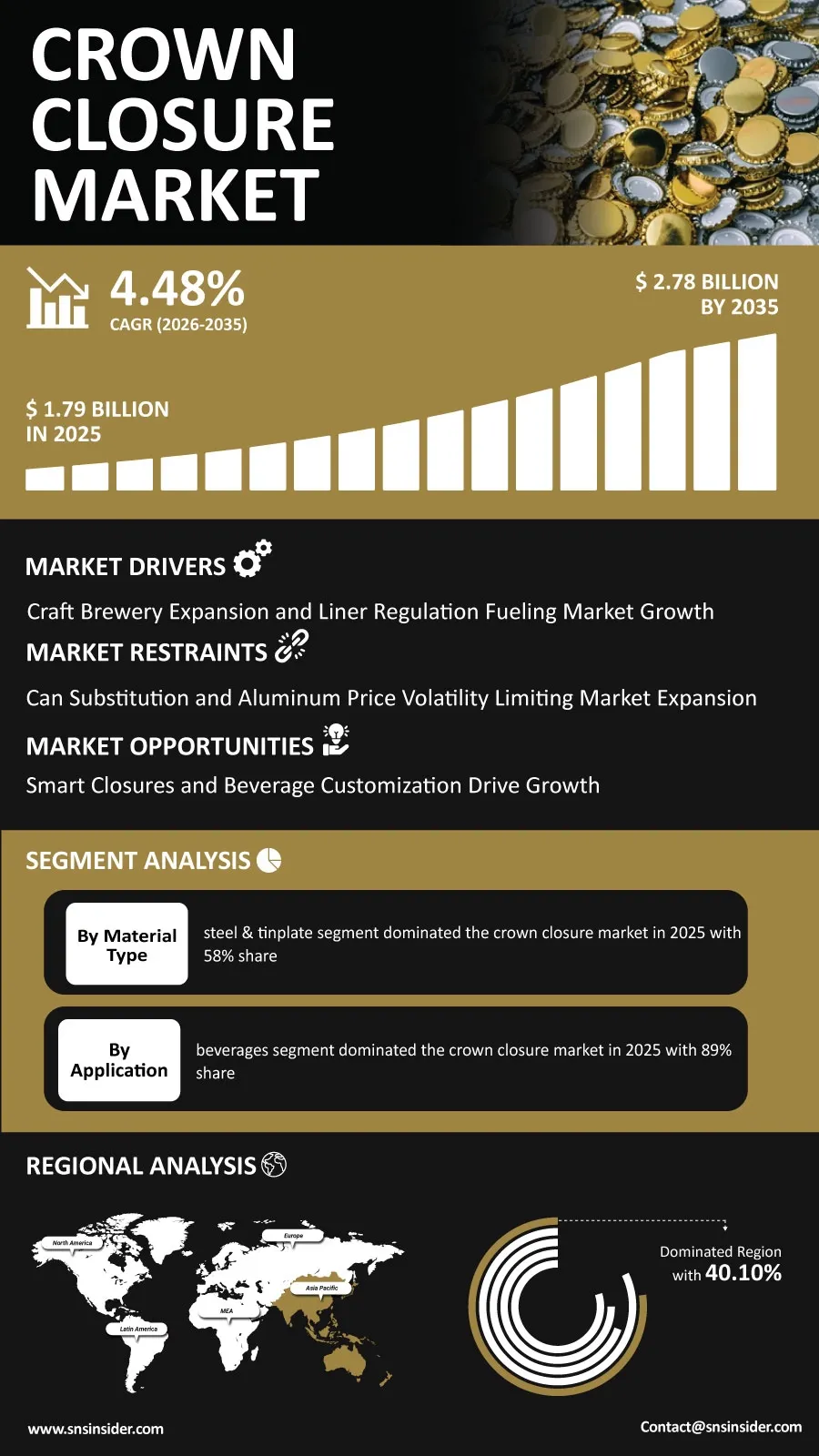
The global Crown Closure Market is on a steady growth path through 2035, as craft brewing expansion and tightening liner regulation continue reshaping closure manufacturing requirements worldwide. “According to a recent study by SNS Insider, the global Crown Closure Market size valued at USD 1.79 billion in 2025, is anticipated to grow to USD 2.78 billion by 2035, registering a CAGR of 4.48% over the 2026-2035 forecast period.”
A crown closure is one of the older ideas in modern packaging, and it has stuck around this long for a simple reason: nothing else seals a carbonated glass bottle quite as reliably or as cheaply at high production speeds. What has changed is everything happening inside that simple crimped disc, liner chemistry, printing technology, and increasingly, embedded traceability features that would have seemed unnecessary a decade ago. Regulatory pressure around liner compounds, more than any single consumer trend, is what is pushing manufacturers to invest in new formulations right now, particularly as food-contact chemical migration rules tighten across Europe and gradually extend into other major markets.
To Get Detailed Insights on the Crown Closure Market – Request a Sample Report
Liner Chemistry Transition Reshapes Manufacturing Investment
PVC-based liners dominated crown closure manufacturing for decades largely because they were cheap, reliable, and well understood, but tightening food-contact regulation is forcing a genuine transition toward PVC-free alternatives across the industry.
This shift is not simply a materials swap, it requires requalification with beverage and food brands, new supply chain relationships for alternative liner compounds, and in some cases retooling of existing crimping equipment.
Manufacturers who invested early in PVC-free liner capability are increasingly winning contracts with brand owners looking to get ahead of regulatory deadlines rather than scrambling to comply once enforcement begins.
Key Market Findings Highlight High-Growth Segments
Steel & tinplate held the largest share of the Crown Closure Market in 2025, at 58%, reflecting its cost advantage and compatibility with high-speed bottling line crimping requirements.
Aluminum is the fastest-growing material, expanding at a 5.56% CAGR, pulled forward by bottlers prioritizing lightweighting and corrosion resistance.
By beverage type, beer led with 46% share in 2025, while craft & specialty beverages is growing fastest, at a 6.80% CAGR, driven by small-batch producers favoring custom embossing and limited-run printing.
PVC-based liners remained dominant at 54% share, but PVC-free liners are climbing fastest, at a 7.20% CAGR, as food-contact chemical migration regulation tightens across major markets.
Liner Compliance and Custom Printing Anchor Competitive Positioning
Buyers are increasingly evaluating crown closure suppliers on liner compliance and custom printing flexibility nearly as much as on unit price, particularly among craft and premium beverage brands.
Investment in PVC-free liner formulations and digital inkjet printing capability is becoming a genuine competitive differentiator, while suppliers without that investment increasingly compete only in commodity, price-sensitive segments.
This divide is expected to sharpen further as more markets adopt Europe-style food-contact liner regulation.
Asia Pacific Leads on Both Scale and Growth
Asia Pacific holds both the largest share of global market revenue and the fastest growth rate, driven by expanding brewery capacity and rising packaged beverage consumption across China, India, and Southeast Asia. North America holds a steady, mature share as well, anchored by an unmatched scale of craft brewing activity.
Europe's share is shaped heavily by regulatory pressure around liner chemistry, which is accelerating the region's transition toward PVC-free alternatives faster than almost anywhere else in the world.
Leading Companies Drive Innovation and Competition
Competition in this market centers on liner technology, printing capability, and regional manufacturing scale nearly as much as on unit pricing, with the top five converters controlling roughly 55 to 60% of global capacity.
Some of the major companies that operate in the global crown closure market are Crown Holdings, Inc., Ball Corporation, Silgan Holdings Inc., BERICAP Holding GmbH, Nippon Closures Co., Ltd., AptarGroup, Inc., Sonoco Products Company, Amcor plc.
An SNS Insider Analyst Santosh Bhul commented, “Crown closures might be one of the oldest ideas in beverage packaging, but the companies winning share right now are the ones treating liner chemistry and traceability features as genuine innovation rather than incremental updates to a century-old design. As food-contact liner regulation keeps tightening globally, compliance readiness is becoming just as important a competitive factor as manufacturing scale.”
About the Author

Get in touch