
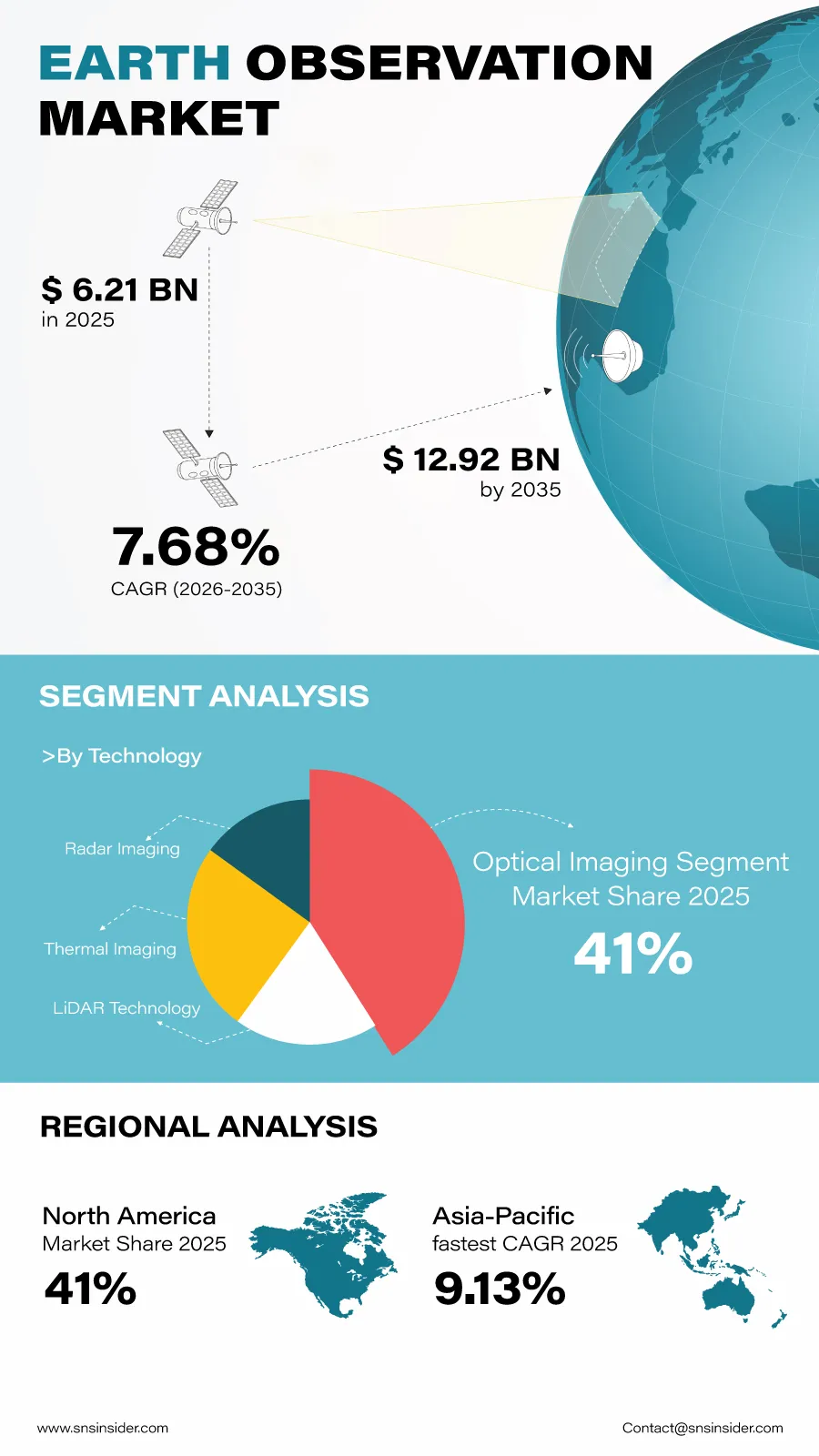
The global Earth Observation Market is poised for sustained expansion over the coming decade as governments, commercial enterprises, and research organizations increasingly rely on satellite-derived intelligence to support critical decision-making. According to a recent study by SNS Insider, the global Earth Observation Market size valued at USD 6.21 billion in 2025, is anticipated to grow to USD 12.92 billion by 2035, registering a CAGR of 7.68% over the 2026–2035 forecast period.
There is an increasing demand for high-resolution images, geospatial analytics, and environmental intelligence in various sectors such as defense, agriculture, infrastructure development, and even disasters. Companies have started investing in modern Earth observation systems to help increase efficiency and make informed decisions based on the changes in environmental conditions.
Technological developments in satellite miniaturization, artificial intelligence, cloud computing, and remote sensing have helped Earth observation companies to become much more popular and easily available. The decreasing cost of satellite launches and growth in commercial space ventures have also contributed to this trend.
Growing Demand for Geospatial Intelligence Creates New Market Opportunities
The global emphasis on climate resilience, food security, national security, and sustainability of resource management is leading to a considerable increase in the usage of Earth observation technologies. Governments are increasingly leveraging satellite data to keep track of forests, coasts, water resources, and infrastructures, while preparing themselves for natural calamities and extreme weather conditions.
Private businesses are incorporating geospatial intelligence into their operations to ensure efficient management of their logistics, monitoring of assets, agricultural output, and even development of infrastructures. With the growing emphasis of the industry on making data-driven decisions, earth observation can be expected to provide actionable data.
Advancements in AI-powered image processing, predictive analytics, and cloud-based data platforms are further enhancing the speed and accuracy of satellite intelligence, opening new commercial opportunities for technology providers and analytics companies worldwide.
Key Market Insights Highlight Shifting Demand Patterns
By technology, optical imaging segment held around 41% of global market revenue in 2025, supported by its extensive use in agriculture, urban planning, environmental monitoring, and disaster management. LiDAR technology is projected to register the fastest growth through 2035 as demand rises for highly accurate three-dimensional mapping across infrastructure, forestry, and autonomous navigation applications.
Based on platform, satellite-based Earth observation is anticipated to contribute nearly 55% of market revenue in 2025 owing to its broad geographic coverage and ability to support continuous global monitoring. UAV and drone-based Earth observation solutions are forecast to witness the fastest expansion as organizations increasingly require flexible, localized, and high-frequency data collection.
By orbit type, Low Earth Orbit (LEO) systems segment represented around 55% of market revenue in 2025 due to their capability to deliver high-resolution imagery with frequent revisit times. Medium Earth Orbit (MEO) platforms are projected to experience the fastest growth as investments increase in navigation, communication, and regional monitoring capabilities.
In terms of application, environmental monitoring accounted for 22% of market revenue in 2025 because of growing emphasis on ecosystem management, pollution control, and natural resource conservation. Climate change research is expected to emerge as the fastest-growing application segment as governments and scientific institutions strengthen investments in long-term environmental monitoring programs.
An Infographic Representation of the Global Earth Observation Market
AI and Advanced Analytics Transform Earth Observation Capabilities
AI and machine learning are revolutionizing the Earth Observation space by providing faster analysis of satellite imagery data. With the advent of automated analysis, predictive modeling, and cloud computing, it is becoming increasingly easier for organizations to glean relevant information in real time.
With an increasing number of multisource data being incorporated into the picture such as satellite images, drone imaging, IoT, and GIS data, Earth Observation services are helping in making more informed decisions in urban planning, agriculture, disaster relief, infrastructure management, and national security.
As satellite constellations continue to expand and sensor technologies become increasingly sophisticated, Earth observation services are expected to deliver even higher levels of accuracy, responsiveness, and operational value.
Regional Markets Demonstrate Strong Growth Potential
The North American region is predicted to generate approximately 41% of the overall revenue of the global market by 2025 owing to the presence of substantial investments made by the government on space programs, satellite technology, military prowess, and geospatial analytics.
On the other hand, the Asia-Pacific region is estimated to exhibit the highest CAGR of about 9.13% until 2035 due to increasing investments by the governments in satellite programs, increased activities in the commercial segment of space industry, rising urbanization, and more applications in agriculture and environmental monitoring among others.
As countries worldwide expand investments in climate resilience, infrastructure modernization, and digital transformation, demand for Earth observation technologies is expected to accelerate across both mature and emerging economies.
Industry Participants Focus on Innovation and Advanced Data Intelligence
The competitive landscape continues to evolve as the key players in the industry invest in new generations of satellites, synthetic aperture radar technology, artificial intelligence analysis, and geospatial cloud services. They will also expand their partnerships with government agencies, academic organizations, and commercial customers to enhance the availability of data.
Key companies operating in the global Earth Observation Market include Airbus Defence and Space, Maxar Technologies, Planet Labs PBC, ICEYE, Capella Space, BlackSky Technology Inc., Spire Global, Inc., Satellogic, Thales Alenia Space, Pixxel, Open Cosmos Ltd, Synspective, ImageSat International N.V., GeoIQ, Orbital Insight, Descartes Labs, Earth-i, GHGSat, SI Imaging Services (SIIS), and China Siwei.
An SNS Insider analyst Santosh Bhul commented, “Growing reliance on geospatial intelligence for climate resilience, national security, infrastructure planning, and environmental monitoring is accelerating demand for advanced Earth observation solutions. Organizations that continue investing in AI-powered analytics, high-resolution imaging, and scalable satellite technologies will be well positioned to capitalize on expanding global opportunities throughout the coming decade.”
About the Author

Get in touch




