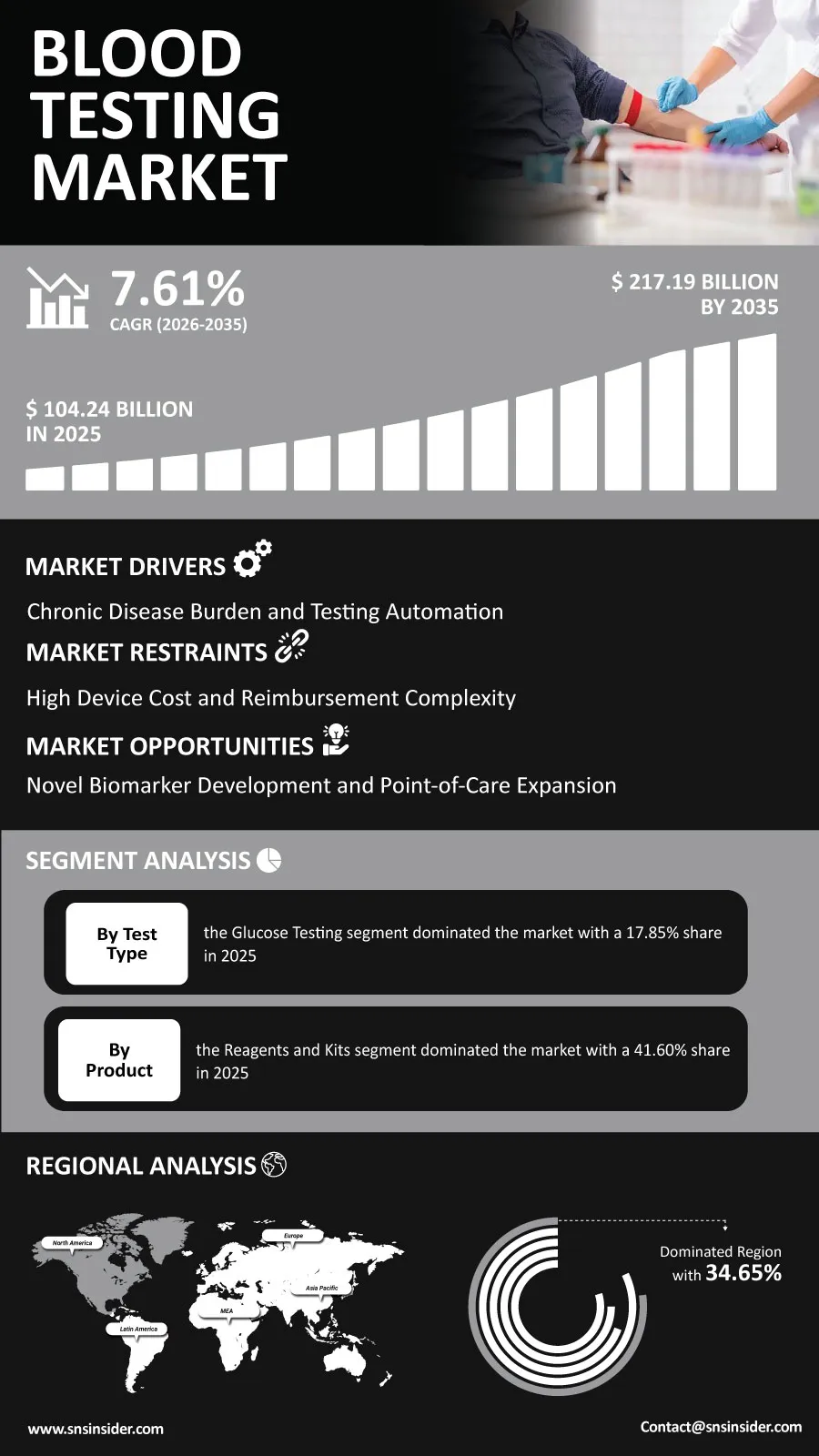
A single vial of blood continues to carry more diagnostic information than almost any other sample a physician can draw, and the technology for reading that information keeps getting more sophisticated. According to a recent study by SNS Insider, the global Blood Testing Market, valued at USD 104.24 billion in 2025, is projected to reach USD 217.19 billion by 2035, registering a CAGR of 7.61% across the 2026-2035 forecast period.
Blood testing encompasses the full range of diagnostic procedures performed on blood samples, spanning routine glucose and complete blood count panels run in every hospital laboratory worldwide through specialised infectious disease, coagulation, and biomarker assays that increasingly inform precision treatment decisions. The category sits at the core of modern clinical medicine, since blood remains the single most accessible and information-rich diagnostic sample a physician can draw from a patient.
To Get Detailed Insights on the Blood Testing Market – Request a Sample Report
Chronic Disease Burden and Testing Automation Fuel Growth
The growing burden of chronic and infectious diseases continues to widen demand, as rising diabetes, cardiovascular disease, and cancer prevalence requires frequent blood-based diagnostic testing across an expanding global patient population. Continued laboratory automation reinforces this trend, as advanced analysers continue to expand how many samples a single laboratory can process accurately.
Manufacturers are responding with novel blood-based biomarker tests capable of detecting conditions including Alzheimer's disease and cardiovascular risk from a simple blood draw, continuing to widen the diagnostic reach of blood testing well beyond its traditional metabolic and infectious disease applications.
Segment Findings Point to a Market in Transition
Glucose testing led the market in 2025 and is also growing fastest, reflecting the enormous and still-growing global diabetic patient population. Reagents and kits hold the largest product share, though instruments are growing fastest at 8.35% as laboratory automation investment accelerates.
Automated testing dominates the method mix and is also expanding fastest at 9.45% as rising test volumes push facilities toward automation. Hospitals and clinics account for the largest end-use share, while diagnostic laboratories are growing fastest at 8.65% as outsourced reference laboratory testing gains favour.
North America Leads, Asia Pacific Set to Grow Fastest
North America accounted for the largest share of global revenue in 2025, at 34.65%, supported by a vast clinical laboratory infrastructure and broad insurance coverage. The United States represented the substantial majority of the regional market.
Asia Pacific is projected to expand at the fastest rate of any region through 2035, at a CAGR of approximately 9.85%, as China, India, Japan, and South Korea continue expanding hospital infrastructure and healthcare investment. Europe remains a significant contributor, anchored by Germany's substantial healthcare sector, while Latin America and the Middle East and Africa continue building adoption at a more gradual pace.
Biomarker Innovation and Consolidation Reshape Competitive Dynamics
Competition within this market increasingly centres on which manufacturers can pair reliable core testing capability with genuinely differentiated biomarker innovation, as leading diagnostics companies continue securing regulatory clearances for novel assays addressing previously underserved diagnostic needs while pursuing acquisitions that expand testing portfolios.
Some of the major companies operating in the global blood testing market include Abbott Laboratories, F. Hoffmann-La Roche Ltd., Siemens Healthineers AG, Danaher Corporation, Becton, Dickinson and Company, Thermo Fisher Scientific Inc., bioMerieux SA, Sysmex Corporation, QuidelOrtho Corporation, and Quest Diagnostics Incorporated.
Looking ahead, the pace of biomarker innovation, continued diagnostics consolidation, and sustained chronic disease burden growth are likely to determine which manufacturers gain the most share over the coming decade. Companies that combine proven testing reliability with genuine assay innovation are expected to be best placed to benefit from the market's sustained, chronic-disease-driven growth throughout the forecast period.
Companion diagnostic development is increasingly becoming a genuine strategic growth avenue linking blood testing directly to therapeutic outcomes. As pharmaceutical companies increasingly require validated blood-based biomarkers to guide patient selection and dosing for targeted therapies, diagnostics companies that can deliver genuinely reliable companion assays are capturing demand that extends well beyond conventional diagnostic testing alone, tying blood test revenue directly to the broader success of the therapies these assays support.
An SNS Insider Analyst, Parry Kardani commented, "This market continues to benefit from sustained chronic disease prevalence growth and a genuine industry-wide push toward novel, higher-value biomarker testing. Manufacturers that pair proven testing reliability with genuine biomarker and automation innovation are best positioned to capture the next phase of demand, particularly across Asia Pacific's fast-growing hospital infrastructure investment."
About the Author

Get in touch