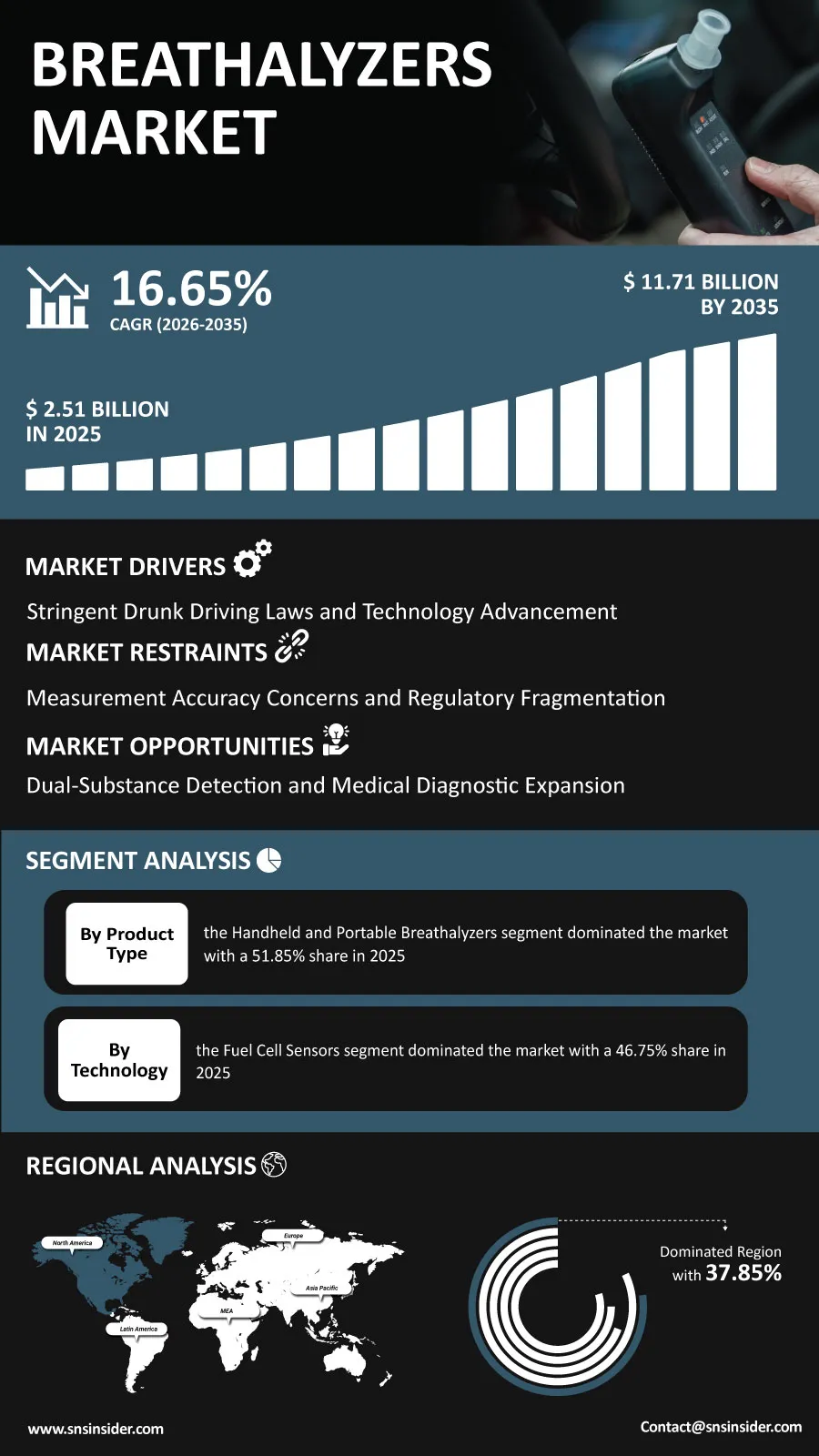
A device small enough to fit on a keychain can now measure blood alcohol concentration with a precision that once required a police station's evidential-grade equipment. According to a recent study by SNS Insider, the global Breathalyzers Market, valued at USD 2.51 billion in 2025, is projected to reach USD 11.71 billion by 2035, registering a CAGR of 16.65% across the 2026-2035 forecast period.
Breathalyzers measure substances present in a person's breath to detect blood alcohol concentration, drug use, or specific disease markers, spanning everything from a simple keychain-sized personal device through evidential, courtroom-grade instruments used by police departments and increasingly sophisticated medical diagnostic breath analysers. Increased smartphone connectivity and AI-driven calibration continue to change the personal consumer market sector, where consumers now have access to accurate measurement previously only possible using high-end technology.
To Get Detailed Insights on the Breathalyzers Market – Request a Sample Report
Stringent Drunk Driving Laws and Technology Advancement Fuel Growth
Increased implementation of stringent drunk driving laws continues to widen demand, as governments worldwide prioritise initiatives to reduce impaired-driving road accidents. Advancements in breathalyzer technology reinforce this trend, as continued improvement in sensor accuracy, connectivity, and miniaturisation keeps expanding the range of applications these devices can reliably serve.
Manufacturers are responding with dual alcohol and cannabis detection technology addressing a rapidly evolving legal landscape, and with AI-driven calibration bringing professional-grade accuracy within reach of everyday consumer devices.
Segment Findings Point to a Market in Transition
Portable and handheld breath alcohol analyzers dominated the market in 2025 due to their easy operation in roadside testing and workplace testing, whereas plug-ins for smartphones have emerged as the fastest-growing segment at 20.65% CAGR because application-connected personal devices have become popular. The fuel cell sensor category dominates in terms of technology, although infrared spectroscopy is gaining ground with a 18.85% CAGR.
However, alcohol detection forms the highest application share, whereas disease diagnosis holds the fastest growing application segment, accounting for 19.65%. The law enforcement agencies form the highest end user market share, while personal users form the fastest growing end user segment, accounting for 18.35%.
North America Leads, Asia Pacific Set to Grow Fastest
North America accounted for the largest share of global revenue in 2025, at 37.85%, supported by stringent drunk driving enforcement and substantial workplace testing requirements. The United States represented the substantial majority of the regional market.
Asia Pacific is projected to expand at the fastest rate of any region through 2035, at a CAGR of approximately 19.45%, as China, India, Japan, and South Korea continue tightening drunk driving enforcement and expanding workplace safety regulation. Europe remains a significant contributor, anchored by Germany's enforcement infrastructure, while Latin America and the Middle East and Africa continue building adoption at a more gradual pace.
Dual-Substance Detection and AI Calibration Reshape Competitive Dynamics
Competition within this market increasingly centres on which manufacturers can pair reliable core measurement accuracy with genuinely differentiated dual-substance detection and AI-enabled calibration, as leading companies continue racing to address cannabis legalisation's new impairment-detection challenges.
Some of the major companies operating in the global breathalyzers market include Dragerwerk AG & Co. KGaA, Intoximeters, Inc., Abbott Laboratories, Lifeloc Technologies, Inc., BACtrack, AlcoPro, Inc., Quest Products, Inc., C4 Development Ltd., Alcolizer Pty Ltd., and Hound Labs, Inc.
Looking ahead, the pace of dual-substance detection innovation, continued AI calibration advancement, and sustained drunk driving enforcement are likely to determine which manufacturers gain the most share over the coming decade. Companies that combine proven measurement reliability with genuine technology innovation are expected to be best placed to benefit from the market's sustained, enforcement-driven growth throughout the forecast period.
An SNS Insider Analyst, Parry Kardani commented, "This market continues to benefit from sustained global road safety enforcement and a genuine industry-wide push toward connected, AI-enabled breath testing technology. Manufacturers that pair proven measurement reliability with genuine dual-substance detection innovation are best positioned to capture the next phase of demand, particularly across Asia Pacific's fast-growing enforcement and consumer device adoption."
About the Author

Get in touch