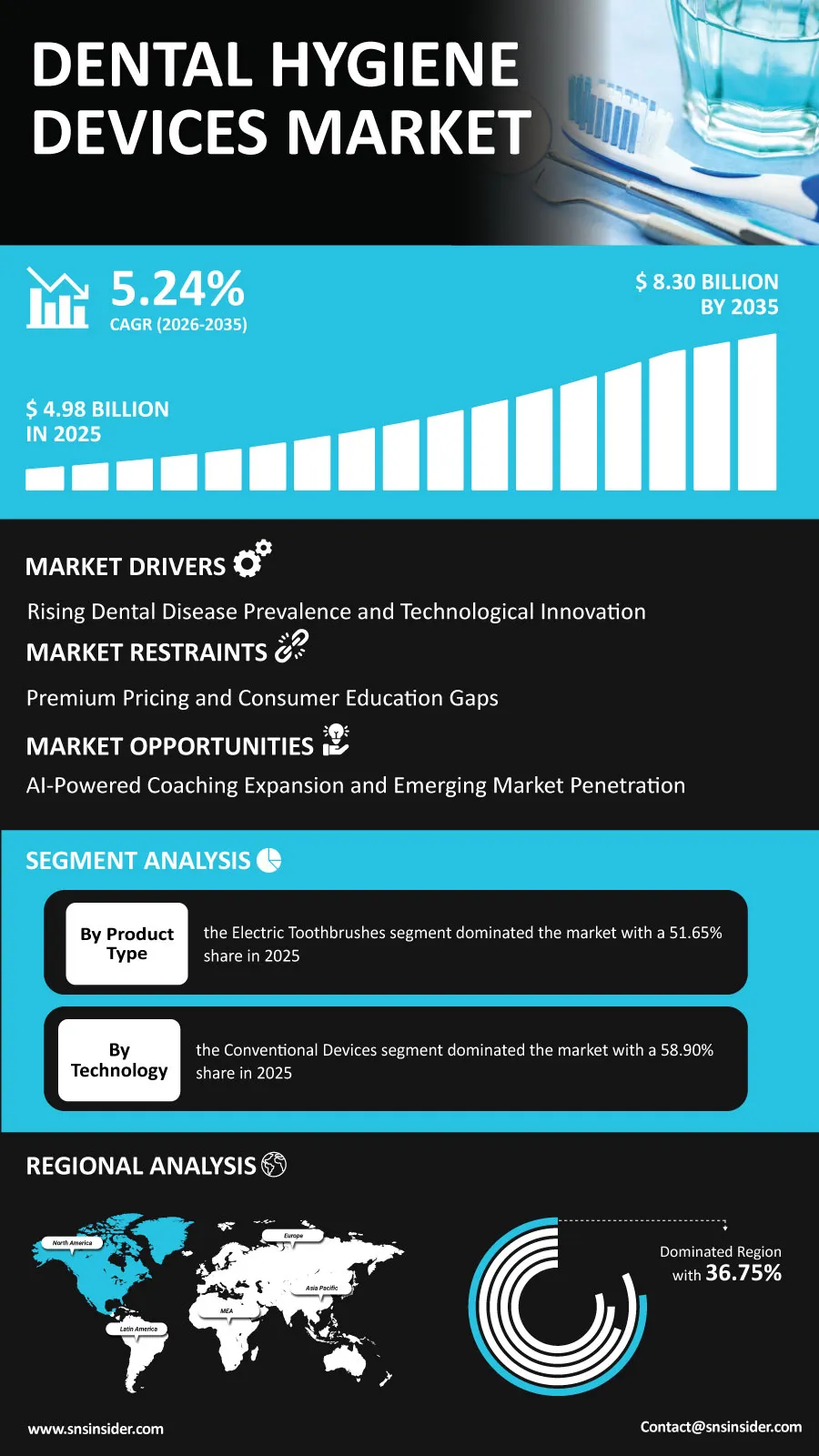
A toothbrush that can now tell you exactly where you missed during your last brushing session marks a genuine shift in how consumers think about daily oral care. "According to a recent study by SNS Insider, the global Dental Hygiene Devices Market, valued at USD 4.98 billion in 2025, is projected to reach USD 8.30 billion by 2035, registering a CAGR of 5.24% across the 2026-2035 forecast period."
Dental hygiene gadgets range from electric and manual toothbrushes, water flossers, interdental brushes, and oral irrigators, which consumers use to clean their teeth and gums daily, to modern gadgets powered by AI and connected through apps to provide brushing data in real-time. It is an industry that combines consumer electronics and prevention medicine as the manufacturers are working to move away from the basic function of mechanical cleaning towards teaching the users.
To Get Detailed Insights on the Dental Hygiene Devices Market – Request a Sample Report
Rising Dental Disease Prevalence and Technological Innovation Fuel Growth
The rising global incidence of dental caries, gingivitis, and periodontal disease continues to widen demand, as growing awareness of these conditions drives consumers toward more advanced hygiene tools. Continued technological innovation reinforces this trend, as manufacturers push device capability well beyond simple mechanical cleaning toward AI-powered coaching and real-time feedback.
Manufacturers are responding with on-device artificial intelligence capable of showing users precisely how well they are brushing during each session, and with retail exclusivity partnerships that continue to expand device accessibility across a broader range of price points than premium-only positioning historically allowed.
Segment Findings Point to a Market in Transition
Electric toothbrushes led the market in 2025, reflecting their superior plaque removal performance relative to manual brushing, while water flossers are recording the fastest growth at a 7.45% CAGR as interdental cleaning awareness rises. Conventional devices hold the largest technology share, though AI-powered and smart-connected devices are growing fastest at 9.65% as real-time coaching features demonstrate genuine value.
Online retail dominates distribution and is also growing fastest at 8.35% as e-commerce convenience continues to win share from physical retail. Adults account for the largest end-user share, while the geriatric population is expanding fastest at 7.15% as ageing populations face rising periodontal disease rates. Preventive oral care leads by application, though orthodontic maintenance is growing fastest at 7.90% as adult orthodontic treatment volumes rise.
North America Leads, Asia Pacific Set to Grow Fastest
North America dominated in terms of market share in 2025 at 36.75% on account of high awareness among consumers regarding preventive oral care and availability of dental insurance across North America. United States was the major contributor to the regional market share.
The Asia Pacific region is estimated to grow at the fastest pace than any other region, at a CAGR of about 8.15%, owing to the increasing disposable incomes and retail network in China, Japan, and India. Europe continues to be an important market driven by consumer health sector of Germany.
AI Innovation and Retail Partnerships Reshape Competitive Dynamics
Competition within this market increasingly centres on which manufacturers can pair reliable core cleaning performance with genuinely differentiated AI coaching capability, as leading brands continue forming retail exclusivity partnerships that expand device accessibility across a broader range of price points and distribution channels.
Some of the major companies operating in the global dental hygiene devices market include Procter & Gamble Company, Koninklijke Philips N.V., Colgate-Palmolive Company, GlaxoSmithKline plc, Dentsply Sirona Inc., Church & Dwight Co., Inc., Hu-Friedy Mfg. Co., LLC, Young Innovations, Inc., Panasonic Corporation, and Conair LLC.
Looking ahead, the pace of AI coaching feature adoption, continued retail partnership expansion, and sustained dental disease prevalence growth are likely to determine which manufacturers gain the most share over the coming decade. Companies that combine proven cleaning performance with genuine AI innovation are expected to be best placed to benefit from the market's sustained, oral-health-driven growth throughout the forecast period.
Sustainability credentials are also becoming a genuine point of brand differentiation, as consumers increasingly weigh environmental impact alongside cleaning performance when selecting an electric toothbrush. Manufacturers that can reduce plastic use in packaging and design recyclable or refillable brush head systems are finding this resonates with a growing segment of environmentally conscious consumers, particularly in European markets where sustainability expectations tend to run ahead of other regions.
Subscription and replacement head programs are also reshaping how manufacturers think about long-term customer relationships beyond the initial device purchase. As more brands introduce recurring brush head or flossing tip delivery subscriptions, the industry is gradually shifting toward a model that more closely resembles razor and cartridge economics, where the core device purchase matters less over time than the recurring revenue stream from consumables, a dynamic that continues to influence how manufacturers price entry-level devices to maximise long-term subscription enrollment.
Professional dental endorsement continues to matter as much as consumer marketing in shaping purchasing decisions. As dentists and hygienists increasingly recommend specific advanced devices to patients during routine visits, manufacturers that can demonstrate genuine clinical evidence supporting their AI coaching and enhanced cleaning claims are finding this professional validation meaningfully accelerates consumer adoption relative to competitors relying primarily on direct-to-consumer marketing alone.
An SNS Insider Analyst, Parry Kardani commented, "This market continues to benefit from rising global awareness of preventive oral care and a genuine industry-wide shift toward AI-powered, personalised brushing guidance. Manufacturers that pair proven cleaning performance with genuine AI innovation and broad retail accessibility are best positioned to capture the next phase of demand, particularly across Asia Pacific's fast-growing disposable income and retail infrastructure investment."
About the Author

Get in touch