
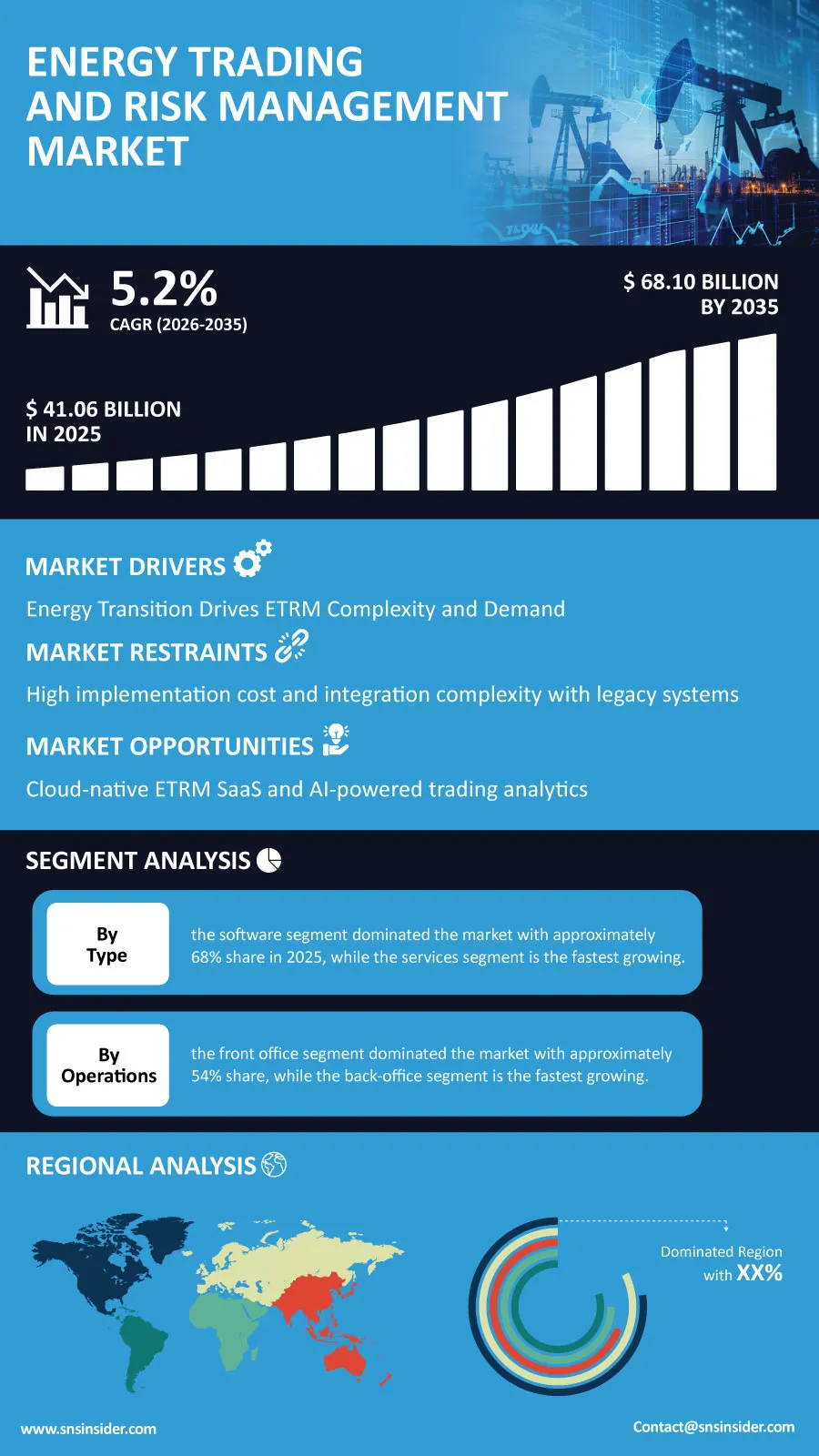
The global Energy Trading and Risk Management (ETRM) Market is witnessing sustained expansion as energy companies strengthen digital trading capabilities to navigate increasingly complex electricity, natural gas, renewable energy, and carbon markets. “According to a recent study by SNS Insider, the global Energy Trading and Risk Management Market size valued at USD 41.06 billion in 2025, is anticipated to grow to USD 68.10 billion by 2035, registering a CAGR of 5.2% over the 2026–2035 forecast period.”
Volatility in the global energy market landscape is driving the need for modernizing the trading capabilities through the use of intelligent platforms that enhance decision-making and risk management. With the continued growth of renewable energy production, there is the need for technologies that will help to handle issues such as variable production, pricing, and increasing compliance complexities.
Cloud-based platforms are increasingly being embraced in digital transformation programs due to their ability to provide increased flexibility and collaboration capabilities in front office, middle office, and back office environments. This has made the ETRM platforms to become strategic tools instead of just transaction management software.
To Get Detailed Insights on the ETRM Market – Request a Sample Report
Renewable Energy Trading and Digitalization Expand Market Opportunities
The fast-changing nature of international energy markets is leading to increased need for a sophisticated ecosystem of smart trading that would be able to handle traditional commodities along with electricity generation from renewable sources, environment certificates, and carbon trading.
Artificial intelligence, predictive analytics, and automation technologies are assisting firms to get more accurate predictions while discovering market opportunities. Contemporary ETRM software applications help build operational resilience by streamlining the process of compliance with regulations and minimizing human interventions.
Cloud deployment models continue gaining traction because they reduce infrastructure costs while allowing organizations to rapidly scale trading operations without significant technology investments.
Key Market Insights Reflect Changing Trading Priorities
By type, the Software segment accounted for approximately 68% of global revenue in 2025, reflecting widespread adoption of integrated trading platforms across utilities and commodity trading organizations. The Services segment is projected to achieve the fastest growth through 2035 as organizations increasingly seek consulting, implementation, and managed support for complex trading environments.
Based on operations, the Front Office segment represented approximately 54% of market revenue in 2025 owing to rising investment in trade execution, pricing, and portfolio optimization tools. The Back Office segment is expected to record the strongest growth during the forecast period as automation improves settlement efficiency and financial reporting.
In terms of application, Power Trading contributed nearly 34% of total market revenue in 2025 because electricity markets continue requiring sophisticated transaction management capabilities. Renewable Energy Trading is anticipated to experience the highest growth through 2035 as solar, wind, and hybrid energy assets expand worldwide.
AI and Cloud Technologies Transform Modern Energy Trading
Innovation in technology is changing the way energy firms operate commercially. Artificial intelligence is helping in forecasting through market analysis, climate patterns, changes in demand, and trading history to enable faster and evidence-based decisions.
Machine learning technologies are aiding firms in risk analytics by detecting pricing outliers and optimizing portfolios. Moreover, cloud-based technologies are offering better scalability, cybersecurity, and availability of systems while at the same time integrating with ERP systems, market exchanges, and regulatory reporting solutions.
The growing adoption of carbon accounting capabilities within ETRM platforms is also enabling organizations to monitor environmental obligations alongside traditional commodity trading activities, supporting broader sustainability initiatives.
North America Accounted for the Largest Market Share in 2025; Asia Pacific Forecast to Expand at the Fastest CAGR by 2035
North America continues to dominate as the leading regional market in 2025 due to its developed system of energy trading, advanced digital technologies, and an excellent regulatory regime for commodities trading. Increased use of advanced trading and risk management systems by utilities, financial organizations, and independent power producer’s fuels investments in these solutions in North America.
The fastest growing market will be Asia Pacific, where the investments in renewables, electricity market liberalization, and growing activities in LNG trading will increase rapidly until 2035. China, Australia, Japan, and Singapore are constantly improving their regional trading capacities by implementing digital technologies and investing in renewables.
Europe stays competitive with cross-border electricity markets, development of renewables, and new environmental regulations. The same goes for Latin America and Middle East & Africa, where energy infrastructure is continuously modernized and energy trading is increasing.
Industry Participants Invest in AI-Driven Trading Intelligence
Competition within the ETRM market continues to intensify as software providers focus on artificial intelligence, cloud-native deployment, predictive analytics, and integrated carbon management capabilities. Vendors are expanding product functionality to address evolving customer requirements while supporting increasingly diversified energy portfolios across electricity, natural gas, LNG, emissions trading, and renewable assets.
Key companies operating in the global Energy Trading and Risk Management (ETRM) Market include Openlink Financial LLC (ION Group), Allegro Development Corporation, Endur, SAP SE, Energy Exemplar Pty Ltd., OATI (Open Access Technology International), SunGard Energy Systems (FIS), Amphora Inc., Brady plc, Schneider Electric, Hitachi Energy Ltd., ENGIE's GEMS platform, Eka Software Solutions (Aveva), DataGenic Group Ltd., Lacima Group, Oracle Energy and Water, ETR Analytics GmbH, Greenbyte AB (Beckman Coulter), Trayport Ltd. (TMX Group), PwC Energy Trading & Risk Management Practice, and Aetherflux.
An SNS Insider analyst Santosh Bhul commented, “The ongoing transformation of global energy markets is creating sustained demand for intelligent trading and risk management platforms capable of supporting increasingly diversified energy portfolios. Organizations investing in AI-powered analytics, cloud-native infrastructure, and integrated compliance capabilities are expected to gain a significant competitive advantage as renewable energy trading and digital energy ecosystems continue to evolve.”
About the Author

Get in touch




