
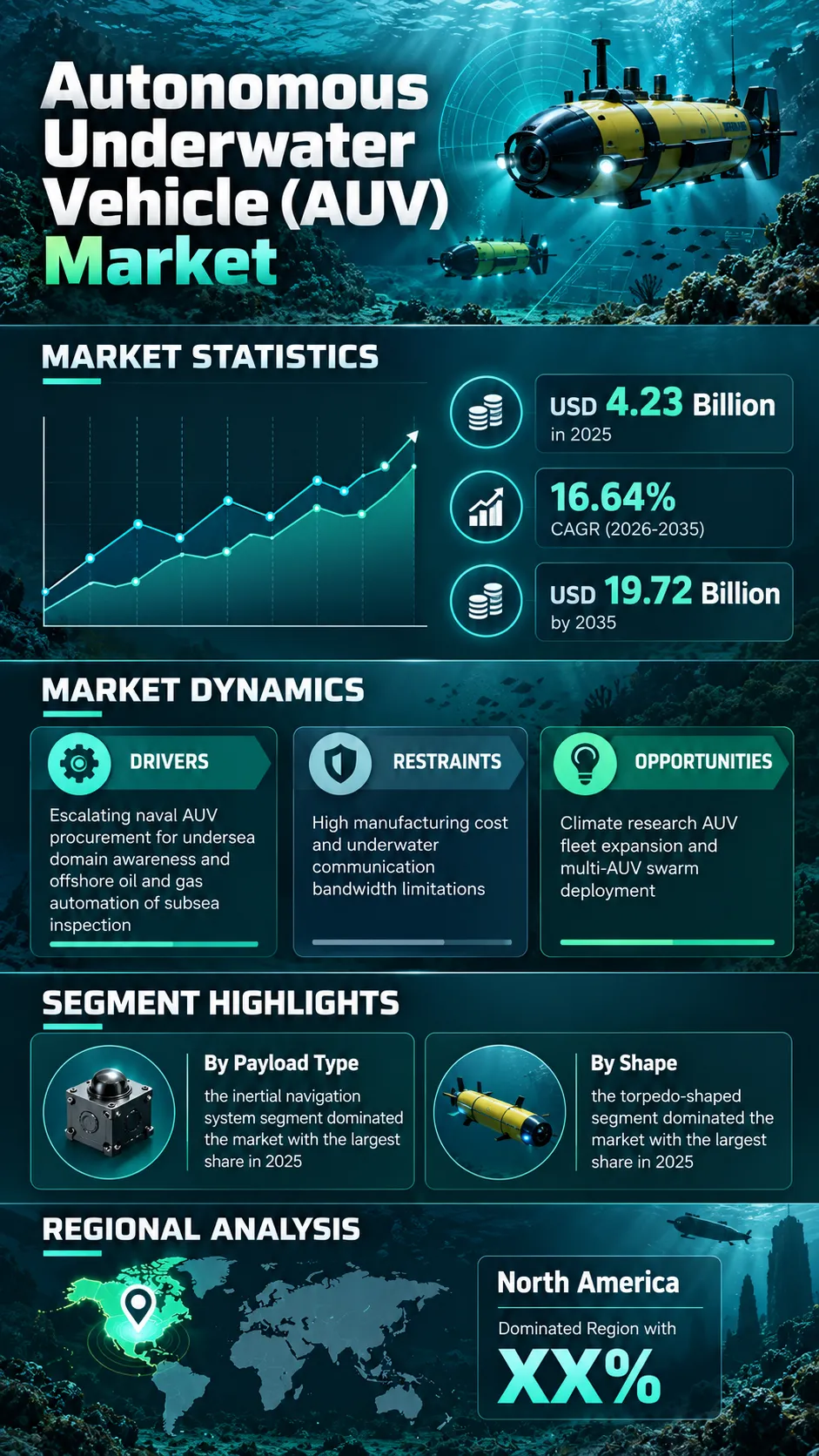
The Autonomous Underwater Vehicle (AUV) Market is entering a period of rapid expansion as defense agencies, energy companies, and research institutions increase investments in autonomous technologies for underwater operations. “According to a recent study by SNS Insider, the global Autonomous Underwater Vehicle (AUV) Market size valued at USD 4.23 billion in 2025, is anticipated to grow to USD 19.72 billion by 2035, registering a CAGR of 16.64% over the 2026–2035 forecast period.”
With the increasing demands for underwater surveillance, underwater mapping, structure inspection, and marine studies, there has been an increased need for platforms that can operate without requiring much human intervention. The advancements in artificial intelligence, navigation, sensing technology, and energy storage have allowed AUVs to perform missions that are long and complex.
There is another significant factor behind the increase in the demand for AUVs. This growth is driven by the increasing offshore energy industry where operators are considering the use of autonomous systems in subsea inspections and surveys.
To Get Detailed Insights on the Autonomous Underwater Vehicle (AUV) Market – Request a Sample Report
Autonomous Mission Capabilities Create New Growth Opportunities
Intelligent underwater vehicles present multiple opportunities both from the perspective of defense and commercial applications. Mission planning through AI provides AUVs with an opportunity to adapt their navigation plans depending on the surrounding environment and sensor data.
Developments in batteries, alternative underwater power sources, and acoustic communication technologies are expanding the capabilities of AUVs. In addition, multi-AUV operations are presenting new opportunities in such fields as wide area surveillance, mine countermeasures, seabed survey, and infrastructure inspection.
Growing interest in compact AUVs is further broadening the addressable market by enabling deployment in ports, coastal waters, and other environments where larger platforms may be less practical.
Key Market Insights Highlight Shifting Demand Patterns
By payload type, inertial navigation systems are set to retain their dominance by 2025 due to the significance of precise underwater localization for autonomous surveying. The cameras category is estimated to witness the highest growth rate, owing to innovations in the field of underwater visualization and data processing for infrastructure inspections, security surveillance, habitat monitoring, and underwater archaeology.
Based on shape, torpedo-type AUVs segment was expected to dominate the market by 2025 due to their efficient architecture that facilitates movement and increased ranges underwater. Multi-hulled vehicles are expected to have the highest growth rate up to 2035 owing to their stability in low-speed operations such as inspections, mapping, and environmental surveys.
By technology, navigation is anticipated to emerge as the dominant technology area in 2025 owing to its significance for precise position determination and self-contained navigation capabilities when operating without GPS. The segment of collision avoidance is anticipated to grow at the fastest rate as the demand for the safe operation of AUVs in challenging aquatic conditions grows.
In terms of application, defense was expected to dominate the market in 2025 due to increased naval expenditure on surveillance, mine countermeasures, and undersea warfare. Scientific research will be the fastest-growing sector due to increased investment in ocean observation, climate monitoring, and marine biodiversity research.
AI and Swarm Operations Reshape Underwater Missions
Integration of AI is revolutionizing the planning and execution of underwater operations. Route optimization, decision-making via sensors, and better obstacle detection are some of the advancements that have enabled AUVs to perform much better in various environments.
Collaboration between multiple AUVs is becoming another important area in technology development. These AUVs can divide survey zones, communicate with each other, and expand coverage while minimizing the amount of time needed to accomplish complex operations.
North America Leads AUV Market as U.S. Accounts for 87.4% of Regional Revenue and China Holds 44.8% in Asia Pacific
North America is likely to continue being an important market region owing to the considerable defense purchases in the U.S., oil exploration at sea, and oceanography. In 2025, the U.S. generated about 87.4% of North American AUVs revenue due to its vast system of military and civilian applications of the devices.
Asia Pacific becomes an attractive market due to the increased capacity of the naval fleet, offshore energy projects, and increasing marine research. In 2025, China generated about 44.8% of Asia Pacific AUVs revenue, whereas Japan, South Korea, India, and Australia develop their systems of underwater technology.
Europe is still benefiting from the modernization of its military sector, offshore inspections, and the experience in working with marine technologies. Norway generated approximately 28.4% of AUVs revenue in Europe in 2025 due to its offshore energy and advanced system of underwater technologies.
Industry Participants Focus on Autonomous Technology Innovation
The competitive scenario has changed due to the efforts being made by manufacturers and technology providers in the field of longer endurance, advanced sensing technologies, autonomous navigation, and modular mission capabilities. Strategy formulation has become more focused on building platforms which could support a number of missions.
Key companies operating in the global Autonomous Underwater Vehicle (AUV) Market include Kongsberg Maritime AS, Teledyne Marine, L3Harris Technologies Inc., Boeing Defense, Space & Security, General Dynamics Mission Systems, Saab AB, ECA Group, HII Mission Technologies, Fugro N.V., Ocean Infinity Ltd., Exail Technologies SA, Sonardyne International Ltd., Liquid Robotics Inc., Riptide Autonomous Solutions, Atlas Elektronik GmbH, BAE Systems plc, Thales Group SA, Anduril Industries, Ocean Aero, Inc., and MSubs Ltd.
An SNS Insider analyst Santosh Bhul commented, “The growing need for persistent underwater intelligence, automated inspection, and advanced marine research is accelerating investment in autonomous underwater systems. Continued progress in AI, navigation, endurance, and multi-vehicle coordination is expected to expand the range of missions that AUV platforms can perform and create significant opportunities across defense, energy, and scientific applications.”
About the Author

Get in touch




