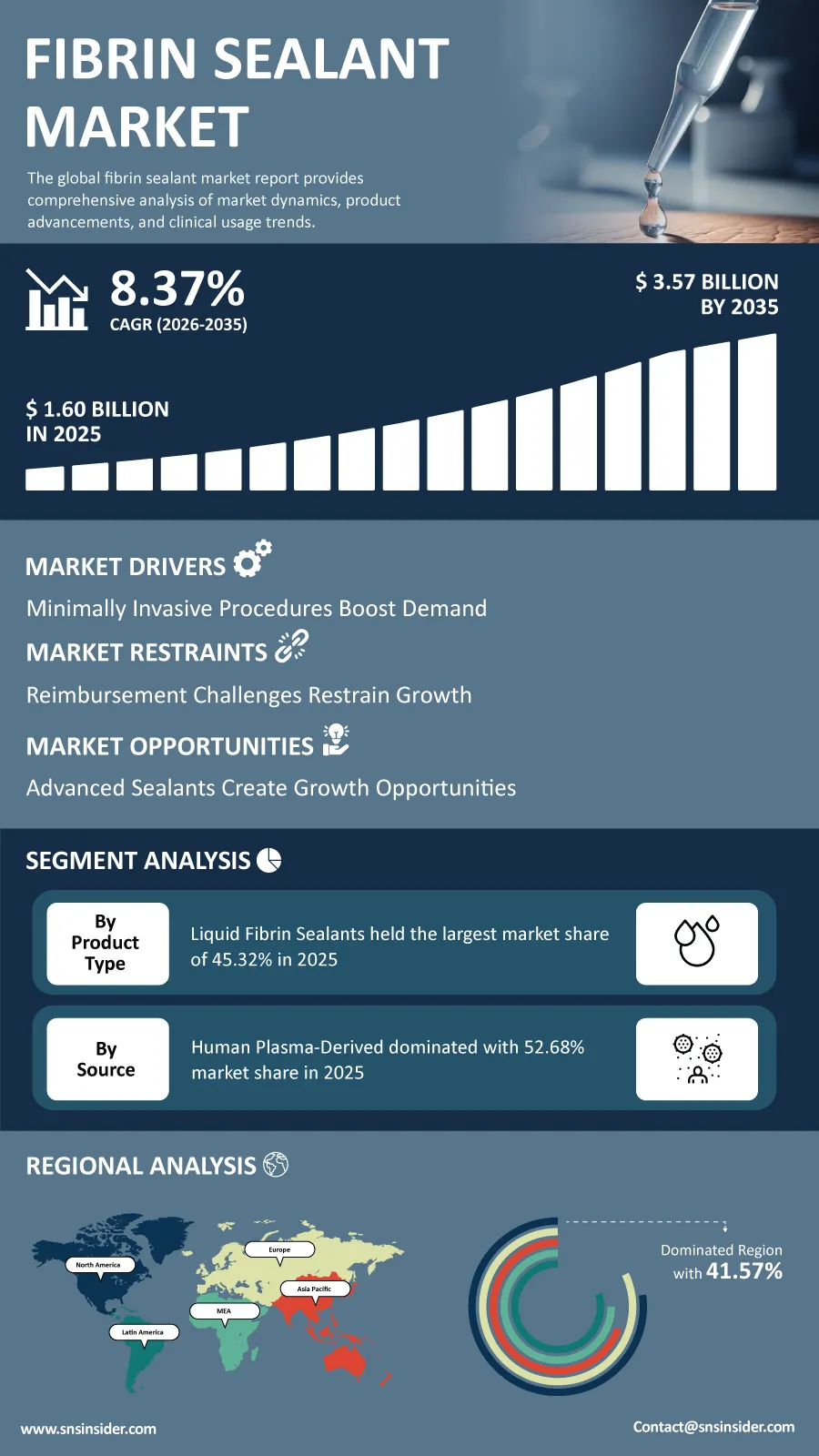
The global Fibrin Sealant Market is expected to witness substantial growth over the coming decade as healthcare providers increasingly adopt biologic surgical solutions that improve hemostasis, tissue adhesion, and postoperative recovery. “According to a recent study by SNS Insider, the global Fibrin Sealant Market size valued at USD 1.60 billion in 2025, is anticipated to grow to USD 3.57 billion by 2035, registering a CAGR of 8.37% over the 2026–2035 forecast period.”
Due to growing needs for innovative surgical technologies, increased procedure complexity, and increasing focus on enhancing patient results, healthcare organizations are turning toward next-generation tissue management devices in their daily practices. There is a growing tendency among hospitals and surgery centers to find solutions that will help patients heal faster and reduce complications.
As healthcare systems continue investing in modern operating rooms and enhanced surgical workflows, biologic sealants are becoming an increasingly important component of contemporary surgical care.
To Get Detailed Insights on the Fibrin Sealant Market – Request a Sample Report
Innovation in Surgical Care Accelerates Market Development
With ongoing developments in materials science, technology, and bioengineering, the future of surgical tissue management will be transformed. Companies are innovating products that help make applications easier, provide enhanced sealing properties, and increase compatibility with a wide range of surgical procedures.
As minimally invasive procedures gain popularity, there is an increased need for surgical products that aid in providing precise, efficient, and quick post-operative recovery. Simultaneously, there is growing importance placed on technologies that help decrease the complexities of the procedure while improving outcomes.
Collaborative research initiatives involving medical device manufacturers, healthcare institutions, and clinical researchers continue to accelerate product innovation and expand the range of surgical applications.
Key Market Findings Highlight Emerging Opportunities
By product categories, liquid fibrin sealants accounted for 45.32% of total market revenue in 2025, reflecting broad clinical acceptance and extensive utilization across numerous surgical specialties. The spray-based sealants are projected to register the fastest growth through 2035, expanding at a CAGR of 9.12%, supported by increasing demand for efficient tissue coverage during minimally invasive and complex procedures.
From a source perspective, human plasma-derived fibrin sealants represented 52.68% of global market revenue in 2025, while recombinant fibrin sealants are expected to record the fastest growth at a CAGR of 10.03%, reflecting ongoing advances in biotechnology and increasing preference for next-generation biologic products.
By formulation, sheet and patch products accounted for 40.55% of market revenue in 2025, maintaining strong adoption across surgical specialties. However, matrix and gel formulations are anticipated to experience the fastest growth, registering a CAGR of 9.25%, driven by their adaptability across complex surgical environments.
Application trends continue to evolve as healthcare providers expand the use of advanced tissue-sealing technologies. Cardiovascular surgery represented 27.48% of total market revenue in 2025, while trauma care is projected to witness the fastest growth at a CAGR of 9.87% during the forecast period, supported by increasing demand for rapid bleeding management in emergency care settings.
Expanding Surgical Infrastructure Supports Long-Term Growth
Investments in healthcare all around the world are continuing to improve their surgical capabilities by establishing more specialized hospitals and outpatient centers, along with developing an advanced operating environment. The growth of procedures in areas such as cardiovascular surgeries, orthopedic surgeries, reconstructive surgeries, and emergency surgery is creating an environment for innovation in tissue sealants.
Manufacturers are also focusing on improving product usability, procedural efficiency, and workflow integration, helping clinicians achieve greater precision while supporting better patient outcomes.
Regional Markets Continue to Expand
The North America segment held 41.57% of the total market share in 2025 due to the presence of well-equipped healthcare facilities and procedures performed in high numbers. Moreover, the presence of modern surgical devices in the region helps to boost its dominance.
On the other hand, Asia Pacific is anticipated to become the leading regional market with an estimated CAGR of 9.73%. This can be attributed to the increased healthcare expenditure, enhanced surgical capabilities, improved availability of modern medical equipment, and rising demand for patient care.
Industry Leaders Continue to Strengthen Competitive Position
Competitive dynamics are ongoing in terms of continuous efforts in researching, developing products, strategic partnerships, and international expansions by the companies. Innovations are aimed at increasing surgical efficiency, improving patients' safety, and applying the technology to several medical fields.
Key companies operating in the global fibrin sealant market include Baxter International, Johnson & Johnson, CSL Behring, Grifols, Pfizer, Takeda Pharmaceutical Company, Stryker, B. Braun, Integra LifeSciences, and Advanced Medical Solutions Group.
An SNS Insider analyst Parry Kardani commented, "Growing emphasis on surgical efficiency, patient safety, and advanced biologic technologies is transforming the tissue-sealing landscape. Continued innovation in delivery systems and next-generation formulations is expected to create significant opportunities for manufacturers while supporting improved clinical outcomes across a broad range of surgical procedures."
About the Author

Get in touch