
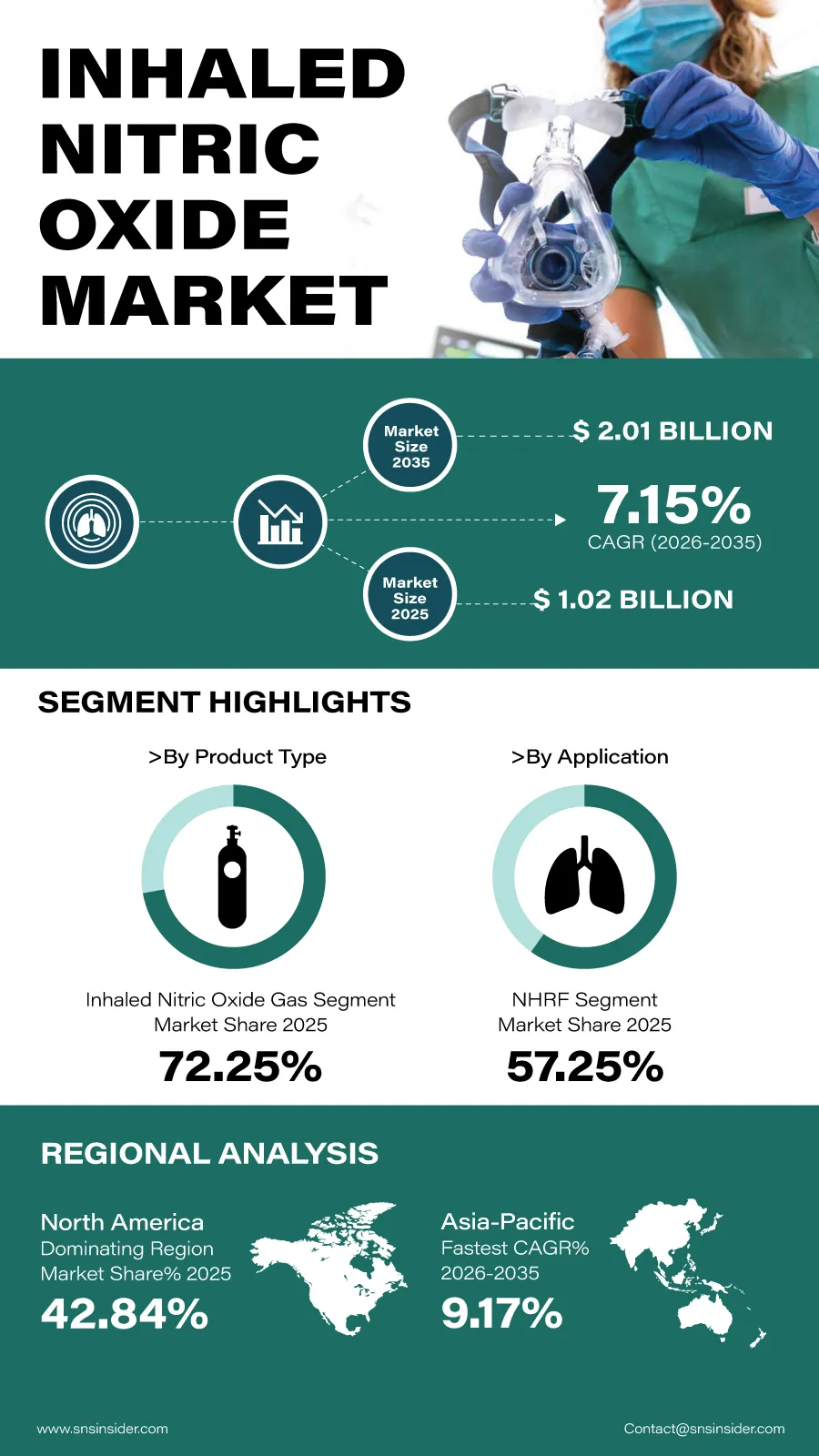
The global Inhaled Nitric Oxide Market is expected to experience steady expansion over the next decade as healthcare providers increasingly adopt advanced respiratory therapies to improve outcomes for patients with severe pulmonary conditions. “According to a recent study by SNS Insider, the global Inhaled Nitric Oxide Market size valued at USD 1.02 billion in 2025, is anticipated to grow to USD 2.01 billion by 2035, registering a CAGR of 7.15% over the 2026–2035 forecast period.”
Due to increased funding in critical care medicine, advances in breathing machines, and greater availability of specialized neonatal and intensive care facilities, there are positive trends for market growth in the long term. Global healthcare facilities are developing their capacities to deal with difficult cases of respiratory disorders using innovative methods for delivering oxygen to the patients.
The increasing emphasis on early intervention, specialized respiratory management, and enhanced critical care infrastructure is encouraging wider adoption of inhaled nitric oxide therapy across hospitals and specialized treatment centers.
To Get Detailed Insights on the Inhaled Nitric Oxide Market – Request a Free Sample Report
Innovation in Respiratory Care Continues to Expand Clinical Applications
Rapid technological advances in the field of medical devices have enabled the treatment delivery of inhaled nitric oxide to undergo a sea change. The manufacturing companies are now designing next-generation delivery systems, which help deliver precise treatment and streamline the clinical process at the same time.
Moreover, with the increased incorporation of digital surveillance technology and advanced respiratory systems in the industry, healthcare experts are being able to administer therapy in an effective manner along with gaining efficiency. This development has been aiding the adoption of inhaled nitric oxide in NICUs, intensive care departments, and respiratory centers.
Increasing research on the other potential uses of inhaled nitric oxide is likely to make its position stronger in future respiratory medicine.
Key Market Findings Highlight Growth Opportunities
Among product categories, inhaled nitric oxide therapeutics accounted for 72.25% of total market revenue in 2025, reflecting their established role across specialized respiratory care settings.
Meanwhile, delivery systems are projected to register the fastest growth through 2035, expanding at a CAGR of 9.12%, supported by increasing demand for portable, integrated, and technologically advanced respiratory care solutions.
Application analysis shows that neonatal hypoxic respiratory failure represented 57.25% of global market revenue in 2025, highlighting the continued importance of inhaled nitric oxide therapy within neonatal intensive care. At the same time, chronic obstructive pulmonary disease (COPD) applications are expected to witness the fastest growth, recording a CAGR of 7.62% during the forecast period, reflecting expanding clinical research and broader therapeutic interest.
By patient group, neonates accounted for 65.25% of market revenue in 2025, while the adult segment is projected to experience the strongest growth through 2035, driven by increasing utilization across pulmonary hypertension and other severe respiratory conditions.
Hospitals remained the leading end-user category, contributing 52.12% of total market revenue in 2025, whereas home care settings are expected to grow at the fastest CAGR of 8.25%, supported by increasing availability of portable respiratory care technologies.
An Infographic Representation of the Global Inhaled Nitric Oxide Market
Advancing Critical Care Infrastructure Supports Market Expansion
The need for the advancement of respiratory therapy capabilities remains strong owing to increasing demands for special treatments across the world. The developments in neonatal intensive care units, intensive care unit facilities, and advances in respiratory therapy equipment have been promoting the uptake of these services.
There are growing interests in portable respiratory therapies as well, and these will help improve access to treatment outside of hospital settings. With the development of patient-focused healthcare practices, there are growing expectations that such types of treatment options will be developed in the future.
Regional Markets Present Strong Growth Potential
North America holds a share of 42.84% of the total market revenue in 2025 due to its highly advanced infrastructure in critical care, high utilization of advanced respiratory therapies, and continuous investment in neonatal care services. North America continues to lead in terms of technological advancements in respiratory medicines and therapies.
Asia-Pacific is estimated to be the fastest growing regional market, which is expected to grow at a CAGR of 9.17% till 2035. Factors contributing to the fast-paced growth in the region include improved healthcare infrastructure, investments in intensive care, high awareness about advanced respiratory therapies, and availability of neonatal care services.
Leading Companies Continue to Drive Innovation
The competitive landscape remains dynamic as manufacturers continue investing in advanced delivery technologies, product development, strategic collaborations, and expanded healthcare partnerships to strengthen their market positions.
Key companies operating in the global inhaled nitric oxide market include Mallinckrodt Pharmaceuticals, Linde, Air Liquide Healthcare, Vero Biotech, Beyond Air, Bellerophon Therapeutics, Getinge, Hamilton Medical, GE HealthCare, and Philips Respironics.
An SNS Insider analyst Parry Kardani commented, "The inhaled nitric oxide market is evolving through continued advances in respiratory care technologies, expanding critical care infrastructure, and increasing demand for precision treatment solutions. Future growth will be supported by innovation in delivery systems and broader clinical adoption across diverse respiratory care settings."
About the Author

Get in touch




