
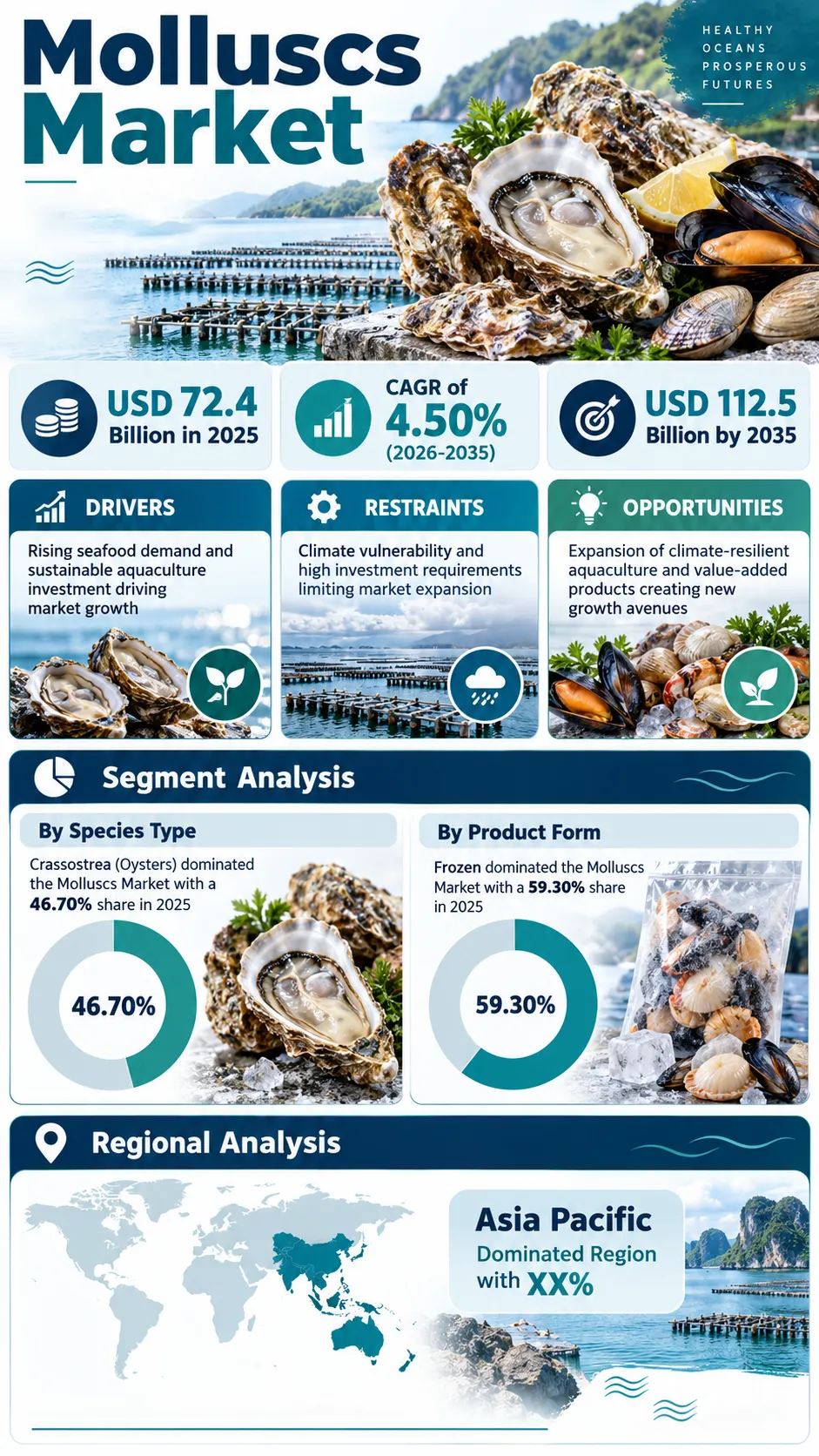
The global Molluscs Market is set for steady expansion as sustainable seafood demand and aquaculture innovation continue to reshape global protein supply chains. “According to a recent study by SNS Insider, the global Molluscs Market size valued at USD 72.4 billion in 2025, is anticipated to grow to USD 112.5 billion by 2035, registering a CAGR of 4.50% over the 2026–2035 forecast period.”
There have been notable changes within aquaculture farming technology over time, due to which many producers who aim at improving climate resilience and production efficiency can take advantage of this trend. This includes the need for more sustainable, technologically advanced farming techniques that will provide producers with the ability to maintain stable supply amid increasingly volatile climate conditions. This applies in situations where molluscs support human consumption, foodservice, and industrial byproduct applications. Producers are constantly working hard to ensure that their aquaculture operations perform better than before in order to meet various consumer and climate resilience requirements.
To Get Detailed Insights on the Molluscs Market – Request a Sample Report
Climate-Resilient Aquaculture Creates New Demand
The molluscs market has evolved from traditional wild-capture harvesting to an increasingly sophisticated, technology-driven aquaculture industry. The growing investment in sustainable farming practices, climate-resilient production techniques, and advanced processing technology across producers of all sizes has required the development of more efficient and resilient mollusc supply chains.
New aquaculture and processing technologies can increase production consistency, improve supply chain resilience, and allow for expansion into increasingly diverse frozen, fresh, and value-added product categories. This gives producers the possibility to meet growing global seafood demand while adapting to increasingly volatile climate conditions affecting traditional farming regions.
Aquaculture producers, seafood distributors, and food service companies are increasingly cooperating thanks to the growing interest in developing future solutions for sustainable, climate-resilient mollusc production and distribution.
Key Market Findings Highlight High-Growth Segments
The Crassostrea (oysters) segment dominated all categories in the molluscs market share with a 46.70% share due to increasing production in emerging markets such as India, China, and Japan. The fastest growing category is expected to be Ruditapes philippinarum (clams) which will grow at a CAGR of 7.20% through 2035, owing to sustainable aquaculture practices enhancing supply chain efficiencies.
By product form, frozen held 59.30% of total market revenue due to longer shelf life and steady demand for ready-to-cook seafood. Fresh products will see the fastest growth in revenue generation at a CAGR of 6.90%, driven by growing premium foodservice demand for minimally processed mollusc products.
Based on distribution channel, retail generated a 73.44% share of market revenue thanks to broad product presence across supermarkets and hypermarkets. On the other hand, online distribution will be the segment recording the fastest revenue growth at a CAGR of 8.60%, supported by growing e-commerce seafood delivery infrastructure.
Distributive application trends are changing as well. Human consumption accounted for the largest revenue share owing to molluscs' established role as a protein-rich dietary staple. But non-food and industrial applications will turn out to be the fastest-growing category through 2035, on the back of growing utilization of mollusc byproducts.
Climate Resilience, Supply Consistency, and Sustainability Gain Importance
In this regard, producers and distributors have been looking at mollusc supply chains that would deliver more consistent production while requiring greater resilience to climate-related disruption.
Innovation in sustainable aquaculture practices, climate-resilient farming techniques, and advanced processing technology has been making it possible for companies to come up with production systems that can operate more reliably despite increasingly volatile ocean temperature conditions. In addition to that, increasing emphasis on lower-carbon animal protein sourcing is also making it possible for producers to find solutions that meet evolving retail and foodservice sustainability expectations. Such trends are likely to become even more prominent in the future.
Asia Pacific Emerges as the Largest Market Amid Large-Scale Production Systems
The Asia Pacific region represented the largest share of regional market revenue in 2025, commanding more than one-half of global revenue thanks to large-scale Chinese production systems and Vietnam's offshore build-out. On the other hand, Europe is the fastest-growing market during the forecast period through 2035, fueled by demand for premium-quality seafood products and growing sustainable aquaculture investment.
Leading Companies Drive Innovation and Competition
The environment continues to stay very dynamic since players continue innovating on sustainable aquaculture and climate resilience as well as forming partnerships in order to enhance their position in the industry. Some of the major companies that operate in the global molluscs market are Maruha Nichiro Corporation, Nireus Aquaculture, Cermaq, Eastern Fish Company, Cooke Aquaculture, Tassal Group, Blue Ridge Aquaculture, Selonda Aquaculture, Ulka Seafoods, and Avla Nettos Exports.
An SNS Insider analyst Santosh Bhul commented, "The growing need for climate-resilient, sustainable seafood production is creating unprecedented demand for technologically advanced mollusc aquaculture. Producers that successfully combine sustainable farming innovation, supply chain resilience, and value-added processing capability will be best positioned to capitalize on emerging opportunities across human consumption, foodservice, and industrial applications."
About the Author

Get in touch




