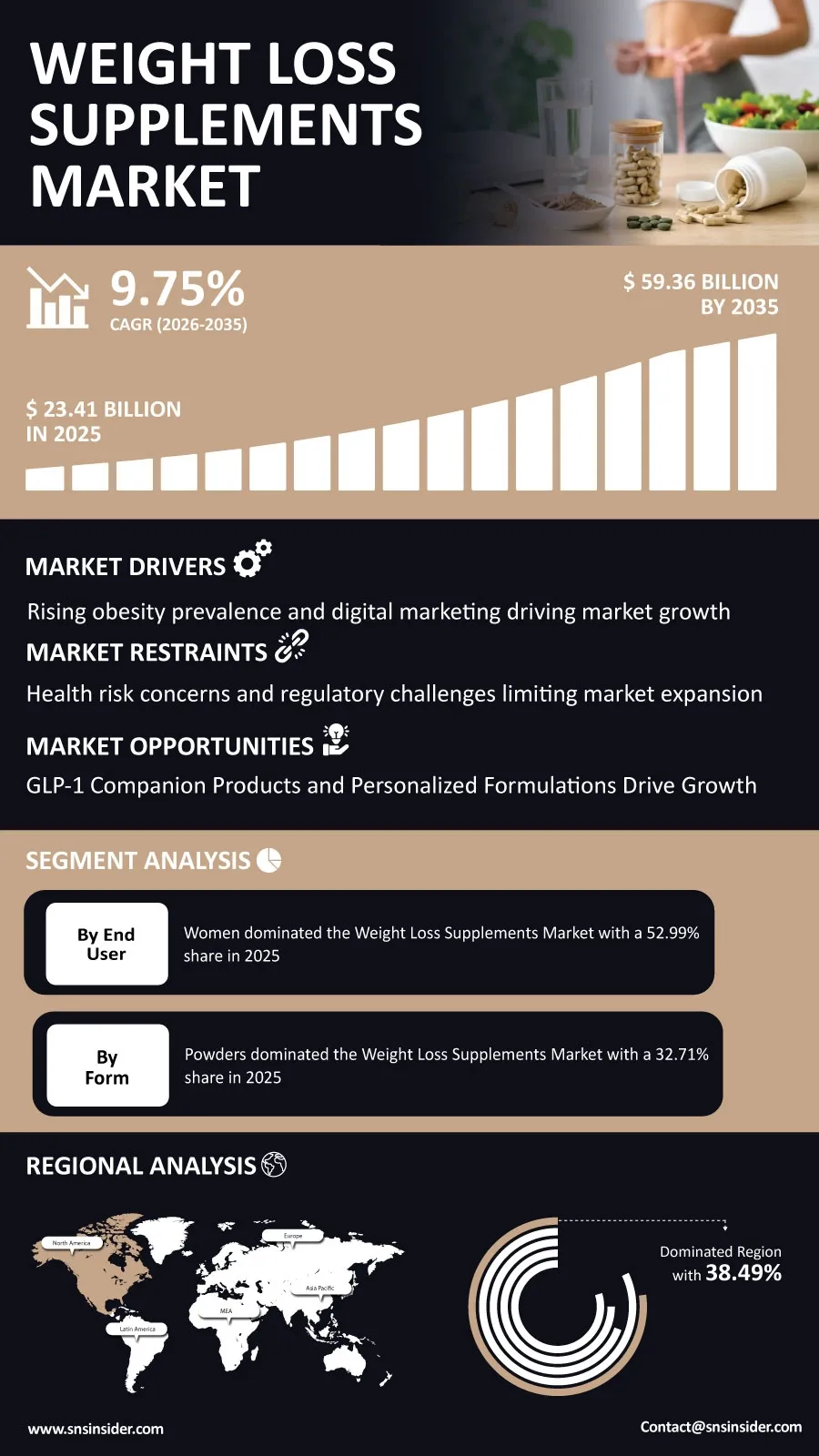
The global Weight Loss Supplements Market is set for significant expansion as rising obesity prevalence and natural formulation demand continue to reshape weight management product consumption worldwide. “According to a recent study by SNS Insider, the global Weight Loss Supplements Market size valued at USD 23.41 billion in 2025, is anticipated to grow to USD 59.36 billion by 2035, registering a CAGR of 9.75% over the 2026–2035 forecast period.”
There have been notable changes within weight management formulation technology over time, due to which many manufacturers who aim at improving efficacy and natural positioning of their products can take advantage of this trend. This includes the need for more clinically validated, personalized formulations that will provide consumers with the ability to achieve targeted weight management outcomes. This applies in situations where weight loss supplements support appetite suppression, fat burning, and metabolic enhancement applications. Manufacturers are constantly working hard to ensure that their supplement products perform better than before in order to meet various consumer health and efficacy requirements.
To Get Detailed Insights on the Weight Loss Supplements Market – Request a Sample Report
GLP-1 Companion Products Create New Demand
The weight loss supplement industry has advanced from simple appetite suppressant and fat burner products to advanced personalization and targeting of weight loss products. The increased emphasis on the sourcing of natural ingredients, GLP-1 product development and use of digital marketing technology by the manufacturers of all sizes have necessitated the need for advanced weight loss products.
Advanced formula and marketing strategies will enhance product effectiveness, advance positioning of natural ingredients and enable diversification into various consumer markets even those using GLP-1 drugs. Consumers will therefore have an opportunity to use weight management products with advanced digital marketing and increasingly personalization of their health care regimen.
Supplement companies, fitness firms, and healthcare companies are working together as a result of the increasing interest in the development of weight management products in the future.
Key Market Findings Highlight High-Growth Segments
The women segment dominated all categories in the weight loss supplements market share with a 52.99% share in 2024 due to historically higher engagement with dietary supplementation. The fastest growing category is expected to be men which will grow at an 11.63% CAGR through 2030, owing to growing fitness culture adoption and active lifestyle emphasis.
By form, powders captured 32.71% of market revenue in 2024 due to their versatility across shake and smoothie-based formulations. Liquids will see the fastest growth in revenue generation at an 8.63% CAGR, driven by growing consumer preference for ready-to-consume, rapidly absorbed formats.
Based on distribution channel, online retail commanded 35.83% of revenue in 2024 and also carries the fastest growth trajectory at a 12.73% CAGR, reflecting the ease of shopping from home and quick delivery advantage.
Distributive ingredient type trends are changing as well. Vitamins and minerals dominated the market with a 54.67% share owing to broad consumer familiarity and metabolic health support. But herbal and plant-based ingredients will turn out to be the fastest-growing ingredient category through 2035, on the back of growing consumer preference for natural formulations.
Efficacy, Natural Positioning, and Digital Accessibility Gain Importance
In this regard, consumers have been looking at weight loss supplements that would deliver more consistent efficacy while requiring greater natural ingredient transparency and digital accessibility.
Innovation in natural ingredient sourcing, GLP-1 companion product development, and digital marketing technology has been making it possible for companies to come up with products that appeal to increasingly diverse, health-conscious consumers. In addition to that, increasing emphasis on personalized nutrition is also making it possible for manufacturers to find solutions that address individual consumer health profiles. Such trends are likely to become even more prominent in the future.
North America Emerges as the Largest Market with 38.49% Global Sales Amid Rising Obesity Prevalence
The North America region represented the largest share of global sales in 2024 at 38.49%, owing to high obesity prevalence and strong consumer awareness of health and wellness benefits. On the other hand, Asia-Pacific is forecast to record the fastest 10.85% CAGR between 2025 and 2030, propelled by rising disposable incomes and expanding dietary supplement manufacturing capacity across the region's major economies.
Leading Companies Drive Innovation and Competition
The environment continues to stay very dynamic since players continue innovating on natural formulation and GLP-1 companion products as well as forming partnerships in order to enhance their position in the industry. Some of the major companies that operate in the global weight loss supplements market are Herbalife Nutrition, Amway, Nestlé, Glanbia, GNC Holdings, Abbott Laboratories, Reckitt Benckiser Group, Nature's Bounty, Isagenix International, and USANA Health Sciences.
An SNS Insider analyst Parry Kardani commented, "The growing global obesity epidemic combined with the emergence of GLP-1 pharmaceutical therapies is creating unprecedented demand for complementary, natural weight management supplements. Manufacturers that successfully combine natural ingredient innovation, digital marketing capability, and personalized formulation expertise will be best positioned to capitalize on emerging opportunities across women's, men's, and GLP-1 companion product segments."
About the Author

Get in touch