
Food Service Market Report Scope & Overview:
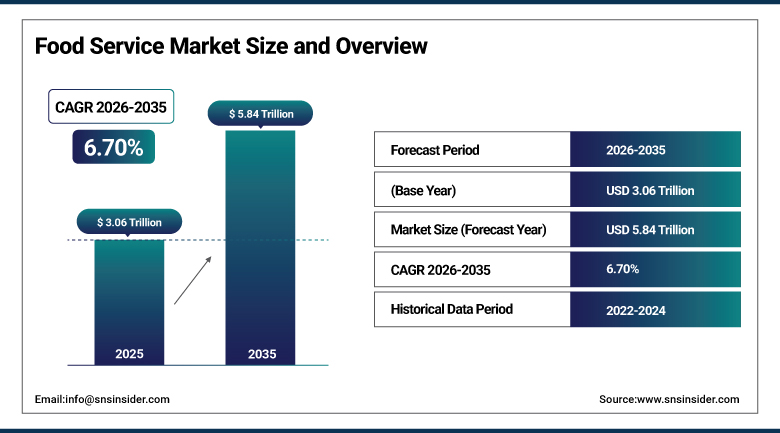
The Food Service Market was valued at USD 3.06 Trillion in 2025 and is expected to reach USD 5.84 Trillion by 2035, growing at a CAGR of 6.70% from 2026 to 2035.
The market is growing owing to increasing consumer spending on dining out experiences, rapid expansion of quick-service restaurants (QSRs), increasing adoption of online food delivery and growing demand for convenience foods. The global food service industry is experiencing a revolution in the form of digital ordering platforms, cloud kitchens, AI-enabled restaurant management systems and changing consumer lifestyle. The long-term growth of the market in developed and emerging economies will be further stimulated by the growth of organized restaurant chains, the tourism sector and institutional catering services.
In 2026, McDonald’s continued to expand its AI-powered restaurant operations and digital ordering overseas, aiming to enhance customer experience and operational efficiency. Yum! Brands accelerated the rollout of artificial-intelligence-powered restaurant technologies and upgraded digital ordering platforms across its worldwide KFC, Pizza Hut and Taco Bell chains in 2025.
To Get more information Food Service Market - Request Free Sample Report
Market Trends:
-
Increasing adoption of AI-powered ordering, kitchen automation, and restaurant management technologies globally.
-
Rising demand for online food delivery and cloud kitchen services is transforming food service operations.
-
Growing consumer preference for healthy, sustainable, and personalized menu offerings is driving innovation.
-
Expansion of quick-service restaurant chains and digital loyalty programs is strengthening customer engagement.
-
Increasing investments in contactless payment, self-service kiosks, and smart restaurant technologies are improving operational efficiency.
U.S. Food Service Market Outlook:
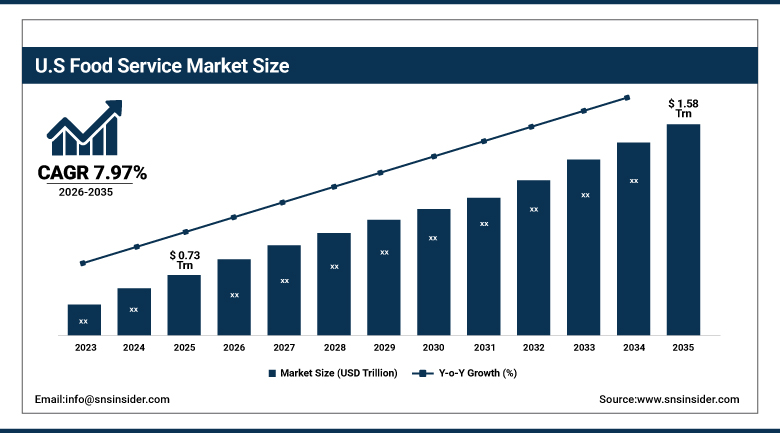
The U.S. Food Service Market was valued at approximately USD 0.73 Trillion in 2025 and is expected to reach approximately USD 1.58 Trillion by 2035, growing at a CAGR of approximately 7.97% from 2026 to 2035.
US Food Service Market has grown due to the increasing customer preference for convenient dining services, the availability of online food delivery services, and the rapid implementation of technological changes in restaurants. Growth of the market is attributed to the increased need for fast service restaurants and fast casual dining as well as take-away services. Restaurants have invested heavily in artificial intelligence ordering systems, kitchen automation, contactless payment methods and loyalty programs for their customers. The growth of commercial restaurants, institutional catering and food delivery services continues to grow steadily across the US market because of the increasing disposable income, lifestyle changes, tourism, and constant changes to the menus.
In 2025, Starbucks implemented AI-powered store operations and personalized digital ordering system in its US stores for improving customer engagement. On the other hand, Chipotle Mexican Grill has introduced further automation of kitchens and digital make-line to improve its efficiency and cope with the growing volume of orders placed online.
Food Service Market Segment Analysis:
-
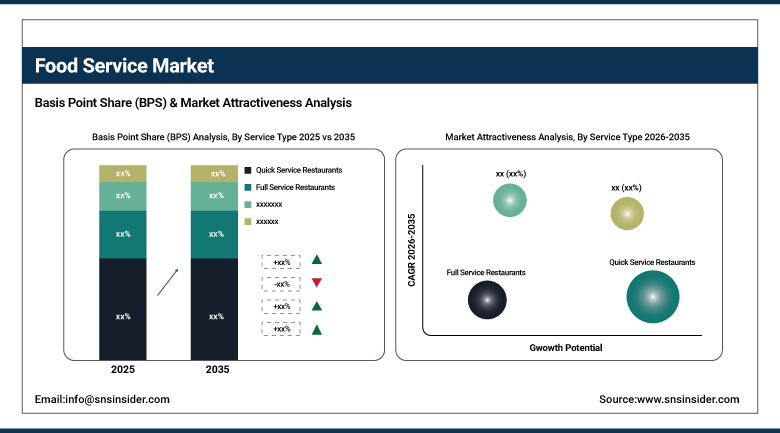
By Service Type, Quick Service Restaurants (QSRs) dominated the Food Service Market with 37.00% share in 2025, while Cloud Kitchens are the fastest growing service segment from 2026 to 2035.
-
By Ownership, Chain Outlets dominated the Food Service Market with 61.00% share in 2025, while Independent Restaurants are the fastest growing ownership segment from 2026 to 2035.
-
By Ordering Channel, Dine-in dominated the Food Service Market with 49.00% share in 2025, while Online Delivery is the fastest growing ordering channel from 2026 to 2035.
-
By End User, Commercial Consumers dominated the Food Service Market with 72.00% share in 2025, while Institutional Catering is the fastest growing end-user segment from 2026 to 2035.
By Service Type, Quick Service Restaurants dominate, Cloud Kitchens grow fastest
Quick Service Restaurants dominated the Food Service Market in 2025, accounting for around 37% of the revenue share. The segment continues to benefit from strong consumer demand for affordable meals, fast service and convenient dining. The expansion of global restaurant chains, digital ordering platforms, and drive-through services further consolidate the market leadership in developed and emerging economies.
Cloud Kitchens are predicted to record the fastest CAGR owing to the increasing demand for online food delivery and lower operating costs. Commercialization continues to accelerate across global food service ecosystems, with growing partnerships with delivery aggregators, AI-enabled kitchen management and expansion of delivery-only restaurant models.
By Ownership, Chain Outlets dominate, Independent Outlets grow fastest
Chain Outlets dominated the Food Service Market in 2025 and held a share of approximately 61% in terms of revenue. Their leadership is driven by strong brand recognition, standardized menus, extensive franchising networks and sophisticated digital ordering systems. Leading restaurant chains in the world build their competitive advantage through constant expansion in emerging markets, investment in customer loyalty programmes and efficient supply chain management.
Independent Outlets are expected to grow at the fastest CAGR during the forecast period owing to increasing consumer preference for authentic local cuisine, personalized dining experiences and unique menu offerings. Independent restaurants are growing into new locations, capitalizing on the growth of food tourism and the culture of neighborhood dining, as well as the increasing demand for specialty restaurants. They are also using online delivery platforms and digital marketing to reach wider audiences.
By Ordering Channel, Dine-in dominates, Online Delivery grows fastest
Dine-in dominated the Food Service Market in 2025 with approximately 49% revenue share. Consumers still value restaurant ambience, social dining experiences and premium customer service offered by full service and casual dining establishments. The ongoing investments in restaurant modernization, digital menus and improved customer experiences continue to bolster the dominance of dine-in food service globally.
Online Delivery is expected to have the fastest CAGR, driven by increasing smartphone penetration, digital payment adoption and increasing collaborations between restaurants and food delivery platforms. Cloud kitchen expansion, AI-based ordering systems and faster last mile delivery services are allowing restaurants to reach out to a wider consumer base while enhancing operational efficiency and customer convenience around the world.
By End User, Commercial Consumers dominate, Institutional Catering grows fastest
Commercial Consumers dominated the Food Service Market with a revenue share of approximately 72% in 2025. This segment continues to see strong demand from restaurants, cafes, hotels, quick-service outlets and takeaway establishments. The market for commercial food service operations will continue to witness sustained expansion, supported by rising disposable incomes, increasing urban lifestyles and growing consumer preference for convenient dining experiences.
Institutional Catering is estimated to grow at the fastest CAGR during the forecast period owing to rising demand from hospitals, educational institutions, corporate offices, government establishments and defense organizations. There are still major long term growth opportunities globally with increasing outsourcing of food service operations, growing focus on nutritional meal planning and increasing contract catering services.
Regional Analysis:
|
Region |
Major Country |
Global Market Share (2025 %) |
|---|---|---|
|
North America |
United States |
83.72% |
|
Europe |
Germany |
30.98% |
|
Asia Pacific |
China |
33.71% |
|
Middle East & Africa |
UAE |
2.80% |
|
Latin America |
Brazil |
3.88% |
North America Food Service Market Insights
The North America region is anticipated to register the fastest CAGR during the forecast period due to increasing quick-service restaurant chains, rapid digitalization of food ordering and growing consumer demand for convenient dining experiences. The US is leading regional growth across commercial food service operations, with significant investments in AI-powered restaurant technologies, cloud kitchens, delivery platforms and automated food preparation systems.
Operators of restaurants are increasingly adopting self-service kiosks, contactless payment systems, kitchen automation, and loyalty platforms to improve operational efficiency and customer engagement. The region’s competitive landscape is being amplified by the increasing demand for online food delivery, premium dining concepts and ongoing technological innovation, creating long-term growth opportunities for restaurants, cafes and institutional food service providers.
Europe Food Service Market Insights
Europe was a key contributor to the global Food Service Market in 2025. The market in Germany, France, Italy, Spain and the United Kingdom is growing, due to the strong tourism sector, well established restaurant culture and increasing consumer preference for premium dining experiences. The increasing emphasis on sustainable sourcing of food and healthier menu options is also driving demand in the region.
European restaurant businesses are rolling out digital ordering platforms, contactless payment technologies and smart restaurant management systems to improve customer experience and operational performance. The hospitality modernization investments and eco-friendly packaging and menu innovation are boosting competitiveness and driving steady long-term growth in the regional food service industry.
Asia Pacific Food Service Market Insights
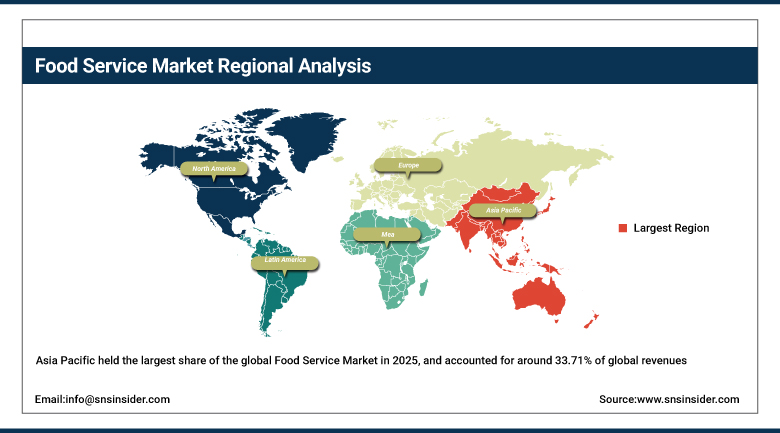
The Asia Pacific held the largest share of the global Food Service Market in 2025, and accounted for around 33.71% of global revenues. Strong urbanization, rising disposable income, growing middle-class populations and large-scale restaurant industry growth continue to support regional leadership. China is still the king of the market while India and South-east Asian countries continue to expand fast in organized food service operations.
Regional ecosystem continues to be strengthened with growing investments in international restaurant chains, cloud kitchens, mobile ordering apps and food delivery platforms. Higher food consumption driven by growing tourism, changing consumer lifestyles and fast digital transformation across restaurants is underpinning significant long-term opportunities for organized food service operators across Asia Pacific.
Get Customized Report as per Your Business Requirement - Enquiry Now
Middle East & Africa & Latin America Food Service Market Insights
Middle East & Africa and Latin America are also showing steady growth in Food Service Market, driven by increasing urban population, growing tourism and rising investment in hospitality infrastructure. Brazil, Mexico, UAE and Saudi Arabia continue to be major contributors as organized restaurant chains, cafes and quick service outlets continue to grow across both regional markets.
More restaurant owners are investing in digital ordering systems, delivery apps and new restaurant technologies to make things easier for their customers and run their businesses better. Both regional markets continue to present attractive long-term growth opportunities amid growing international food service brands, expanding retail developments and rising consumer spending on dining experiences.
Market Dynamics:
Growth Driver: Rising Digital Food Ordering and Expanding Quick-Service Restaurants
The Food Service Market is thriving on the back of increasing consumer inclination towards convenient food consumption options, rapid expansion of fast-food restaurants, and increasing adoption of digital food ordering platforms. To improve operational efficiency, reduce service time and improve customer experience, restaurant operators are investing in AI-powered ordering systems, self-service kiosks, automated kitchens and mobile applications. The increasing urbanization and changing lifestyles worldwide are fueling continued acceleration in demand for organized food service.
Growing disposable incomes, increasing adoption of online food delivery and increasing investments in cloud kitchens and omnichannel restaurant models further support market expansion. Contactless payments, loyalty programmes, predictive demand analytics and digital restaurant management platforms can help operators improve profitability and customer retention. Expansion of delivery infrastructure and continuous menu innovation are creating long-term commercial opportunities across global food service ecosystems.
Restraints: Rising Operating Costs and Labor Shortages
Food Service Market faces stiff challenges in the form of increase in price of food ingredients, labor constraints, higher employee salaries and energy costs. Food Services industry continues to face difficulties in being profitable due to increased expenses associated with purchasing ingredients, recruiting staff, logistics and maintenance. Disruption in the supply chains and changing cost structure of raw materials also cause uncertainties in the very competitive food service market.
Stringent rules for food safety, rising inflation, and stiff competition from other domestic and foreign restaurant chains continues to hamper the efficiency of the operations. Some regional markets are having restricted growth potential due to high labor turnover, labor shortage, compliance requirements, and technology investments that are imposing a financial strain on small and medium sized food service firms.
Opportunities: Growth of Cloud Kitchens and AI-Powered Restaurant Technologies
Cloud kitchen expansion, the use of artificial intelligence to manage restaurant operations, and food preparation automation systems have created many new opportunities in the Food Service Market. Restaurant owners are utilizing predictive analysis, digital inventory management, food preparation using robotics, and intelligent customer engagement systems to optimize their operations and cope with the fast-changing demands of consumers through various dining options.
The increasing demand among consumers for healthy food products, sustainable food sourcing, and environmentally friendly food packaging has motivated constant innovation of new products in the industry. Continued investments in smart restaurants, food delivery systems, personalized marketing platforms, and kitchen automation systems are projected to contribute to future growth of the market.
Recent Developments:
-
2026: McDonald's expanded AI-powered restaurant operations and intelligent drive-thru ordering systems across multiple international markets.
-
2026: Yum! Brands accelerated deployment of AI-enabled restaurant technologies and digital ordering platforms across KFC, Pizza Hut, and Taco Bell.
-
2025: Starbucks expanded personalized mobile ordering capabilities and AI-powered customer engagement solutions across global operations.
-
2025: Chipotle Mexican Grill expanded automated kitchen technologies and digital make-line systems supporting higher online order volumes.
Key Players:
-
McDonald's Corporation
-
Starbucks Corporation
-
Yum! Brands Inc.
-
Restaurant Brands International Inc.
-
Domino's Pizza Inc.
-
Chipotle Mexican Grill Inc.
-
Inspire Brands Inc.
-
Subway IP LLC
-
Darden Restaurants Inc.
-
The Wendy's Company
-
Papa John's International Inc.
-
Bloomin' Brands Inc.
-
Brinker International Inc.
-
Whitbread PLC
-
Compass Group PLC
-
Sodexo S.A.
-
Aramark Corporation
-
Jollibee Foods Corporation
-
The Cheesecake Factory Incorporated
-
Panera Bread Company
Food Service Market Report Scope:
| Report Attributes | Details |
|---|---|
| Market Size in 2025 | USD 3.06 Trillion |
| Market Size by 2035 | USD 5.84 Trillion |
| CAGR | CAGR of 6.70% from 2026 to 2035 |
| Base Year | 2025 |
| Forecast Period | 2026-2035 |
| Historical Data | 2022-2024 |
| Report Scope & Coverage | Market Size, Segments Analysis, Competitive Landscape, Regional Analysis, DROC & SWOT Analysis, Forecast Outlook |
| Key Segments | • By Service Type (Quick Service Restaurants (QSRs), Full Service Restaurants (FSRs), Cafés & Coffee Shops, Cloud Kitchens, Street Food & Kiosks) • By Ownership (Chain Outlets, Independent Outlets) • By Ordering Channel (Dine-in, Takeaway, Online Delivery, Drive-through) • By End User (Commercial Consumers, Corporate Catering, Healthcare & Institutional Catering, Educational Institutions) |
| Regional Analysis/Coverage | North America (US, Canada, Mexico), Europe (Eastern Europe [Poland, Romania, Hungary, Turkey, Rest of Eastern Europe] Western Europe] Germany, France, UK, Italy, Spain, Netherlands, Switzerland, Austria, Rest of Western Europe]), Asia Pacific (China, India, Japan, South Korea, Vietnam, Singapore, Australia, Rest of Asia Pacific), Middle East & Africa (Middle East [UAE, Egypt, Saudi Arabia, Qatar, Rest of Middle East], Africa [Nigeria, South Africa, Rest of Africa], Latin America (Brazil, Argentina, Colombia, Rest of Latin America) |
| Company Profiles | McDonald's Corporation, Starbucks Corporation, Yum! Brands Inc., Restaurant Brands International Inc., Domino's Pizza Inc., Chipotle Mexican Grill Inc., Inspire Brands Inc., Subway IP LLC, Darden Restaurants Inc., The Wendy's Company, Papa John's International Inc., Bloomin' Brands Inc., Brinker International Inc., Whitbread PLC, Compass Group PLC, Sodexo S.A., Aramark Corporation, Jollibee Foods Corporation, The Cheesecake Factory Incorporated, Panera Bread Company. |
Frequently Asked Questions
The Food Service Market was valued at approximately USD 3.06 Trillion in 2025.
The Food Service Market is expected to grow at a CAGR of 6.70% during the forecast period.
Asia Pacific dominated the Food Service Market in 2025 due to its large consumer base, expanding restaurant industry, rapid urbanization, and increasing digital food ordering adoption.
Quick Service Restaurants (QSRs) dominated the market in 2025 due to strong consumer preference for affordable, convenient, and fast dining experiences.
Rising consumer demand for convenience dining, expansion of digital food delivery platforms, and increasing adoption of AI-powered restaurant technologies are the major factors driving market growth globally.
