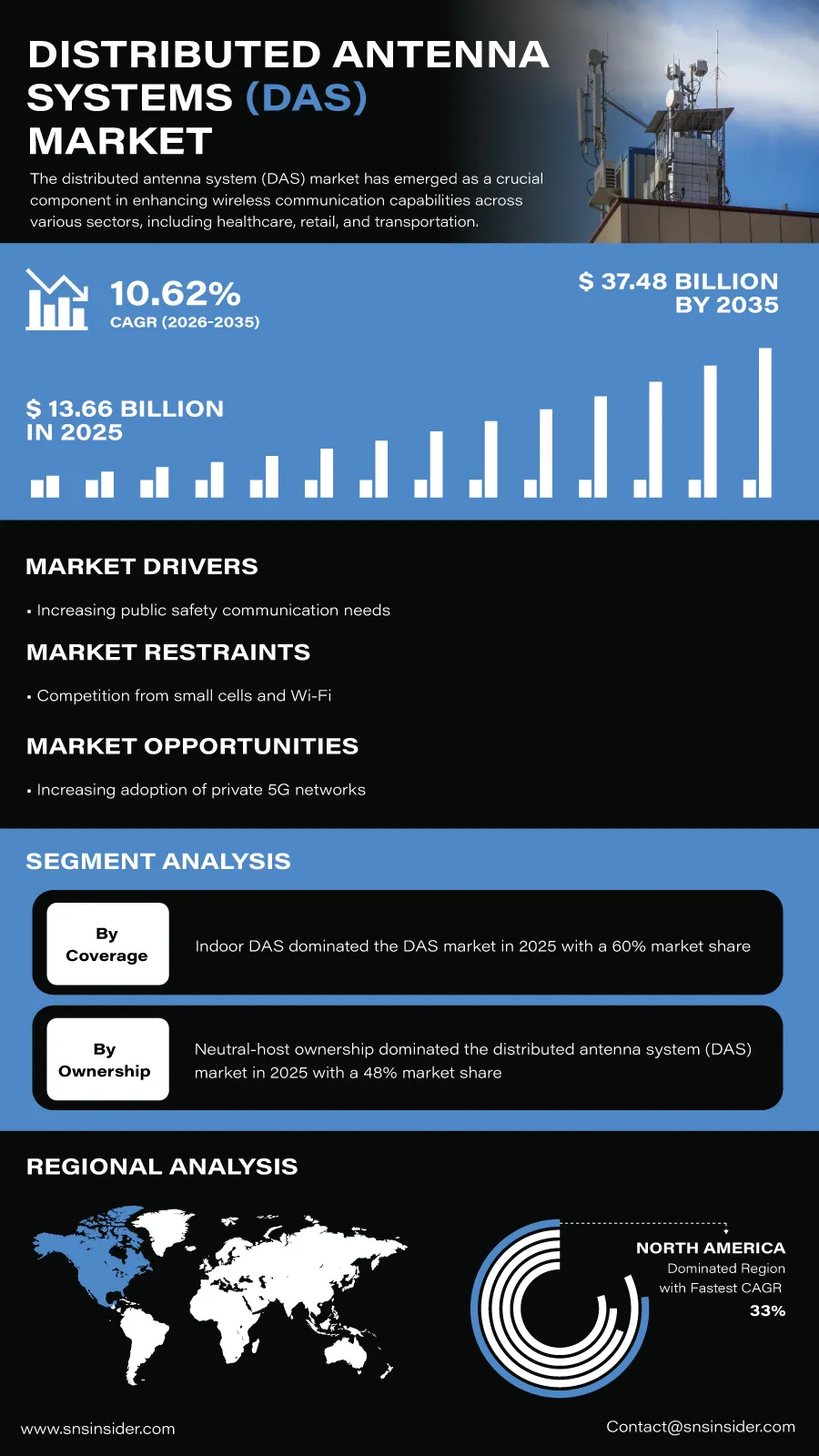
The global Distributed Antenna Systems (DAS) Market is positioned for substantial growth as businesses and telecommunications providers invest in reliable wireless coverage and next-generation network infrastructure. “According to a recent study by SNS Insider, the global Distributed Antenna Systems (DAS) Market size valued at USD 13.66 billion in 2025, is anticipated to grow to USD 37.48 billion by 2035, registering a CAGR of 10.62% over the forecast period.”
With more adoption of 5G technology, increased use of mobile data, and an increase in connected devices, there is an ever-growing need for advanced indoor and outdoor connectivity systems. Buildings used commercially, transport stations, hospitals, and recreational centers are increasingly favoring wireless systems that provide reliable services to meet their communication needs.
In the quest for greater capacity and coverage, DAS is becoming increasingly significant in areas where regular cellular networks have difficulties in ensuring reliable service. In addition, investments in intelligent buildings and digital infrastructure are also helping the market grow.
To Get Detailed Insights on the Distributed Antenna Systems (DAS) Market – Request a Sample Report
5G Infrastructure Investments Create New Growth Opportunities
The migration towards highly capable wireless networks is driving telecom service providers and infrastructure providers to invest in connectivity infrastructure in the highly dense environments. DAS enables distribution of cellular signals using carefully placed antennas and enhances the quality of service within large buildings and other infrastructures.
Increased implementation of smart city infrastructure as well as enterprise-level connectivity infrastructure is offering new opportunities. Airports, sports stadiums, healthcare centers, university campuses, retail centers and many more places need effective connectivity infrastructure to facilitate communication.
However, the threat from competing technologies such as small cell networks, Wi-Fi, and even conventional cellular networks cannot be ignored by potential buyers during cost considerations of deployment. DAS providers are responding by developing scalable architectures and shared-network solutions that improve infrastructure utilization.
Key Market Insights Highlight Shifting Demand Patterns
By coverage, indoor DAS held around 60% of global market revenue in 2025. Its leadership reflects demand for consistent cellular connectivity in enclosed environments where building materials and structural obstacles can weaken signals. Outdoor DAS is projected to grow fastest through 2035 as urban development, campus connectivity requirements, and expanding 5G networks increase demand for coverage beyond building interiors.
Based on ownership, neutral-host DAS was leading with a 48% of market revenue in 2025. This model allows multiple mobile network operators to share infrastructure, helping reduce duplicated investment and simplify connectivity deployment in high-traffic locations. Carrier-owned DAS is expected to register the fastest growth as telecommunications providers increase direct investment in network capacity and customer experience.
By signal source, small cells captured around 45% of market revenue in 2025, supported by their ability to improve cellular capacity in densely populated areas. Off-air antenna systems are expected to record the fastest growth during the forecast period, particularly in buildings and facilities where existing cellular signals can be distributed without extensive new infrastructure.
Connected Buildings Increase Demand for Reliable Wireless Coverage
In view of increased reliance on mobile apps, connected devices, and communication needs, network availability is becoming an important consideration for both commercial and public infrastructure. Hospitals require reliable network connection to enable clinical communication as well as connected healthcare devices, while transport centers require a robust network system to enable passengers and employees as well as other technologies.
With the use of DAS technology together with 5G, IoT platform, and smart buildings, the application of DAS is now going beyond the provision of traditional cellular services. Infrastructure companies are increasingly considering future-proof solutions to allow multi-operator networks.
North America Leads DAS Market with 33% Share as Asia Pacific Accelerates Growth
North America is likely to hold the top position, capturing around 33% of DAS market revenue share worldwide by 2025. Well-established telecom infrastructure, ongoing 5G adoption, and developments at sports stadiums, airports, hospitals, and other commercial establishments will fuel demand in the region. The United States will continue to play an important role in the market due to enterprise demands and infrastructure improvements.
Asia-Pacific is anticipated to witness strong growth until 2035 owing to urbanization, increased smartphone penetration, and investments in digital infrastructure in countries, such as China, India, and Japan. Increasing smart cities projects and demand for large bandwidth wireless services are poised to provide many growth prospects for DAS players.
Industry Participants Focus on Network Innovation
Competitive landscape in the DAS market is focused around increasing network capacity, deployment flexibility, and efficiency. Companies are designing their products to cater to the requirements of multiple operators, provide 5G coverage, and be compatible with other wireless systems. Partnership programs and infrastructure sharing are also being leveraged to meet the connectivity demands of big premises.
Key companies operating in the global Distributed Antenna Systems (DAS) Market include CommScope, Corning, TE Connectivity, American Tower Corporation, AT&T, Boingo Wireless, Comba Telecom, SOLiD Technologies, Dali Wireless, Ericsson, Huawei, Nokia, ZTE Corporation, Betacom Incorporated, Galtronics Corporation, Fiber-Span, JMA Wireless, Axell Wireless, Advanced RF Technologies (ADRF), and Anixter.
An SNS Insider analyst, Sushant Kadam, commented, “Increasing 5G adoption, rising mobile data traffic, and the digitalization of commercial infrastructure are strengthening the need for dependable wireless coverage. Providers that deliver scalable, multi-operator solutions and cost-effective network integration will be well positioned to benefit from the continued expansion of distributed antenna systems.”
About the Author

Get in touch