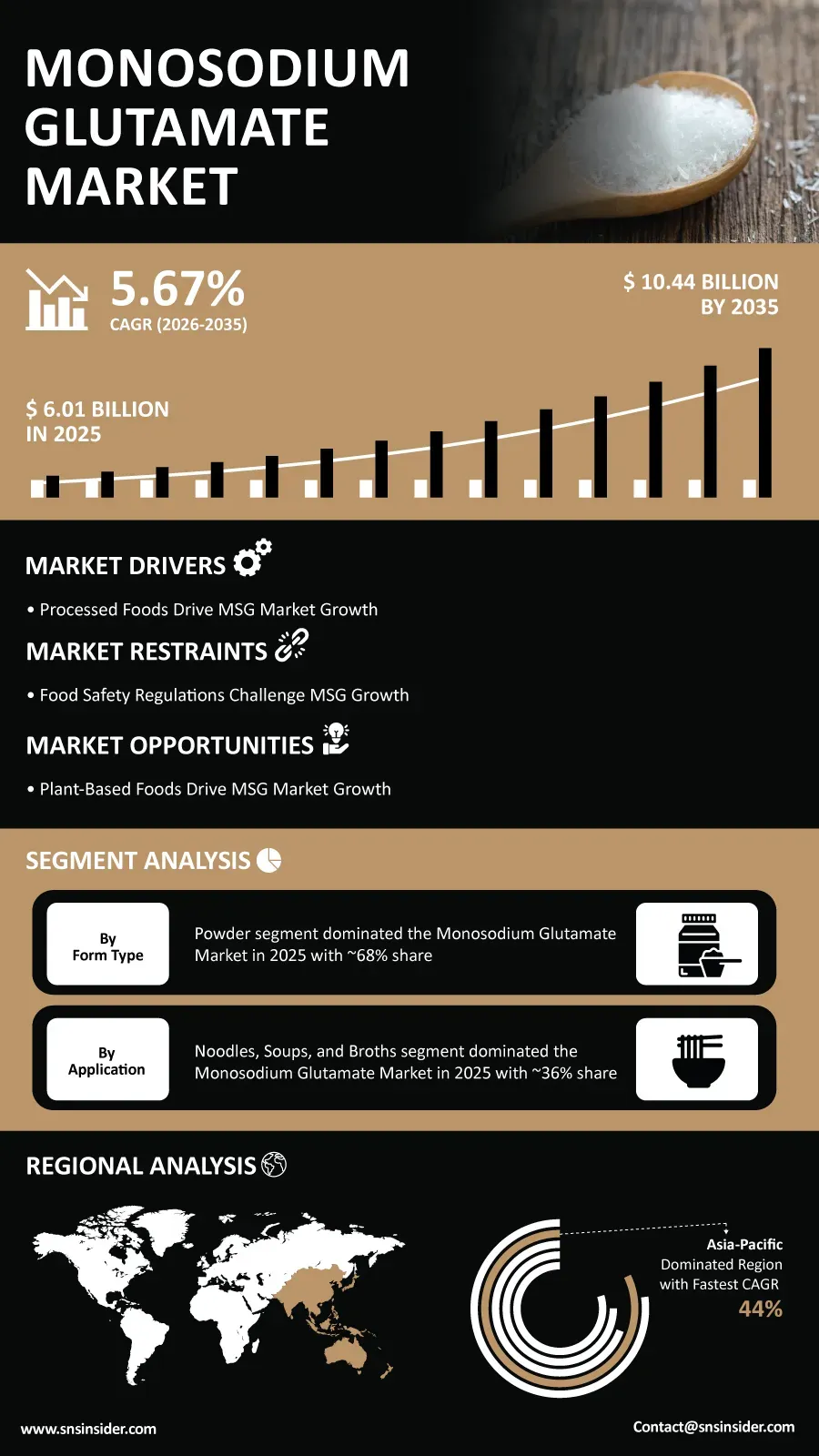
Global Monosodium Glutamate (MSG) Market is projected to witness robust growth throughout this decade, mainly due to food manufacturers increasingly focusing on flavor enhancement, cost-effective formulation and sodium reduction strategies across processed & convenience food products. “According to a recent study by SNS Insider, the global Monosodium Glutamate Market size valued at USD 6.01 billion in 2025, is anticipated to grow to USD 10.44 billion by 2035, registering a CAGR of 5.67% over the 2026–2035 forecast period.”
Rapid urbanisation, shifting dietary habits and increasing consumer demand for ready-to-cook and ready-to-eat meals continue to re-define the global food industry. In response, manufacturers are adding ingredients that provide uniform taste while enabling large-scale manufacturing. This is why monosodium glutamate still features prominently in the formulations of many food types.
Long-term demand is also being supported by expanding packaged food portfolios, the growing restaurant chains and rising global interest in many more international cuisines. Food businesses continue their investment cycle in providing new product innovation which enables growth by catering to the three pillars of taste, affordability as well as other nutrition-based objectives.
To Get Detailed Insights on the Monosodium Glutamate Market – Request a Sample Report
Food Industry Innovation Creates New Opportunities for Flavor Enhancement
At the same time, food brands face pressure to enhance taste while balancing production costs and changing consumer behaviour. This has driven increased use of new high-impact flavour-enhancing ingredients that can provide a strong savoury taste with minimal complexity in formulation.
Concurrently, the expansion of modern retail networks and e-commerce grocery platforms is increasing product accessibility in developed as well as emerging markets. Additionally, as global investments in food processing infrastructure continues to grow, so does the involvement of functional food ingredients across the entire supply chain.
Technological innovations of fermentation processes are also allowing manufacturers to increase production efficiency while maintaining consistency and striving for sustainability. Such developments are offering businesses an opportunity to reinforce their manufacturing capacities and at the same time meet changing quality needs.
Key Market Insights Reflect Evolving Consumer Preferences
In terms of form, powdered monosodium glutamate accounted for approximately 68% of total market revenue in 2025, primarily fueled by its excellent solubility and blending properties, along with its widespread use in industrial food production. However, the granules segment is anticipated to show highest growth throughout the forecast years as vegetable granules are gaining traction on account of increasing demand for premium-grade seasoning products with enhanced handling and texture.
Among applications, the noodles, soups and broths segment accounted for roughly 36% of global revenue in 2025 due to high worldwide consumption of ready-to-eat meals. As consumers aspire to try new restaurant-style cooking at home, the seasonings and dressings category is anticipated to register the highest growth record during the forecast period.
On the basis of channel, the B2B segment accounted for over 72% revenue share in 2025 mainly due to significant purchasing by food manufacturers, foodservice operators, and industrial processors. That said, B2C segment is expected to grow at the highest CAGR due to increased household consumptions through retail channels and online grocery platforms.
Manufacturers Focus on Product Quality and Sustainable Production
Food ingredient manufacturers repeatedly stress the need for manufacturing efficiency, sustainability, product quality improvement etc. in order to enhance competitiveness in their businesses Advanced fermentation technologies are increasingly being used to minimize environmental footprint of staple food production, enforce replicability and operational efficiencies.
Furthermore, the increasing demand for plant-based foods has throwing open new avenues of usage for flavor booster ingredients. Another area where manufacturers are more likely to produce offerings for meat substitution, vegan items, and low-fat foods without compromising flavor.
Ingredient suppliers, packaged food majors and quick-service restaurant chains have continued their collaboration on product innovation, supporting commercial adoption across geographies.
Asia Pacific Accounted for 44% Market Share in 2025; North America Forecast to Witness Stable Growth Through 2035
Asia Pacific Region held around 44% Monosodium Glutamate Market share in terms of value during 2025, owing to high consumption of processed food and the presence of efficient food processing industry along with extensive acceptance for umami based ingredients. Nonetheless, it was followed only by countries of production and consumption such as China, Japan, India, Indonesia and South Korea.
North America is sticking to a growth course supported by increasing demand in packaged food, restaurant-based meals, frozen products and fast-casual restaurants. Vestige Food manufacturers are actively researching flavour and flavour technology optimisation approaches that can facilitate sodium reduction efforts without compromising the overall quality of the product.
While Europe will continue to capitalize on higher demand for convenience foods and multicultural cuisine, Latin America and the Middle East & Africa are adding new opportunities through expanding food processing industries, urbanization, and a burgeoning modern retail sector.
Industry Leaders Accelerate Innovation Across Global Food Ingredients Market
Competition remains cutthroat as manufacturers compete to build their market share by investing in sustainable production technologies, fermentation developments and product diversification. In addition, companies are advancing strategic expansion partnerships and investing to research tactics that would boost flavor performance, manufacturing efficiency ratios, or regulatory compliance.
Key companies operating in the global Monosodium Glutamate Market include Ajinomoto Co., Inc., Fufeng Group, Meihua Holdings Group Co., Ltd., Ningxia Eppen Biotech Co., Ltd., COFCO Biochemical (Anhui) Co., Ltd., Vedan International (Holdings) Limited, Cargill Incorporated, Gremount International Company Limited, Shandong Qilu Biotechnology Group Co., Ltd., Henan Lotus Flower Gourmet Powder Co., Ltd., Shandong Xinle Monosodium Glutamate Limited Company, Linghua Group Limited, Star Lake Bioscience Co., Inc., CJ CheilJedang Corporation, Daesang Corporation, Foodchem International Corporation, Arshine Food Additives, Great American Spice Company, Prinova Group LLC, and McCormick & Company, Inc.
An SNS Insider analyst Santosh Bhul commented, "Growing global demand for convenient food products, continuous innovation in food processing technologies, and increasing interest in flavor optimization are supporting long-term opportunities for monosodium glutamate manufacturers. Companies focusing on sustainable production, product quality, and evolving consumer preferences are expected to remain well-positioned for future market growth."
About the Author

Get in touch