
Functional Foods Market Report Scope & Overview:
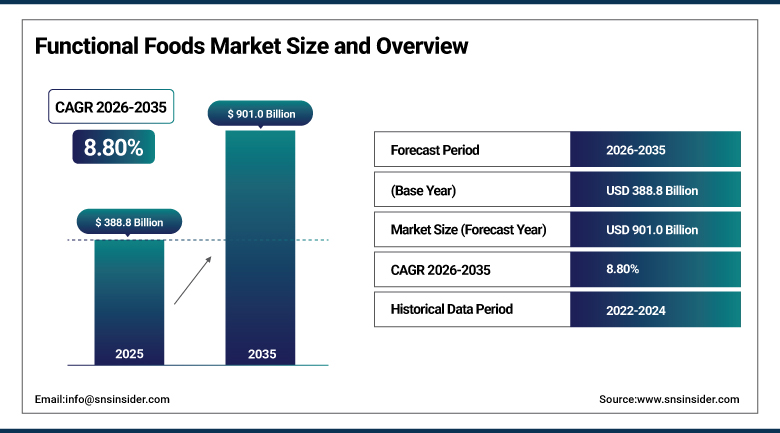
The Functional Foods Market was valued at USD 388.8 Billion in 2025 and is expected to reach USD 901.0 Billion by 2035, growing at a CAGR of 8.80% from 2026 to 2035.
The Functional Foods Market is experiencing tremendous growth due to increased health awareness, preventive health care practices, an aging population that suffers from age-related health issues, and health policies of governments. The term "functional food" refers to ordinary food that has been enhanced by adding some components for improved health outcomes. This encompasses probiotics, prebiotics, proteins, vitamins, minerals, fibers, and phytonutrients among other such nutrients that are included as a solution to certain health concerns. Moreover, the growth of the Functional Foods Market is being driven by the rise in the consumption of plant-based and clean-label functional foods, the adoption of digital health and personalized nutrition, increased fitness consciousness, and innovations in technology such as precision fermentation and synthetic biology.
Top five companies of the Functional Foods Market, namely Nestlé, Danone, PepsiCo, Abbott, and General Mills, altogether accounted for a 46.5% market share in 2024, illustrating a relatively concentrated competitive environment where dominant multinationals in the food and beverages industry keep competing alongside increasing numbers of niche brands in the category of functional foods and beverages.
To Get more information Functional Foods Market - Request Free Sample Report
Functional Foods Market Trends
- Rising subscription-based models are improving recurring access to functional foods tailored to specific wellness needs.
- Growing integration of digital health and personalized nutrition is enabling more targeted functional food formulations.
- Increasing adoption of precision fermentation and synthetic biology is improving scalable production of bioactive food ingredients.
- Expanding consumer preference for clean-label and clearly differentiated products is supporting growth across sports nutrition, immunity, and weight management.
- Strategic partnerships among food manufacturers, ingredient suppliers, and digital health platforms are expanding application-specific functional food portfolios.
The U.S. Functional Foods Market Outlook
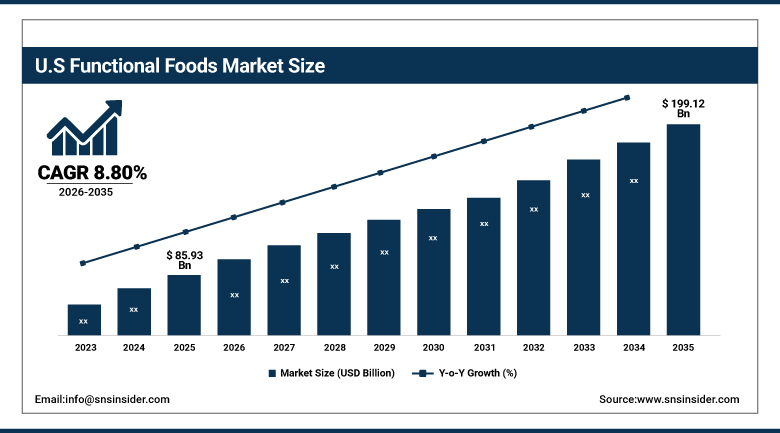
The U.S. Functional Foods Market was valued at USD 85.93 Billion in 2025 and is projected to reach USD 199.12 Billion by 2035, growing at a CAGR of 8.80% during 2026–2035.
The major producers of food and beverages in the country have not stopped growing their portfolio of functional food products because of the growing demand for nutrition-packed foods owing to stressful lives and increased awareness of health benefits on the part of consumers. With the costs of medical treatments being high and elderly consumers worried about maintaining their good health and the increased awareness of the connection between good health and eating well, the domestic market continues to grow.
The U.S. Functional Foods market is expected to grow significantly over the forecast period, driven by rising demand for nutrient-rich foods as a result of hectic lifestyles, improved consumer knowledge of health benefits, and growing medical costs increasing focus on preventive healthcare and healthy eating.
Functional Foods Market Segment Analysis
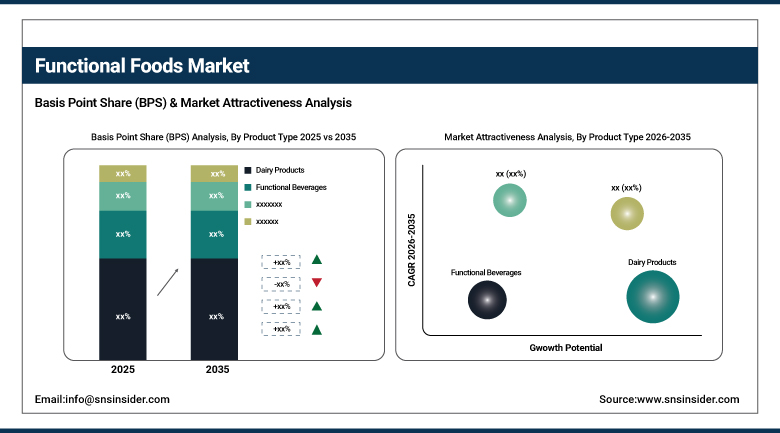
- By Product Type, dairy products dominated the functional foods market with a 38.00% share in 2025, while functional beverages is the fastest-growing product type segment with a CAGR of 9.60% from 2026–2035.
- By Ingredient Type, vitamins dominated the functional foods market with a 27.00% share in 2025, while prebiotics & probiotics is the fastest-growing ingredient type segment with a CAGR of 9.80% from 2026–2035.
- By Application, sports nutrition dominated the functional foods market with a 31.70% share in 2025, while digestive health is the fastest-growing application segment with a CAGR of 9.40% from 2026–2035.
- By Distribution Channel, supermarkets/hypermarkets dominated the functional foods market with a 52.60% share in 2025, while online retail is the fastest-growing distribution channel segment with a CAGR of 10.20% from 2026–2035.
By Product Type, dairy products dominated the functional foods market, while functional beverages is the fastest-growing segment.
Dairy products dominate the functional foods market with a 38.00% market share. Functional dairy products remain the dominant product type category owing to their established consumer acceptance and versatile fortification potential, with probiotics, vitamins, and minerals commonly incorporated into yogurt, milk, and cheese products across virtually every major global functional food market.
The functional beverages segment held the highest growing market over the forecast period, expected to grow at a CAGR of 9.60%. Growing consumer preference for convenient, on-the-go functional nutrition delivery is driving rapid segment growth, as manufacturers increasingly develop fortified waters, energy drinks, and functional teas addressing specific health positioning such as immune support and cognitive function.
By Ingredient Type, vitamins dominated the functional foods market, while prebiotics & probiotics is the fastest-growing segment.
In terms of ingredient, the vitamins segment commands a 27.00% share in the Functional Foods Market. Vitamins remain the dominant ingredient category owing to their well-established consumer recognition and broad applicability across fortified food and beverage products addressing general wellness, immune support, and preventive health positioning worldwide.
The prebiotics & probiotics segment is expected to register the fastest CAGR of 9.80% during the forecast period 2026-2035. Growing scientific validation of gut microbiome health's connection to overall wellness is driving strong consumer and manufacturer interest in digestive health-focused ingredients, as functional food and beverage products increasingly incorporate live cultures and fiber-based prebiotics.
By Application, sports nutrition dominated the functional foods market, while digestive health is the fastest-growing segment.
The sports nutrition segment is projected to hold 31.70% of the functional food market share. Sport and active nutrition segments will continue to hold sway in the consumption segment owing to the growing consumer interest in fitness and muscle building along with energy. Protein bars, protein-enriched drinks, and electrolyte drinks have been identified as the most prevalent products consumed by consumers with interest in fitness.
Digestive health segment is projected to show highest CAGR of 9.40% during the forecast period from 2026 to 2035. Rising consumer awareness about the importance of gut health for overall immunity and wellness has helped to fuel the growth in this segment.
By Distribution Channel, supermarkets/hypermarkets dominated the functional foods market, while online retail is the fastest-growing segment.
The supermarkets/hypermarkets segment dominated the functional foods market owing to their broad product assortment spanning dairy, beverage, and bakery functional food categories, offering consumers the convenience and competitive pricing that continues to anchor this channel's leading retail position for functional food products worldwide.
The online retail segment is expected to witness the fastest CAGR of 10.20% during the forecast period 2026-2035. Growing consumer comfort with purchasing functional food and beverage products online, combined with expanding subscription-based delivery models providing regular access to health-oriented products, is driving rapid growth in online functional food distribution.
Regional Insights
|
Region |
Major Country |
Share within Region, 2025 (%) |
|---|---|---|
|
North America |
United States |
84.60% |
|
Europe |
Germany |
27.60% |
|
Asia Pacific |
China |
44.60% |
|
Middle East & Africa |
UAE |
25.60% |
|
Latin America |
Brazil |
37.70% |
North America Functional Foods Market Insights
North America is expected to see the fastest market growth in the functional foods market. This is attributed to rising demand for nutrient-rich foods, improved consumer knowledge of health benefits, and growing medical costs increasing preventive healthcare focus across the region.
The US was the leading country within the North America functional foods market in 2025, driven by hectic lifestyles increasing demand for convenient, nutrient-rich foods and growing consumer awareness of the link between healthy eating and overall wellbeing. Canada is contributing to regional growth through its own expanding functional food retail infrastructure and growing consumer interest in preventive health nutrition.
Europe Functional Foods Market Insights
The Europe functional foods industry has played an important role in 2025. The reasons for this include good regulation in Europe related to health claims, increasing demand for functional products without any health claim on labels and increasing aging population that requires cardiovascular and cognitive support.
Germany is among the leading European countries due to the presence of a strong base of food manufacturers in this country and increasing demand for functional dairy and bakery products. Some other countries such as the UK and France have also been helping in the growth of the market through functional beverages and sports nutrition.
Asia Pacific Functional Foods Market Insights
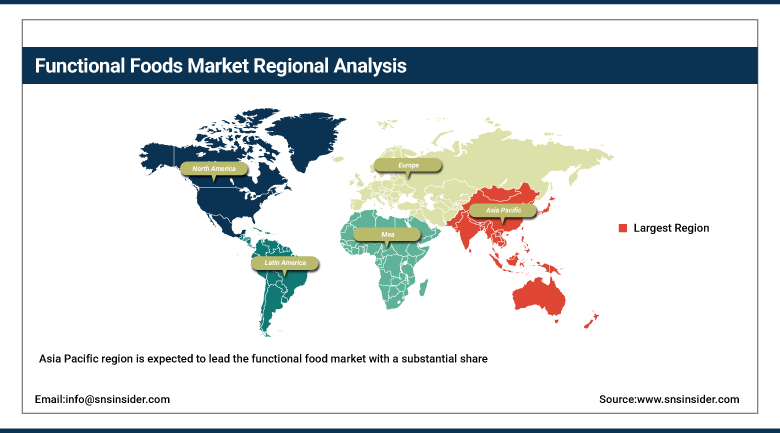
The Asia Pacific region is expected to lead the functional food market with a substantial share, driven by rising disposable incomes, growing health consciousness, and expanding modern retail infrastructure across the region's rapidly developing economies.
China is one of the main growth drivers in the Asia Pacific functional foods market, owing to its massive consumer base and rapidly expanding functional food manufacturing capacity. Japan, a historic pioneer in functional food regulatory frameworks, and India are also contributing to regional growth through expanding health-conscious consumer bases and rising demand for fortified food and beverage products.
Get Customized Report as per Your Business Requirement - Enquiry Now
Middle East & Africa and Latin America Functional Foods Market Insights
Middle East & Africa and Latin American regions are gradually expanding functional foods adoption as retail infrastructure develops and consumer awareness of preventive health nutrition benefits grows across both regions.
Brazil is set to be a prominent Latin American market fueled by growing functional food manufacturing capacity and rising consumer demand for health-oriented products. The Middle East & Africa region has UAE and Saudi Arabia investing in modern retail infrastructure that is expanding access to premium functional food and beverage categories across their growing wellness-focused consumer sectors.
Growth Drivers: Rising health consciousness and preventive healthcare adoption driving market growth
Rising health consciousness and preventive healthcare adoption, an aging population with age-related health concerns, and government health initiatives and dietary guidelines are among the primary drivers of the Functional Foods Market. Consumers are increasingly seeking nutrient-rich foods as a result of hectic lifestyles and improved consumer knowledge of the health benefits associated with specific foods, continuing to fuel market expansion across virtually every product and application category.
Growing medical costs and aging population concerns about preserving excellent health continue to boost demand for nutritious food options addressing preventive health needs. Rising popularity of plant-based and clean-label functional foods, integration of digital health and personalized nutrition platforms, and increasing consumer interest in fitness, muscle recovery, and sustained energy are further supporting demand across the forecast period.
Restraints: High production costs and regulatory compliance limiting market expansion
Another significant obstacle for market expansion would be the cost of production as well as difficulties related to the process of formulation that will make it possible to develop functional foods capable of satisfying not only the needs for sensory pleasure but also those relating to proven health effects.
Moreover, the issue of regulatory constraints regarding health claims and their restrictions within various international markets remains an impediment for functional food manufacturers to support their product health benefit claims. In addition, the complexity of creating products that would have proper taste qualities and at the same time provide health benefits is quite high.
Opportunities: Expansion of personalized nutrition and digital health integration creating new growth avenues
Integration of digital health and personalized nutrition platforms represents a substantial market opportunity, as manufacturers increasingly develop functional food formulations tailored to individual consumer health profiles, creating differentiated, higher-value product offerings within an increasingly competitive functional food landscape.
There is a considerable growth opportunity in the continued development of precision fermentation and synthetic biology technologies enabling more efficient bioactive ingredient production. The expansion of functional food manufacturing capacity and health-conscious consumption in emerging markets across Asia Pacific and Latin America is likely to unlock substantial new demand throughout the forecast period.
Recent Developments
- 2025: Nestle expanded its probiotic-fortified functional dairy product line, offering consumers enhanced digestive health-positioned yogurt and dairy beverage options across its global portfolio.
- 2025: Danone launched an updated gut health functional beverage range, targeting growing consumer demand for probiotic and prebiotic-fortified drinks supporting digestive wellness.
- 2026: PepsiCo expanded its functional beverage portfolio targeting immune support and energy positioning, strengthening its presence in the rapidly growing functional beverage category.
- 2026: General Mills launched a new fiber-fortified functional cereal product line, offering health-conscious consumers enhanced digestive health benefits within familiar breakfast food formats.
Functional Foods Companies are:
- Nestle S.A.
- Danone S.A.
- PepsiCo, Inc.
- Abbott Laboratories
- General Mills, Inc.
- Kellanova (Kellogg Company)
- Yakult Honsha Co., Ltd.
- The Kraft Heinz Company
- Arla Foods amba
- Bayer AG
- Glanbia plc
- Archer Daniels Midland Company
- BASF SE
- Unilever PLC
- Mondelez International, Inc.
- Fonterra Co-operative Group Limited
- Meiji Holdings Co., Ltd.
- Suntory Beverage & Food Limited
- Dean Foods Company
- Groupe Danone
Functional Foods Market Report Scope :
| Report Attributes | Details |
|---|---|
| Market Size in 2025 | USD 388.8 Billion |
| Market Size by 2035 | USD 901.0 Billion |
| CAGR | CAGR of 8.80% From 2026 to 2035 |
| Base Year | 2025 |
| Forecast Period | 2026-2035 |
| Historical Data | 2022-2024 |
| Report Scope & Coverage | Market Size, Segments Analysis, Competitive Landscape, Regional Analysis, DROC & SWOT Analysis, Forecast Outlook |
| Key Segments | • By Product Type (Dairy Products, Functional Beverages, Bakery & Cereals, Meat/Fish/Eggs, Others) • By Ingredient Type (Vitamins, Carotenoids, Prebiotics & Probiotics, Minerals, Dietary Fibers, Others) • By Application (Sports Nutrition, Digestive Health, Weight Management, Clinical Nutrition, Immunity, Others) • By Distribution Channel (Supermarkets/Hypermarkets, Online Retail) |
| Regional Analysis/Coverage | North America (US, Canada), Europe (Germany, UK, France, Italy, Spain, Russia, Poland, Rest of Europe), Asia Pacific (China, India, Japan, South Korea, Australia, ASEAN Countries, Rest of Asia Pacific), Middle East & Africa (UAE, Saudi Arabia, Qatar, South Africa, Rest of Middle East & Africa), Latin America (Brazil, Argentina, Mexico, Colombia, Rest of Latin America). |
| Company Profiles | Nestle S.A., Danone S.A., PepsiCo, Inc., Abbott Laboratories, General Mills, Inc., Kellanova (Kellogg Company), Yakult Honsha Co., Ltd., The Kraft Heinz Company, Arla Foods amba, Bayer AG, Glanbia plc, Archer Daniels Midland Company, BASF SE, Unilever PLC, Mondelez International, Inc., Fonterra Co-operative Group Limited, Meiji Holdings Co., Ltd., Suntory Beverage & Food Limited, Dean Foods Company, Groupe Danone. |
Frequently Asked Questions
The Functional Foods Market is expected to grow at a CAGR of 8.80% from 2026 to 2035.
The Functional Foods Market was valued at USD 388.8 Billion in 2025.
The market is driven by rising health consciousness and preventive healthcare adoption, an aging population, and supportive government health initiatives.
The Dairy Products segment dominated the Functional Foods Market, accounting for approximately 38.00% market share.
The Asia Pacific region dominated the Functional Foods Market in 2025, driven by rising disposable incomes and growing health consciousness.
