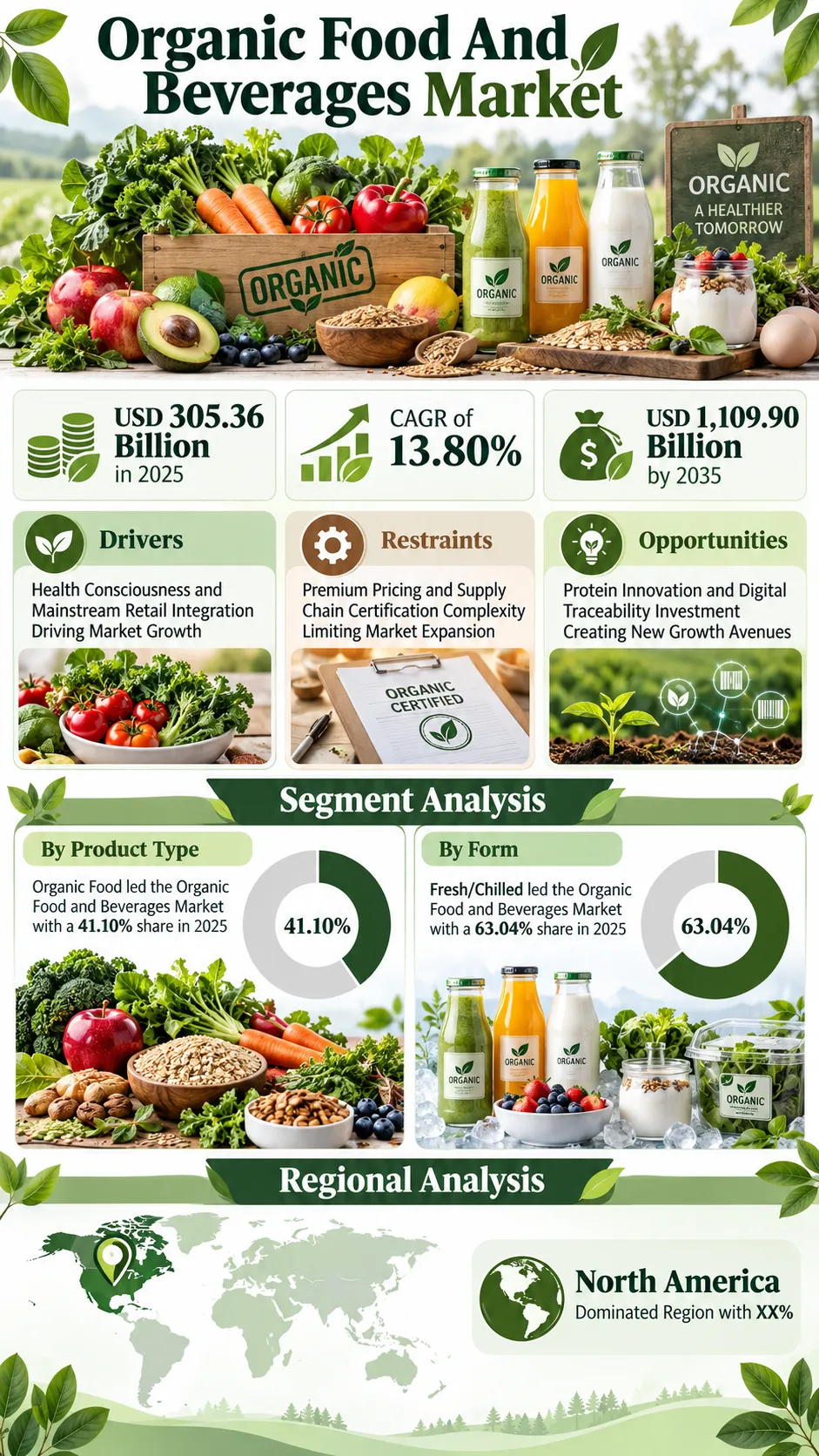
The global Organic Food and Beverages Market is set for extraordinary expansion as consumers worldwide continue prioritizing health, safety, and environmental stewardship. "According to a recent study by SNS Insider, the global Organic Food and Beverages Market size valued at USD 305.36 billion in 2025, is anticipated to grow to USD 1,109.90 billion by 2035, registering a CAGR of 13.80% over the 2026-2035 forecast period."
There have been tremendous changes within organic food and beverage certification and traceability over time due to which many brands who aim at improving consumer trust can take advantage of this trend. This includes the need for more transparent, digitally verified sourcing that will provide consumers with the ability to trust organic claims. This applies in situations where organic products are used across everyday grocery, baby food, and functional beverage applications.
Manufacturers are constantly working hard to ensure that their organic products perform better than before in order to meet various needs of health-conscious consumers worldwide.
To Get Detailed Insights on the Organic Food and Beverages Market – Request a Sample Report
Mainstream Organic Consumption Ecosystems Create New Demand
The organic food and beverages market has evolved from basic niche health-food offerings to more advanced mainstream, digitally traceable use cases. The growing investment in certification transparency, sustainable packaging, and protein fortification for a variety of applications has required the development of more efficient and reliable production systems.
New designs of organic products can increase consumer trust, reduce certification ambiguity, and allow for broader mainstream retail integration. This gives manufacturers the possibility to be more effective when reaching health-conscious consumers and doing better brand differentiation.
Organic food producers, mainstream FMCG companies, and certification bodies are increasingly cooperating thanks to the growing interest in developing future solutions for trustworthy, accessible organic nutrition.
Key Market Findings Highlight High-Growth Segments
The organic food segment dominated all categories in the organic food and beverages market share with a market revenue share of 41.10% in 2025 due to growing consumer preference for clean, chemical-free food options.
The fastest growing category is expected to be organic beverages, led by coffee and tea, which will grow at a CAGR of 17.10% through 2035. This will be possible owing to the increasing consumption of flavored tea and coffee among health-conscious consumers.
By form, fresh and chilled products held the largest share of total market revenue of 63.04% in 2025 due to maximum nutritional value retention. The frozen segment will see the fastest growth in revenue generation at a CAGR of 7.65%.
Based on distribution channel, supermarkets and hypermarkets generated a share of 57.09% of market revenue in 2025 due to broad branded and domestic product portfolios. On the other hand, online retail will be the segment recording the fastest revenue growth at a CAGR of 8.49%.
Distributive trends are changing as well. Traditional supermarket and hypermarket channels remain substantial, but online retail will turn out to be the fastest-growing distribution channel through 2035, on the back of direct-to-consumer subscription models and increased organic auto-replenishment program adoption.
Trust, Transparency, and Mainstream Accessibility Gain Importance
In this regard, manufacturers have been looking at organic products that would make their offerings more trustworthy and require less certification ambiguity and be more accessible.
Innovation in digital labeling, QR code traceability, and sustainable packaging has been making it possible for companies to come up with products that can meet increasingly demanding consumer trust expectations. In addition to that, increasing emphasis on protein fortification and mainstream retail integration is also making it possible for companies to find solutions that optimize consumer confidence.
Such trends are likely to become even more prominent in the future.
North America Emerges as the Largest Market with 43.39% Revenue Share Amid Rising Health Consciousness
The North America region represented 43.39% share of global market revenue in 2025 and was the largest regional market, owing to strong consumer health consciousness and widespread organic certification infrastructure. In addition, Asia Pacific is expected to be the fastest-growing market during the forecast period, propelled by increasing accessibility of organic foods and applications across the region's fast-growing retail industries.
On the other hand, Europe represented a meaningful share of global market revenue in 2025, aided by deep integration of certified organic private labels within mainstream discount supermarket networks.
Leading Companies Drive Innovation and Competition
The environment continues to stay very dynamic since players continue innovating on products and formulations as well as forming partnerships in order to enhance their position in the industry.
Some of the major companies that operate in the global organic food and beverages market are Danone S.A., Nestlé S.A., General Mills Inc., The Hain Celestial Group, Inc., CROPP Cooperative (Organic Valley), Amy’s Kitchen, Inc., Dole plc, SunOpta Inc., Nature’s Path Foods Inc., Eden Foods, Inc., Arla Foods amba, Conagra Brands, Inc., Kellanova, Unilever PLC, The Kraft Heinz Company.
An SNS Insider Analyst Santosh Bhul commented, "The rapid mainstreaming of organic food and beverage consumption is creating unprecedented demand for high-quality, certified transparent products. Manufacturers that successfully combine consumer trust, protein innovation, digital traceability, and advanced sourcing capabilities will be best positioned to capitalize on emerging opportunities across food, beverage, and functional nutrition applications."About the Author

Get in touch