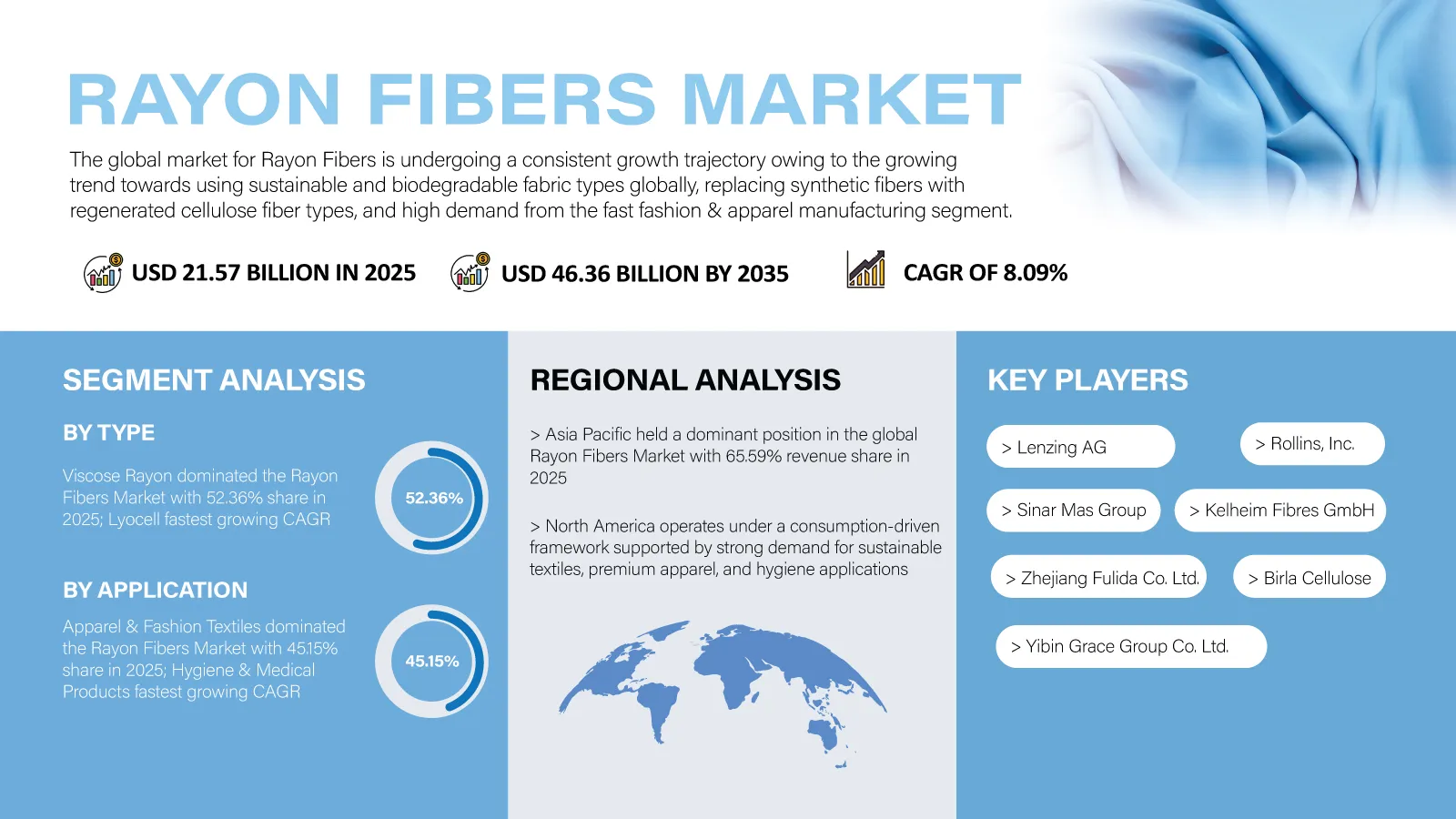
The global Rayon Fibers Market is projected to witness significant growth globally as textile manufacturers, fashion brands, and industrial users accelerate the transition toward renewable and environmentally responsible materials. “According to a recent study by SNS Insider, the global Rayon Fibers Market size valued at USD 21.57 billion in 2025, is anticipated to grow to USD 46.36 billion by 2035, registering a CAGR of 8.09% over the 2026–2035 forecast period.”
Consumer concern for the environment and the rising requirement for sustainable fibers are changing the textile industry across the globe. This change can be witnessed through the increase in the production of sustainable cellulose fibers as these fibers offer comfort, durability, and sustainability to meet the changing needs of customers and sustain the business sustainability.
To Get Detailed Insights on the Rayon Fibers Market – Request a Free Sample Report
The revolution in this industry is also being driven by investments in technology in manufacturing, sustainable sourcing processes, and innovative production processes that help in conserving resources. With increasing emphasis on responsible sourcing from governments and brands, rayon fibers are gaining prominence in a range of applications in textiles.
Sustainable Textile Manufacturing Drives Long-Term Industry Expansion
There are many opportunities that the global push towards green manufacturing processes opens up for the producers of regenerated cellulose fibers. In terms of fashion businesses, there are more efforts being made to source their materials responsibly while consumers are showing an increasing preference for clothes made of sustainable materials offering improved breathability and comfort.
Also, there are production technologies that can improve the efficiency of operations while minimizing carbon footprints and waste. The increased collaboration between fiber producers and clothing companies allows establishing clear supply chains and promoting sustainable textile solutions faster.
Furthermore, rayon fibers have found uses beyond the field of clothing, including home textiles, personal hygiene, medical textiles, and industrial non-woven goods, which creates additional income streams for manufacturers.
Key Market Insights Highlight Changing Industry Dynamics
Viscose rayon continued to be the top fiber type category in 2025 with a revenue share of 52.36% because of its extensive application in the manufacture of clothes and home textiles. In addition, lyocell is projected to exhibit the fastest growth between 2025 and 2035 as firms embrace eco-friendly fibers and their production techniques.
Apparel & Fashion Textiles made up 45.15% of revenue from the market in 2025 due to consistent global demand for lightweight fabrics. Hygiene & Medical Products will, however, lead the way in terms of growth as manufacturers and distributors increase the use of sustainable nonwoven materials in health and personal care.
In terms of end use, the Textile & Apparel sector accounted for 60.85% of total revenue in 2025 as a result of increased manufacture of garments globally. Healthcare & Hygiene on the other hand is forecast to grow the fastest due to growing adoption of disposable medical products.
By form, staple fiber dominated the market with a revenue share of 78.24% because of its compatibility with blended textile production. Filament fiber is on the other hand forecast to post the fastest growth.
Distribution Channel of direct sales to textile manufacturers was the largest with a 57.51% revenue share in 2025, while digital B2B procurement is forecasted to witness the highest growth.
Innovation and Circular Manufacturing Shape Competitive Strategies
There is an increase in manufacturers' investments in production processes, which enhance materials recovery, minimize emissions, and maximize resource efficiency during manufacturing processes. Innovations in pulp procurement, fiber development, and closed-loop manufacturing processes have improved the environmental image of the industry, while helping firms comply with tough sustainability standards.
Tracing supply chains through certified materials are some of the other measures being developed by industry players to ensure transparency in products' lifecycle for apparel brands. Such strategies will be crucial competitive advantages for industry players as regulations change.
Asia Pacific Leads Global Growth Outlook
Asia Pacific contributed 65.59% of global market revenues in 2025 and is anticipated to retain its status as both the leading and fastest-growing regional market over the forecast period of 2035, recording a CAGR of 8.36%. The regional market continues to capitalize on its vast capabilities of textile manufacturing, its growth in export-led clothing industry production, investments in sustainable fiber solutions, and efficient supply chain.
In North America, there continue to be solid demand dynamics, fueled by the consumer preferences toward high-quality sustainable clothes, the usage of eco-friendly materials, and healthcare/hygiene industries' expansion. Europe also contributes to the segment, owing to its circular economy projects, environmental standards, and investments in low-impact textile manufacturing technologies.
Emerging economies of Latin America, Middle East, and Africa continue to adopt the rayon fibers, due to the growing production capabilities in the textiles industry and collaborations between the regional manufacturers and global fiber providers.
Industry Participants Expand Sustainable Fiber Portfolios
Competition across the Rayon Fibers Market remains centered on innovation, production efficiency, and sustainability leadership. Companies continue expanding manufacturing capacity while investing in cleaner processing technologies, certified cellulose sourcing, and next-generation fiber development to meet rising demand from global textile brands.
Key companies operating in the global Rayon Fibers Market include Lenzing AG, Aditya Birla Group (Grasim Industries Ltd.), Sateri Holdings Limited, Tangshan Sanyou Group Xingda Chemical Fibre Co. Ltd., Sinar Mas Group, Kelheim Fibres GmbH, Zhejiang Fulida Co. Ltd., Yibin Grace Group Co. Ltd., Jiangsu Aoyang Technology Co. Ltd., Shandong Helon Co. Ltd., Birla Cellulose, Eastman Chemical Company, Xinxiang Bailu Chemical Fibre Group Co. Ltd., Thai Rayon Public Company Limited, Sappi Limited, Bracell, Acelon Chemicals & Fibre Corporation, Weiqiao Textile Company Limited, Domsjö Fabriker AB, and Guangdong Xinhui Meida Nylon Co. Ltd.
An SNS Insider analyst Himanshu Sharma commented, "Global demand for renewable textile materials continues to reshape the competitive landscape as manufacturers prioritize sustainable production, certified sourcing, and advanced fiber technologies. Organizations investing in innovation, circular manufacturing systems, and strategic partnerships with apparel brands are expected to strengthen their market position throughout the forecast period."
About the Author

Get in touch