
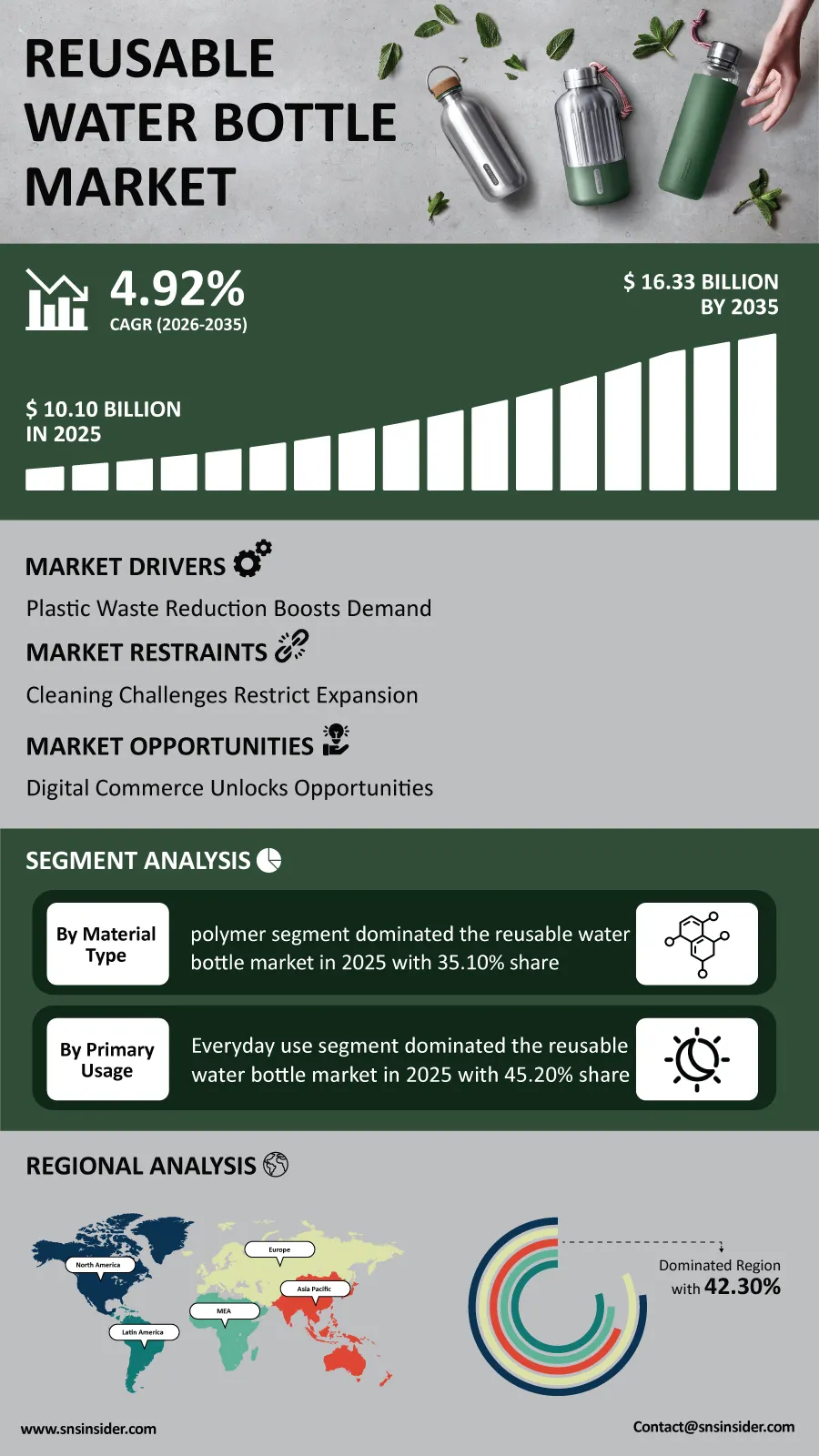
The global market for Reusable Water Bottles is well-positioned for growth, as sustainable solutions have been gaining traction among consumers and companies in lieu of single-use plastics. “According to a recent study by SNS Insider, the global Reusable Water Bottle Market size valued at USD 10.10 Billion in 2025, is anticipated to grow to USD 16.33 Billion by 2035, registering a CAGR of 4.92% over the 2026–2035 forecast period.”
The increased focus on minimizing plastic waste and responsible consumption of products is continuously shaping the buying behavior of people all around the world. Consumers are opting for durable and sustainable hydration solutions that offer convenience along with other features. Meanwhile, the producers are continuously developing innovative designs and materials to cater to the changed needs of consumers.
There is also an added benefit of the rise in the demand for fitness, outdoor and travel activities as well as wellness in the workplace. As hydration solutions have become an important part of leading a healthy life, reusable bottles have become a preferable accessory for many consumers.
To Get Detailed Insights on the Reusable Water Bottle Market – Request a Sample Report
Sustainability Initiatives and Lifestyle Changes Create Long-Term Market Opportunities
The global push to reduce plastic pollution has driven further adoption of reusable consumer products in the residential, commercial and institutional sectors. On the other hand, public awareness campaigns, corporate sustainability programs and government regulations restricting disposable plastics continually provided positive conditions for manufacturers of reusable water bottles.
The premium product segment is also progressing rapidly with consumers searching for bottles with better insulation properties which offer lightweight, leak-proof function and long life. Simultaneously, manufacturers are launching personalized product options and smart hydration features in addition to eco-friendly material innovations that strengthen customer engagement and brand differentiation.
The quick addition of on-line retail sites also provides manufacturers accessibility to bigger audiences even as providing personalised designs, new merchandise first and directly-to-purchaser e-commerce experiences.
Key Market Insights Highlight Evolving Consumer Preferences
In terms of material, the polymer segment was responsible for 35.10% share of global sales revenue in 2025 due to economical price point, lightweight property and availability through many retail channels. On the other hand, the stainless-steel category anticipates the highest growing rate throughout 2035 due to consumer preference for high-quality, long-lasting and sustainable products.
On the basis of usage, in 2025, the day-to-day use section accounted for 45.20% share of market revenue owing to wide spread penetration across households, offices and educational institutions. With fitness is participated globally and outdoor recreational activities being promoted, the sports segment is expected to register highest growth in revenue during the forecast period.
Regarding capacity, bottles from 500 ml to 1 liter accounted for among the highest share of 38.50% in market in 2025 due to the fact that they have an ideal trade-off between capacity which enables portability and demand for hydration. The faster market growth sit tight on the 1–2 liter choice segment, since customers are progressively searching for greater containers, appropriate for expanded open-air and competitor action.
In terms of distribution channels, hypermarkets and supermarkets accounted for 43.10% of overall revenue in 2025, whereas online sales are expected to provide the fastest growth as digital shopping continues to proliferate across parts of the world.
Product Innovation Continues Transforming the Industry
To extend the efficacy of these products, manufacturers are investing in more advanced insulation technologies along with lightweight materials, ergonomic designs and smart hydration features. Vacuum of insulated glass holders that keep drinks cold or hot for much longer are still popular with high-end buyers.
Moreover, connected water bottles have been developed that remind you when to hydrate and track your intake via your smartphone. These innovations cater to the increasing customer interest in health tracking and digital wellness services, while allowing vendors to enhance product differentiation within highly competitive markets.
Asia Pacific Held 42.30% of Reusable Water Bottle Market Revenue in 2025; North America to Record Fastest Growth
Asia Pacific dominated the global market and accounted for approximately 42.30% share of revenue in 2025, on account of increasing environmental awareness, growing urban population, strong manufacturing capabilities, and government initiatives concerning the reduction of single use plastic consumption. Regional Demand Backed by Rapid Retail Expansion and Growing Consciousness about Health
North America is expected to remain the fastest growing market during the next few years, fueled by a shifting consumer preference for premium reusable solutions, increasing participation in outdoor recreation, and a high uptake of sustainable lifestyle practices. An ongoing product innovation with an expansion in e-commerce penetration will continue to auger well for regional market performance.
Currently, Europe remains beneficiary of tighter environmental policies and high demand for green products among consumers while Latin America & Middle East Africa is gradually moving towards the same phase as sustainability awareness continues to improve coupled with retail reach expansion.
Industry Leaders Focus on Product Differentiation and Sustainable Innovation
Competition is still fierce as top manufacturers focus on product innovation, quality materials, direct-to-consumer business models and sustainable manufacturing. This is trending as companies are expanding their portfolio with insulated drinkware, product personalization, smart bottle technology and stronger retail partnerships to cement the existing positive market position.
Key companies operating in the global Reusable Water Bottle Market include Hydro Flask, YETI, Stanley, CamelBak, Klean Kanteen, Nalgene, S'well, Contigo, Thermos, Takeya, Owala, Simple Modern, SIGG, Brita, Tupperware, Chilly's, Zojirushi, KOR Water, Mizu, and Ocean Bottle.
An SNS Insider analyst Himanshu Sharma commented, "Growing consumer commitment toward sustainable lifestyles, combined with continuous innovation in premium hydration products, is expected to support long-term expansion of the reusable water bottle market. Companies investing in durable materials, smart product features, and environmentally responsible manufacturing will remain well positioned to capitalize on evolving global consumer preferences."
About the Author

Get in touch




