
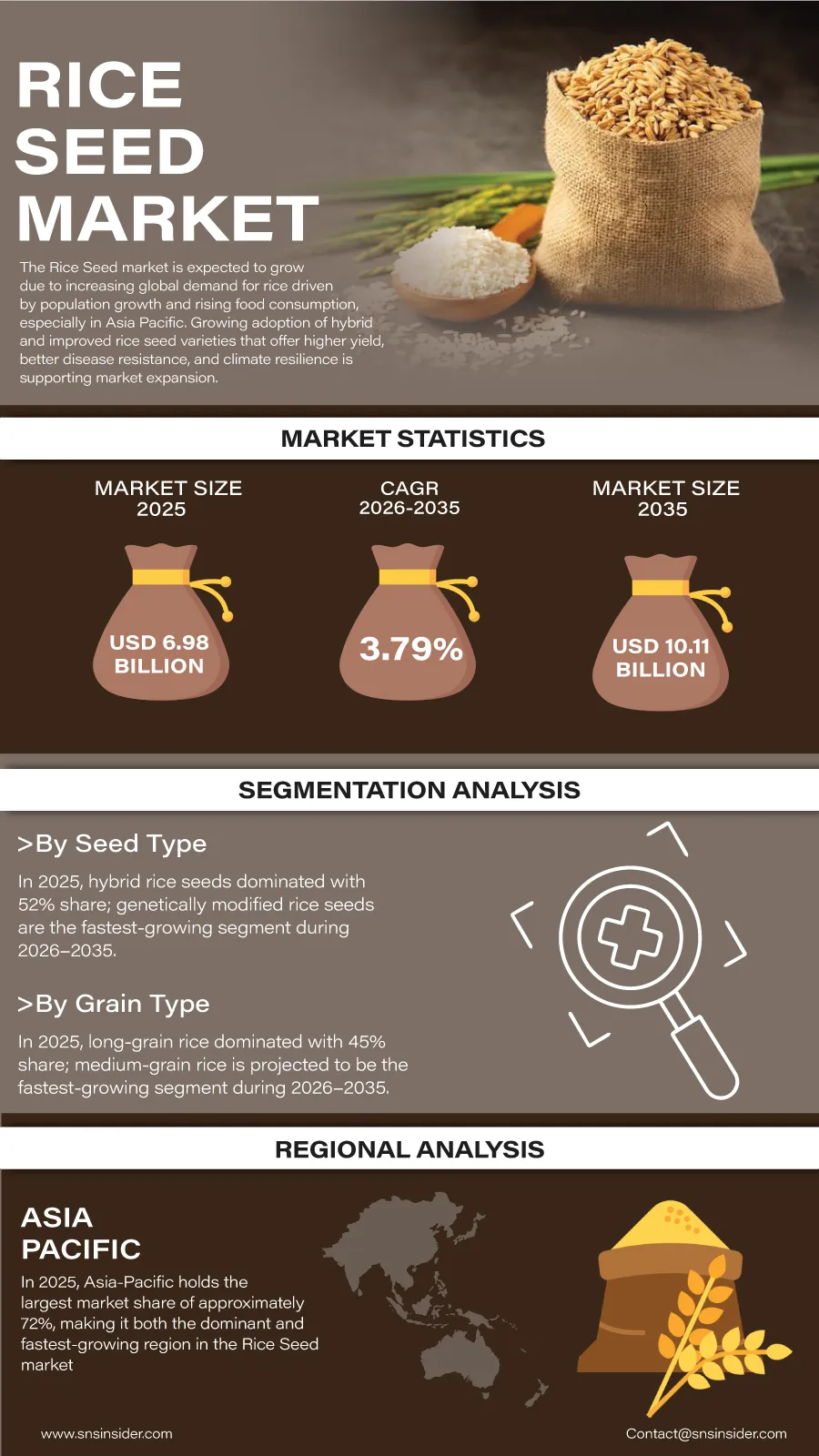
The global Rice Seed Market is expected to witness steady expansion over the coming decade as farmers increasingly adopt advanced seed varieties that improve productivity, strengthen crop resilience, and support sustainable agricultural practices. “According to a recent study by SNS Insider, the global Rice Seed Market size valued at USD 6.98 billion in 2025, is anticipated to grow to USD 10.11 billion by 2035, registering a CAGR of 3.79% over the 2026–2035 forecast period.”
Governments, seed developers and farming communities are investing in new rice cultivation technology to meet the growing global demand for food, the rapid increase in population and the need to optimise agricultural production. There is a growing trend for the use of certified seeds and also a continuing advance in the breeding of crops with greater production efficiency and the ability to respond to changing environmental conditions which is beneficial for the growers.
The growing demand for quality rice seeds is likely to drive the market growth in the long run as agriculture is shifting towards digital technology and sustainable farming techniques.
To Get Detailed Insights on the Rice Seed Market – Request a Free Sample Report
Innovation in Seed Development Supports Agricultural Productivity
Seed companies are investing heavily in breeding techniques to improve yields, increase resistance to pests and disease and make plants more tolerant of harsh environmental conditions. Genomics, precision breeding and biotechnology are being used to fast-track the development of next-generation rice varieties to meet the increasing demands of commercial agriculture.
Digital farming platforms are also changing the way in which choices are made along the agricultural value chain, enabling farmers to select the right seeds, to optimise planting schedules and to enhance farm management. These technological advances are helping to increase production and the use of resources.
Public agricultural institutions and private seed companies and research organisations continue to join forces to accelerate innovation and increase the availability of better planting material around the world.
Key Market Findings Highlight Emerging Opportunities
The global market revenue share of hybrid rice seeds was 52% in 2025, driven by the extensive cultivation by farmers for increased productivity and improved field performance.
Genetically modified rice seeds, meanwhile, are expected to see the fastest growth through 2035, driven by continued advances in biotechnology, trait development and climate-resilient agriculture.
In 2025, long-grain rice accounted for 45% of revenue share in the market, by grain type, maintaining a high demand in both domestic consumption and international trade. Moreover, the medium-grain rice is expected to be the fastest growing segment during the forecast period owing to changing consumer preferences and increasing food processing applications.
Market revenue was generated by irrigated farming to the extent of 58% in 2025, which indicates the well-developed irrigation infrastructure and intensive agricultural practices in the major rice-producing areas. However, the upland cultivation is expected to grow the fastest, which reflects the higher adoption of drought-tolerant seed varieties in the rainfed farming areas.
Distribution trends are also changing. In 2025, distributors and agro-dealers represented 49% of global revenue. Direct sales are projected to experience the highest growth through 2035, fueled by the adoption of digital agriculture platforms, e-commerce and direct contact between seed companies and farmers.
An Infographic Representation of the Global Rice Seed Market
Sustainable Agriculture and Climate Resilience Drive Future Demand
Climate variability, changing weather patterns, and increasing pressure on agricultural resources are supporting increased adoption of resilient crop varieties that can sustain productivity under diverse growing conditions. Seed companies are investing in the development of varieties that enhance water-use efficiency, increase stress tolerance and promote sustainable farming practices.
Governments in big farm economies also are moving to improve seed quality, strengthen certification systems and encourage more use of certified planting material. These efforts are expected to improve crop performance while supporting national food security goals.
Asia Pacific Leads Global Market Expansion
Asia Pacific was the largest and fastest growing regional market and held approximately 72% of the global market revenue in 2025. The region’s dominance is supported by strong rice consumption, rising agricultural modernisation, pro-agricultural government measures, and widespread adoption of hybrid seed technologies.
Outside of Asia Pacific, North America and Europe continue to invest in advanced seed breeding programmes, precision agriculture and sustainable farming technologies. Latin America, Middle East and Africa are developing new sources of growth by expanding irrigation infrastructure, improving seed distribution networks and using more climate-resilient crop varieties.
Leading Companies Continue Expanding Innovation Strategies
The global rice seed market is highly competitive with agriculture companies investing in research, product development, biotechnology, and regional expansion to strengthen their position in the market.
Key companies in the global rice seed market include Syngenta Group, Bayer AG, Corteva Agriscience, UPL Limited, RiceTec Inc., Mahyco, Kaveri Seed Company, National Seeds Corporation, China National Seed Group and Rallis India.
An SNS Insider analyst Santosh Bhul commented, "The future of the rice seed industry will be shaped by continuous advances in breeding technologies, greater adoption of digital agriculture, and increasing demand for resilient crop varieties. Companies focused on innovation and sustainable productivity are expected to play a significant role in supporting global food security over the coming decade."
About the Author

Get in touch




